
When you type a prompt into a Large Language Model (LLM) like GPT-4o, Claude 3.5, or Llama 3, the response appears instantaneously—written with remarkable fluency, nuance, and logical coherence. To a human user, it feels as though the computer is genuinely thinking, comprehending grammar, and reading your thoughts.
In reality, artificial intelligence does not “understand” language the way a human biological brain does. Computers cannot experience meaning, emotion, or real-world physical context. Instead, modern AI processes language by converting human words into complex multi-dimensional geometry, performing billions of matrix multiplications per second, and calculating mathematical probability distributions across vast vocabulary networks.
In this technical deep dive, we break down step by step exactly how AI takes raw, unstructured human text, translates it into numerical mathematical representations, resolves context using Transformer self-attention mechanisms, and generates human-like responses.
1. The Four-Stage Language Processing Pipeline
To transform human prose into structured predictions, AI language models process text through four sequential architectural layers:
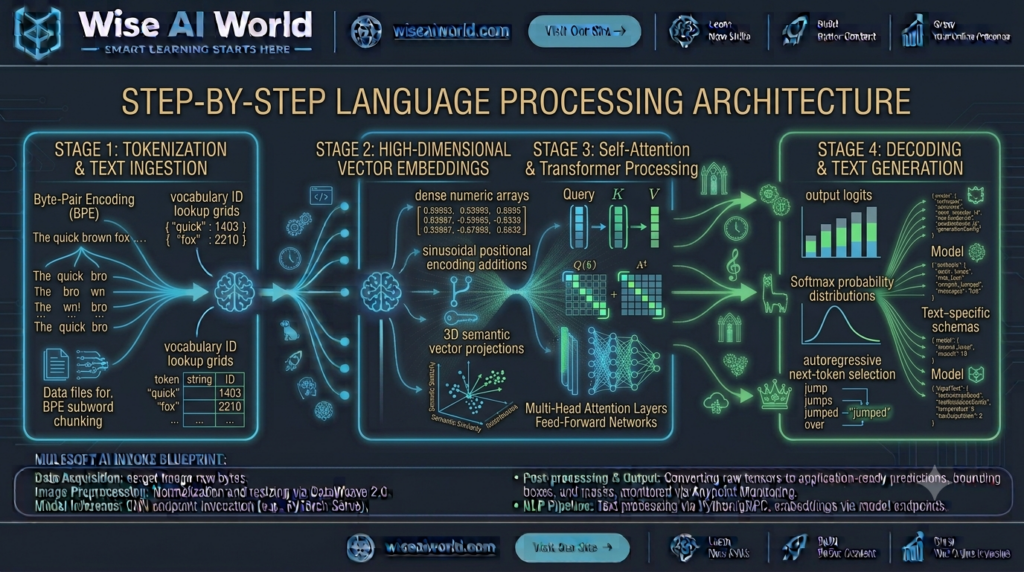
Step 1: Tokenization (Converting Words into Numbers)
Computers cannot process alphabetic characters directly; they operate exclusively on binary numbers. The very first step in any language model pipeline is Tokenization—chopping a raw stream of text into discrete numerical chunks called tokens.
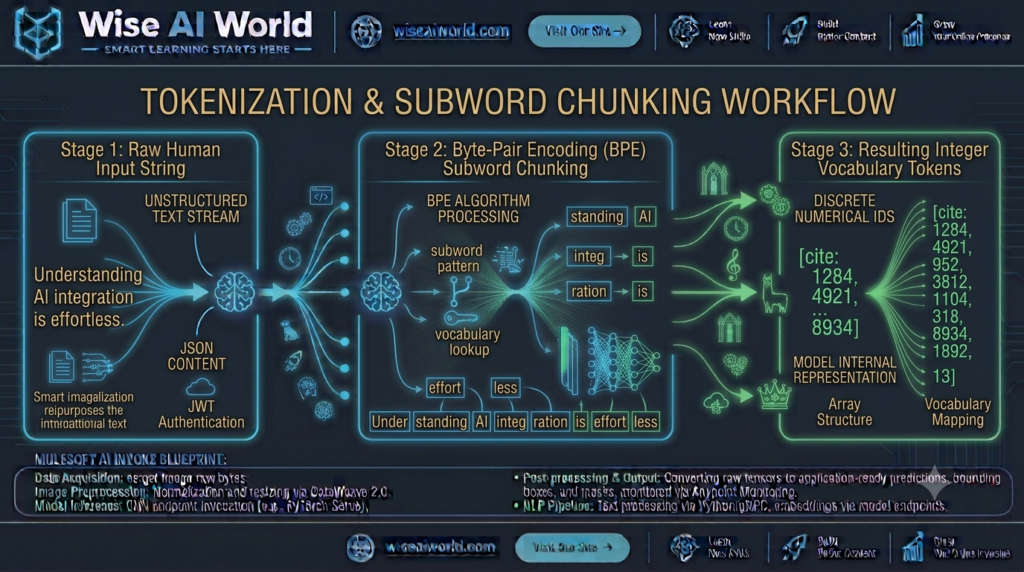
Byte-Pair Encoding (BPE) and Subwords
Early AI systems tried to map every individual word to a unique ID number. However, this approach failed when encountering rare terms, typos, or new compound words. Modern LLMs use Subword Tokenization algorithms, such as Byte-Pair Encoding (BPE).
BPE breaks common words into whole tokens while splitting complex or unfamiliar words into smaller subword fragments:
# Sample Tokenization Decomposition
Input Sentence: "Unbelievable automation capabilities."

Tokenized Output:
1. "Un"          -> Token ID: 3481
2. "believ"      -> Token ID: 12049
3. "able"        -> Token ID: 612
4. " automation" -> Token ID: 18231
5. " capab"      -> Token ID: 9412
6. "ilities"     -> Token ID: 3108
7. "."           -> Token ID: 13
By using subwords, a model with a fixed vocabulary size of ~100,000 unique token IDs can represent virtually any word in any human language, including code, medical terminology, and emojis.
Step 2: Vector Embeddings and Positional Encoding
Converting text into token IDs (like [3481, 12049, 612]) gives the computer numbers to work with, but integer IDs carry no semantic meaning. To the computer, ID 3481 is not inherently closer in meaning to ID 3482 than to ID 9999.
To solve this, the model passes each token ID through an Embedding Layer, turning each single integer into a dense vector—a list of floating-point numbers (typically 4,096 to 12,288 dimensions long).
Semantic Geometry in High-Dimensional Space
Inside this high-dimensional vector space, concepts that share semantic meaning sit close to one another. Dimensions capture abstract language traits like tone, tense, gender, topic, and syntax:
# Simplified 3D Visual Comparison of Vector Embeddings
Vector("king")   = [ 0.82, -0.41,  0.91 ]
Vector("queen")  = [ 0.81, -0.39, -0.88 ]
Vector("apple")  = [-0.91,  0.78,  0.02 ]
Injecting Word Order: Positional Encoding
Unlike human readers, Transformer models process all tokens in a sentence simultaneously in parallel rather than sequentially from left to right. Because convolutions and dot products have no built-in sense of sequence, the model must be told where each word sits.
To preserve word order, the system calculates a Positional Encoding vector using mathematical sine and cosine functions of varying frequencies and adds it directly to the token embedding vector:
$$\text{Final Input Vector} = \text{Token Embedding} + \text{Positional Encoding}$$
This ensures the model can mathematically distinguish between “The dog bit the man” and “The man bit the dog”, even though both sentences contain the exact same tokens.
Step 3: Self-Attention (Understanding Context)
Static embeddings assign the same initial vector to a word regardless of where it appears. However, human language is highly context-dependent. Consider the word “bank” in two different sentences:
- Sentence A: “He deposited money in the bank.”
- Sentence B: “They sat on the grassy bank of the river.”
To resolve dynamic meaning, modern AI uses the **Self-Attention Mechanism** introduced in the landmark 2017 paper “Attention Is All You Need”.
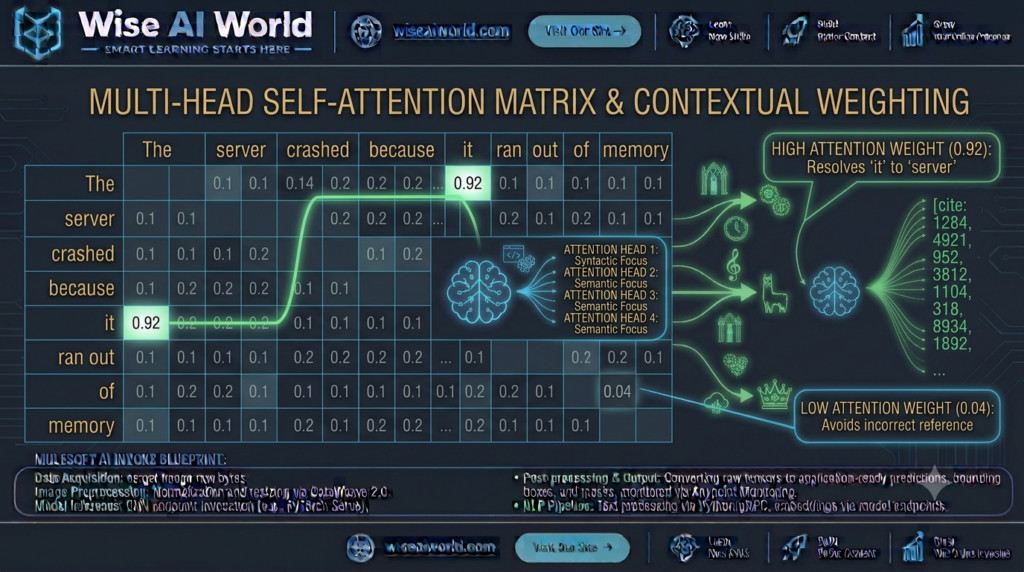
The Math Behind Self-Attention: Query, Key, and Value
For every token in a prompt, the self-attention layer creates three vector representations by multiplying the input vector with learned weight matrices:
- Query ($Q$): What information am I looking for?
- Key ($K$): What information do I contain?
- Value ($V$): What actual semantic content do I hold?
The model computes the dot product between the

Manish Prakash Dubey is an AI educator and technology writer based in India. He founded WiseAIWorld to make artificial intelligence simple and practical for students, professionals, and beginners. His work focuses on AI basics, machine learning, deep learning, NLP, computer vision, and real-world AI tools.
