
Artificial Intelligence (AI) has shifted from experimental labs into the core operational layer of modern software. If 2023 was the year the public discovered generative chat tools and 2024 was marked by enterprise pilots, 2026 represents the era of autonomous execution and agentic systems.
AI is no longer defined merely by conversational text boxes or creative image generators. Today, artificial intelligence refers to software architectures capable of reasoning, planning multi-step tasks, executing API calls across disparate systems, and adapting to unpredictable edge cases without real-time human prompt engineering.
In this guide, we break down what artificial intelligence actually means today, unpack the structural shift toward agentic workflows, analyze key technical pillars, and examine why understanding these systems is critical for businesses and builders moving forward.
1. Defining AI in 2026: From Static Predictions to Agentic Action
To understand why AI matters today, we must look at how its underlying technology has evolved across three distinct generations over the last decade.
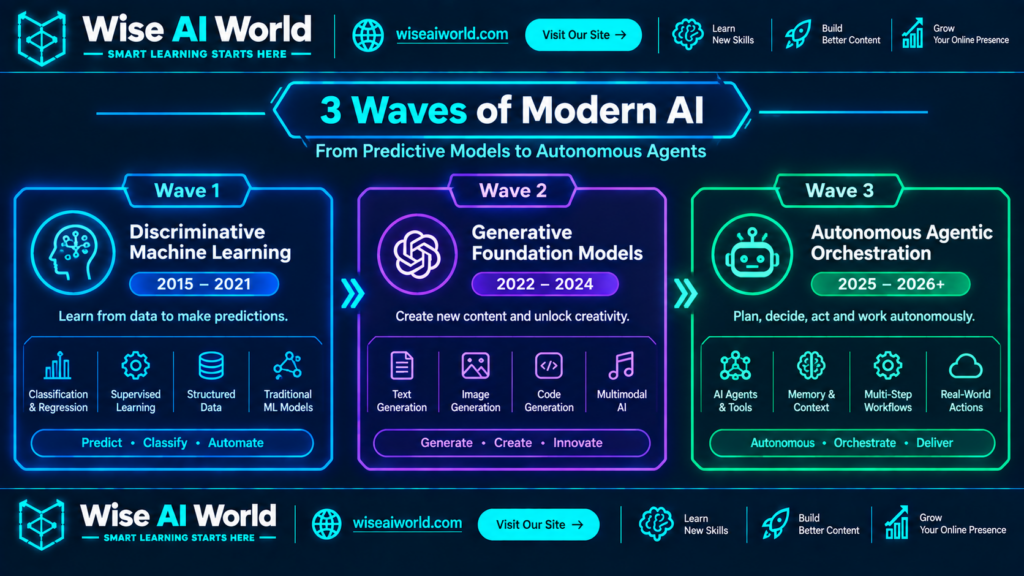
The 3 Eras of Applied Artificial Intelligence
- Discriminative AI (Predictive Machine Learning): Focused on classification, pattern recognition, and numerical forecasts (e.g., credit scoring algorithms, spam filters, and recommendation engines). These models operate on fixed datasets to answer specific, pre-configured queries.
- Generative AI (LLMs & Diffusion Models): Popularized by foundation models like GPT-4, Claude, and Midjourney. These systems process unstructured multimodal inputs (text, image, audio) to generate new content based on statistical likelihoods.
- Agentic AI (Autonomous Execution): The standard in 2026. Models are connected directly to tools, external databases, vector stores, and execution runtimes. Rather than simply writing a response, agentic systems break complex goals down into sequential tasks, call external APIs, evaluate their own output quality, and correct errors autonomously.
2. Core Technical Pillars of Modern AI Systems
Modern enterprise AI does not rely on a single monolithic model. Instead, high-performing systems connect multiple specialized AI technologies together into unified workflows.
| Pillar / Technology | How It Works | Practical Business Application |
|---|---|---|
| Large Language Models (LLMs) | Transformer-based neural networks trained on vast text data to handle reasoning, translation, and code generation. | Drafting customer responses, summarizing legal contracts, writing boilerplate code. |
| Retrieval-Augmented Generation (RAG) | Pairs LLMs with vector databases to fetch precise, real-time company knowledge before generating an answer. | Internal help desk search tools, policy lookup tools, regulatory audit engines. |
| Small Language Models (SLMs) | Lightweight, fine-tuned models running locally on edge hardware or cheap servers for targeted tasks. | Local invoice parsing, mobile device task automation, low-latency log classification. |
| Multimodal Models | Unified models that natively process text, visual graphics, audio streams, and video files simultaneously. | Video editing automation, medical imaging triage, automated UI quality testing. |
3. Why AI Matters in 2026: Key Industry Drivers
The conversation around AI has transitioned from novelty to necessity. Organizations adopting AI effectively are reshaping operational economics across three primary domains.
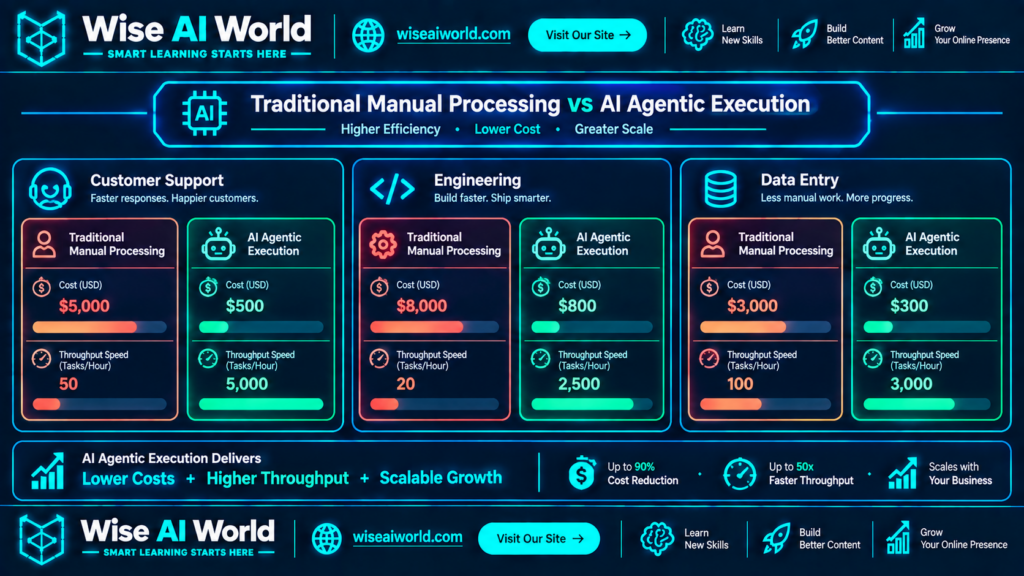
A. Restructuring Software Architecture & Development
Software development has shifted toward AI-assisted pair programming and agentic code generation. Developer teams use autonomous coding agents to write boilerplate tests, update database schemas, draft documentation, and identify security flaws during pull request reviews. This has accelerated product release cycles significantly.
B. Transitioning from Chatbots to Autonomous Back-Office Agents
First-generation customer service bots were notorious for repeating scripted answers. Modern support systems run on orchestrators like n8n or Make connected to high-reasoning models (such as Claude 3.5 or GPT-4o). They can authenticate users, query internal databases, issue refunds within designated limits, and escalate complex edge cases to human agents with full context summaries.
C. Data Processing at Unprecedented Scale
Unstructured data—such as scanned PDFs, handwritten forms, voice recordings, and raw email bodies—historically required extensive manual entry. Current AI parsing pipelines extract, validate, and convert unstructured inputs into validated JSON payloads instantly, connecting directly into enterprise ERP and CRM platforms.
4. Real-World Case Study: Automated Support Triage Pipeline
To see how modern AI operates in practice, consider an automated support ticket pipeline handling technical inquiries for an enterprise software provider:
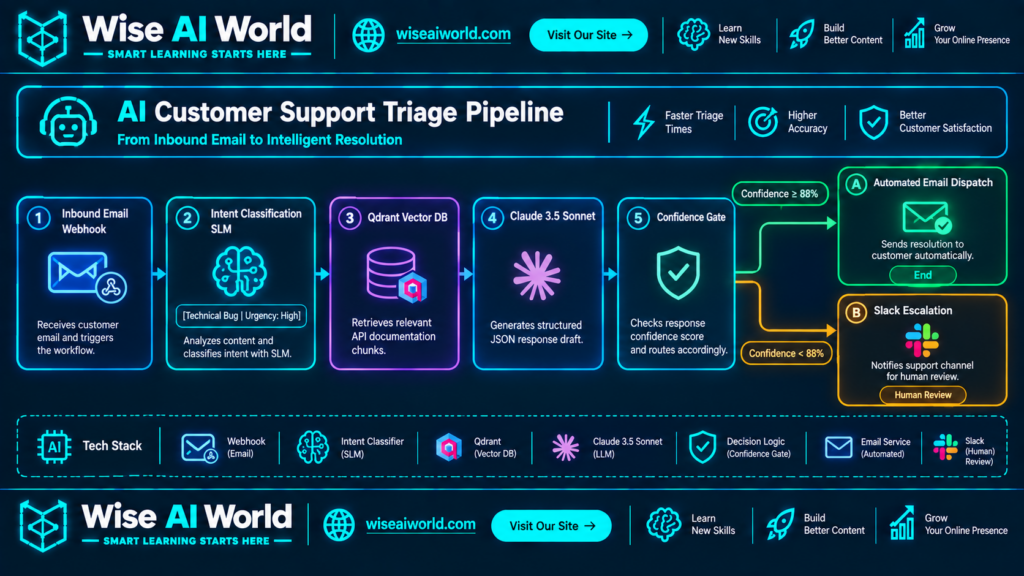
Execution Steps in Production
1. Webhook Trigger: Inbound customer email captured by n8n or Make.com.
2. Intent Classification: SLM categorizes inquiry as [Technical Bug] with an urgency rating of High.
3. RAG Retrieval: System queries Qdrant vector database for relevant API documentation.
4. Response Drafting: Claude 3.5 Sonnet drafts a step-by-step solution using retrieved docs.
5. Confidence Gate:
   - If Confidence Score >= 88%: System dispatches response directly to customer.
   - If Confidence Score < 88%: Ticket is forwarded to human support on Slack with pre-drafted context.
5. Critical Challenges & Ethical Considerations
While AI adoption offers substantial performance advantages, deploying autonomous models requires active risk management around technical and operational vulnerabilities.
- Hallucinations & Grounding Errors: Generative models can state incorrect details with high confidence. Production pipelines address this by implementing strict Retrieval-Augmented Generation (RAG) and low temperature settings.
- Data Privacy & Governance (GDPR / HIPAA): Sending sensitive customer data to public cloud API endpoints presents regulatory compliance risks. Leading enterprises rely on self-hosted model deployments or strict zero-data-retention enterprise agreements.
- Prompt Injection & Security: Malicious users can attempt to bypass system guardrails by embedding unexpected instructions inside input fields. Modern workflows require input sanitization and dedicated output evaluation nodes.
- Over-Reliance and Skill Erosion: Over-delegating core decision-making to automated systems without human oversight can lead to blind spots when edge cases occur.
6. Summary & Practical Getting Started Framework
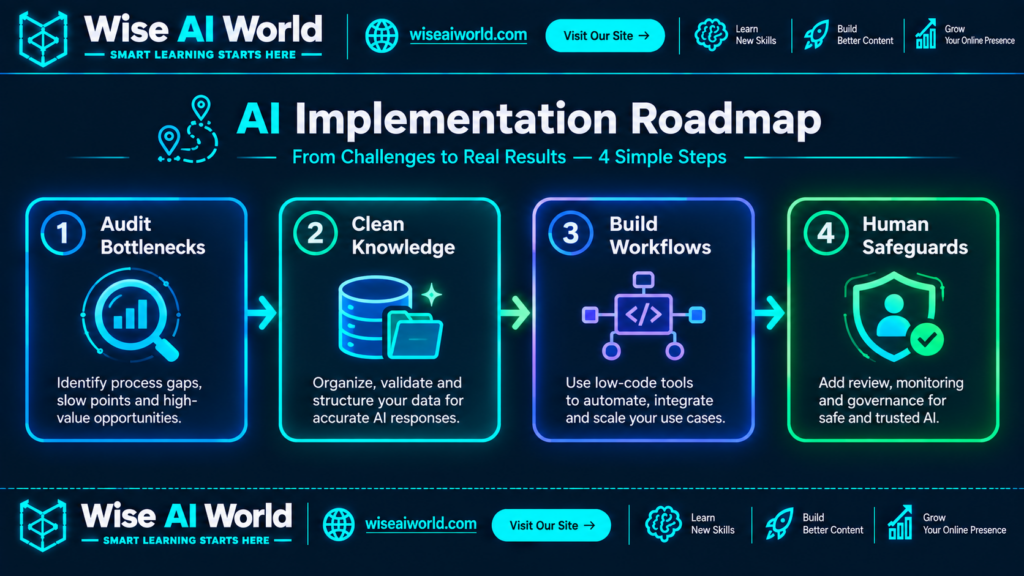
Artificial Intelligence in 2026 is defined by pragmatic automation, integration flexibility, and execution reliability. Organizations leading the market are not simply asking what AI can write; they are building systems that execute real work safely and predictably.
Actionable Steps for Teams:
- Identify Repetitive Bottlenecks: Pinpoint workflows where team members spend hours transferring unstructured data across systems.
- Organize Knowledge Base Content: Clean and structure internal documentation so vector databases can index reliable context.
- Start with Low-Code Tools: Experiment with platforms like Make.com or n8n to prototype simple workflows before building custom code bases.
- Implement Human-in-the-Loop Reviews: Build confidence thresholds that flag edge cases for human review before sending automated output to clients.

Manish Prakash Dubey is an AI educator and technology writer based in India. He founded WiseAIWorld to make artificial intelligence simple and practical for students, professionals, and beginners. His work focuses on AI basics, machine learning, deep learning, NLP, computer vision, and real-world AI tools.
