
Water is one of the most important resources in agriculture.
Yet in many parts of the world, farmers face increasing challenges from droughts, climate change, population growth, and limited freshwater supplies.
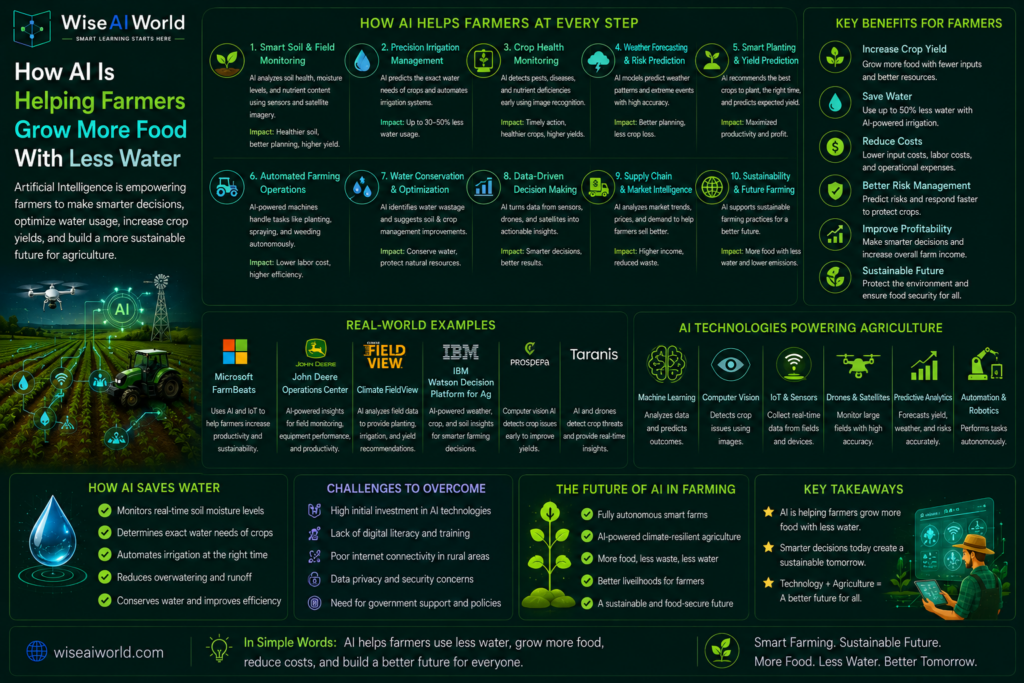
To meet rising food demand while conserving water, many farmers are turning to artificial intelligence.
In 2026, AI-powered farming technologies are helping growers use water more efficiently, improve crop yields, reduce waste, and make smarter decisions based on real-time data.
From smart irrigation systems and soil sensors to drones and predictive analytics, AI is transforming agriculture into a more sustainable and productive industry.
This article explores how AI is helping farmers grow more food with less water, the technologies involved, key benefits, challenges, and the future of AI-driven agriculture.
Why Water Efficiency Matters in Agriculture
Agriculture is one of the largest users of freshwater worldwide.
Farmers depend on water to:
- Grow crops
- Maintain soil health
- Support livestock
- Produce food for growing populations
However, many regions face:
- Water shortages
- Unpredictable rainfall
- Higher temperatures
- Increasing drought conditions
Traditional irrigation methods often waste significant amounts of water through overwatering, runoff, and evaporation.
AI helps address these challenges by ensuring crops receive the right amount of water at the right time.
What Is AI in Agriculture?
Artificial intelligence in agriculture refers to technologies that collect, analyze, and interpret farming data to improve decision-making.
AI systems can process information from:
- Soil sensors
- Weather stations
- Satellites
- Drones
- Irrigation equipment
- Farm machinery
- Historical crop records
Using this data, AI can recommend actions that improve efficiency and productivity.
Smart Irrigation Systems
One of the most important agricultural uses of AI is smart irrigation.
Watering Crops Precisely
Traditional irrigation schedules often rely on fixed watering times.
AI-powered systems can determine:
- When crops need water
- How much water is required
- Which areas need irrigation
- When rainfall may reduce water needs
This precision reduces unnecessary water usage.
Real-Time Adjustments
AI systems continuously monitor changing conditions.
If weather forecasts predict rain, irrigation schedules can be adjusted automatically.
This prevents overwatering and conserves resources.
Soil Monitoring and Analysis
Healthy soil plays a critical role in crop production.
AI-powered sensors help farmers understand soil conditions in real time.
Measuring Soil Moisture
Smart sensors can track:
- Soil moisture levels
- Temperature
- Nutrient content
- Soil health indicators
Farmers receive alerts when water levels fall below optimal ranges.
Better Irrigation Decisions
Instead of watering entire fields uniformly, farmers can target specific areas that need moisture.
This improves efficiency and reduces waste.
AI-Powered Weather Forecasting
Weather is one of the biggest factors affecting agriculture.
Improved Forecast Accuracy
AI analyzes data from multiple sources to generate detailed weather predictions.
Farmers can better anticipate:
- Rainfall
- Heat waves
- Frost conditions
- Wind patterns
- Drought risks
Smarter Water Management
Accurate forecasts help farmers avoid unnecessary irrigation before expected rainfall.
This saves both water and energy.
Precision Agriculture
Precision agriculture uses technology to manage crops more accurately.
AI is at the center of this approach.
Field-Level Insights
AI systems can identify differences across fields and even individual sections of farmland.
This helps farmers determine:
- Which areas need more water
- Which crops are under stress
- Where resources should be allocated
Optimizing Crop Growth
By delivering water precisely where it is needed, farmers can improve yields while minimizing waste.
Drones and Aerial Monitoring
Drones are becoming increasingly common in modern agriculture.
Monitoring Crop Health
AI-powered drones can capture detailed images of fields.
These images help identify:
- Dry areas
- Crop stress
- Disease risks
- Irrigation problems
Early Problem Detection
Farmers can detect issues before they become widespread, allowing for quicker intervention and reduced resource use.
Satellite Data and AI
Satellite imagery provides valuable information about large agricultural areas.
Tracking Crop Conditions
AI can analyze satellite data to monitor:
- Vegetation health
- Soil moisture
- Water stress
- Crop development
Supporting Large Farms
Large-scale agricultural operations benefit from continuous monitoring without needing to inspect every field manually.
Predictive Analytics for Farming
AI can use historical and real-time data to make predictions.
Forecasting Water Needs
By analyzing:
- Weather patterns
- Crop growth stages
- Soil conditions
AI can estimate future water requirements.
Planning Ahead
Farmers can prepare irrigation schedules and resource allocations more effectively.
This reduces waste and improves productivity.
AI and Crop Selection
Different crops require different amounts of water.
Choosing Suitable Crops
AI can help farmers identify crops that are better suited to local conditions.
This may include:
- Drought-resistant varieties
- Climate-adapted crops
- Water-efficient alternatives
Improving Sustainability
Selecting appropriate crops can reduce water consumption while maintaining profitability.
Benefits of AI for Water Conservation
Reduced Water Usage
AI helps ensure water is used only when necessary.
Higher Crop Yields
Proper irrigation supports healthier plants and better harvests.
Lower Costs
Reduced water use often leads to lower operating expenses.
Improved Sustainability
Efficient resource management supports long-term agricultural productivity.
Better Decision-Making
Farmers gain access to data-driven insights rather than relying solely on estimates.
AI and Climate Change Adaptation
Climate change is creating new challenges for agriculture.
Managing Drought Conditions
AI helps farmers respond more effectively to water shortages.
Improving Resilience
Data-driven farming practices help operations adapt to changing environmental conditions.
Protecting Food Supplies
More efficient water use supports stable food production even during difficult growing seasons.
Challenges of AI Adoption in Farming
Despite its benefits, AI adoption is not without obstacles.
Initial Costs
Some technologies require investments in:
- Sensors
- Software
- Connectivity
- Equipment upgrades
Internet Connectivity
Rural areas may face connectivity limitations that affect AI system performance.
Training Requirements
Farmers need time and support to learn how to use new technologies effectively.
Data Quality
AI recommendations depend on accurate and reliable data.
Poor data can reduce effectiveness.
Real-World Examples of AI in Agriculture
Smart Irrigation Farms
Many farms now use AI-driven irrigation systems that automatically adjust watering schedules based on weather and soil conditions.
Result:
- Reduced water consumption
- Improved crop health
Vineyard Management
Wine producers use AI to monitor moisture levels and optimize irrigation for grape production.
Result:
- Better fruit quality
- More efficient water use
Large-Scale Crop Farming
Agricultural operations use drones, sensors, and satellite imagery to monitor thousands of acres.
Result:
- Early issue detection
- Improved resource allocation
The Future of AI in Farming
The next generation of agricultural AI may include:
- Autonomous irrigation systems
- Advanced farm robotics
- Real-time crop monitoring
- More accurate weather models
- Improved water forecasting
- Integrated farm management platforms
As technology continues to improve, farms may become increasingly efficient and sustainable.
Common Myths About AI in Agriculture
AI Will Replace Farmers
AI is a tool that supports farmers, not a replacement for agricultural expertise.
Human judgment remains essential.
AI Is Only for Large Farms
Many AI solutions are becoming affordable and accessible for small and medium-sized farms.
AI Guarantees Perfect Harvests
Agriculture remains influenced by weather, pests, market conditions, and other unpredictable factors.
AI improves decision-making but cannot eliminate all risks.
Key Takeaways
- AI is helping farmers conserve water while improving crop production.
- Smart irrigation systems deliver water more precisely.
- Soil sensors and weather forecasting improve irrigation decisions.
- Drones and satellites provide valuable insights into crop health.
- Predictive analytics help farmers plan water usage more effectively.
- AI supports sustainable farming and climate adaptation.
- Human expertise remains critical to successful agriculture.
Conclusion
Artificial intelligence is helping farmers grow more food with less water by bringing precision, efficiency, and data-driven decision-making to modern agriculture.
Through smart irrigation, soil monitoring, weather forecasting, drone technology, and predictive analytics, AI enables farmers to conserve one of the world’s most valuable resources while maintaining strong crop yields.
As water scarcity and climate challenges continue to affect agriculture, AI will play an increasingly important role in supporting sustainable food production for future generations.
The farms of the future will not rely solely on more water—they will rely on smarter water management powered by artificial intelligence.
Related Articles
- What Is Artificial Intelligence and Why Does It Matter in 2026
- How Artificial Intelligence Is Transforming Small Businesses in 2026
- How AI Is Revolutionizing Healthcare in 2026
- How AI Is Changing the Way Students Learn in 2026
- What Is Machine Learning? A Complete Beginner’s Guide

Manish Prakash Dubey is an AI educator and technology writer based in India. He founded WiseAIWorld to make artificial intelligence simple and practical for students, professionals, and beginners. His work focuses on AI basics, machine learning, deep learning, NLP, computer vision, and real-world AI tools.
