
In March 2026, Stanford researchers unveiled an AI model called Merlin that reads abdominal CT scans with the thoroughness of an experienced radiologist. Trained on over 15,000 scans and nearly one million diagnosis codes, Merlin predicted correct diagnoses with over 81 percent accuracy and could forecast the development of chronic diseases up to five years in advance, according to Techlorex. That is one tool, developed by one research team, in one specialty. Multiply that across radiology, oncology, drug discovery, surgical assistance, mental health support, and hospital administration, and you begin to understand why healthcare is considered one of the most consequential domains for AI in 2026.
This article explains where AI is making the most significant difference in healthcare today, what the evidence shows about its real-world impact, and what questions remain about safety, equity, and the appropriate role of human judgment in AI-assisted medicine.
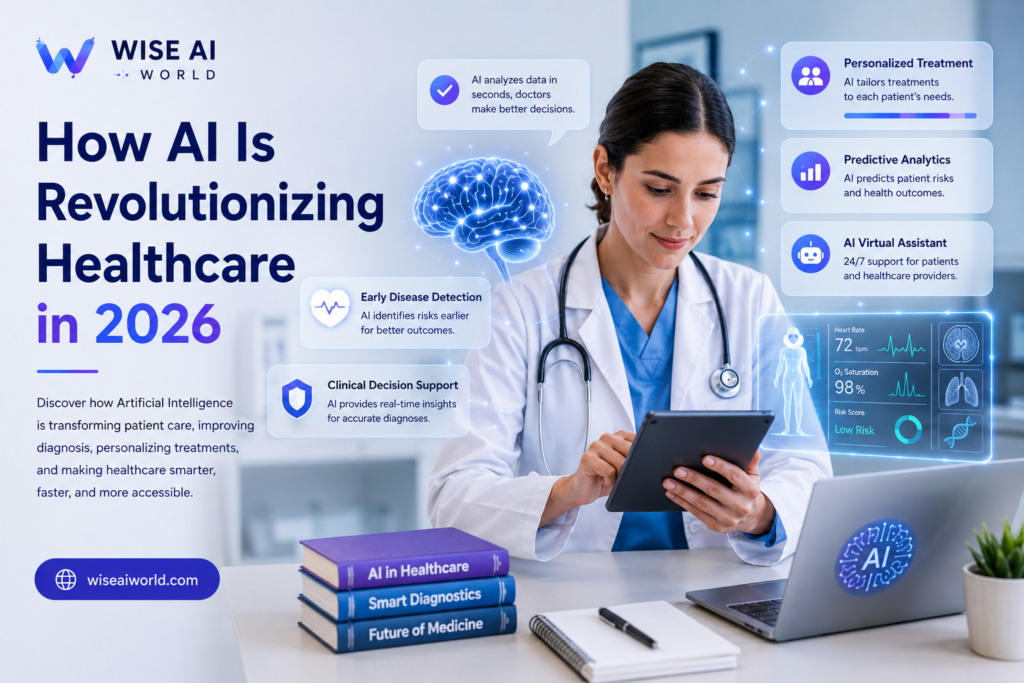
The Scale of AI in Healthcare in 2026
The global AI healthcare market tells part of the story. According to Techlorex, the market is now valued at between 29 and 56 billion US dollars depending on the methodology, with forecasts reaching over 188 billion US dollars by 2032. Healthcare AI startups raised over 7 billion US dollars in venture capital in 2024 alone, according to Offcall, with the largest investments in diagnostic imaging, drug discovery, and clinical workflow automation.
The more meaningful indicator, however, is adoption at the point of care. According to Boston Consulting Group’s 2026 healthcare AI analysis, healthcare organizations are embracing to an unprecedented degree across patient care, clinical workflows, and drug discovery, and AI is no longer experimental in these settings. It is producing measurable, real-world results. According to NVIDIA’s 2026 State of AI in Healthcare and Life Sciences report, cited by RSI Security, industry adoption continues to surge with early successes driving increased investment, expanded use cases, and faster innovation cycles.
AI in Diagnostic Imaging: Catching What Human Eyes Miss
Radiology is the area where AI has made the deepest and most documented impact in clinical medicine. systems trained on millions of labeled medical images can now analyze X-rays, MRI scans, CT scans, and pathology slides to detect abnormalities with accuracy that in many studies matches or approaches that of specialist physicians.
According to RSI Security’s analysis of the NVIDIA 2026 healthcare report, AI-driven image analysis has demonstrated greater precision in detecting abnormalities and is accelerating early disease detection across multiple specialties. In cancer screening specifically, earlier detection made possible by AI analysis translates directly into better patient outcomes, since most cancers are significantly more treatable when caught in early stages.
The Stanford Merlin model is a particularly significant example because it goes beyond identifying abnormalities to forecasting future disease development, a capability that could fundamentally change the nature of preventive medicine by allowing clinicians to intervene before chronic diseases fully manifest. This connects directly to the broader shift BCG describes, from reactive treatment of existing illness toward prediction and prevention enabled by AI analysis of patient data at scale.
It is important to note that current AI diagnostic tools are not replacing radiologists. They are being used as second-opinion systems that help prioritize urgent cases, flag potential abnormalities for human review, and reduce the cognitive burden on specialists dealing with high image volumes. The goal is augmentation of human capability rather than replacement of human judgment.
AI in Drug Discovery: Compressing Decades Into Years
Drug discovery is one of the most time-consuming and expensive processes in all of science. Developing a new drug from initial discovery through clinical trials to approval has historically taken 10 to 15 years and cost over one billion US dollars, with the majority of candidate compounds failing at various stages of development.
AI is beginning to change this in concrete, measurable ways. According to Offcall, pharmaceutical companies using AI to identify promising drug compounds and predict their effectiveness are seeing estimates of 30 to 50 percent reductions in the time and cost of drug development. Companies like Atomwise and BenevolentAI have AI-discovered drug candidates currently in clinical trials.
The most striking data point comes from Techlorex, which reports that drug candidates designed via generative AI are achieving a 90 percent success rate in Phase I safety trials as of early 2026, nearly doubling the historical industry average of approximately 50 percent. If this result holds as more AI-designed drug candidates move through the pipeline, it would represent one of the most significant efficiency gains in pharmaceutical history.
Google DeepMind’s AlphaFold protein structure prediction system, which has mapped the structure of virtually every known protein, has also dramatically accelerated the scientific understanding underlying drug development, giving researchers a foundation for designing compounds that interact precisely with biological targets. The research published in the National Center for Biotechnology Information, referenced by PMC, notes that AI will drive significant improvement in clinical trial design and optimization of drug manufacturing processes, and that any combinatorial optimization process in healthcare could be substantially improved by AI.
AI in Clinical Documentation: Giving Time Back to Doctors
One of the most practically impactful, if less headline-grabbing, applications of AI in healthcare is clinical documentation. The average physician spends two to three hours on documentation for every hour of patient care, according to Offcall. This administrative burden contributes directly to physician burnout and reduces the time available for actual patient interaction.
AI-powered ambient documentation tools listen to clinical conversations during patient visits and automatically generate structured clinical notes, saving the physician the task of typing detailed records after each appointment. According to BCG, providers are increasingly incorporating AI co-pilots into their systems specifically to reduce time spent documenting patient care and to help synthesize patient details alongside the latest clinical research.
Similarly, administrative processes like prior authorizations, insurance verification, and appointment scheduling are being automated through AI. The average physician practice spends 14 hours per week on prior authorizations alone according to Offcall, and AI automation could reduce this by 80 to 90 percent, saving approximately 11 to 12 hours weekly per practice. At scale across the healthcare system, this represents an enormous reallocation of physician time toward patient care.
AI in Predictive Health and Personalized Medicine
One of the most significant shifts underway in healthcare is the move from treating illness after it occurs to predicting and preventing it before it fully develops. According to BCG, health systems are deploying AI to predict and prevent illness with enormous implications for precision medicine, clinical workflow automation, and personalized care.
Predictive analytics tools trained on patient data can identify individuals at high risk for conditions including sepsis, hospital readmission, falls, and disease exacerbation before clinical symptoms become obvious. According to Offcall, hospitals are using these tools to allow for early interventions that improve patient outcomes and reduce costs. Early intervention on sepsis, for example, can be the difference between full recovery and death, and AI models analyzing continuous patient monitoring data can detect the physiological signals of developing sepsis hours before human clinical observation might identify the risk.
Personalized medicine takes this further by using AI to match treatment approaches to individual patient characteristics rather than applying population-average protocols. According to research published via PMC, AI analysis of multimodal datasets, combining genomics, imaging, clinical records, and lifestyle data, may allow for better understanding of disease clustering and patient populations, enabling more targeted preventive strategies and personalized treatment approaches with particular impact in cancer, neurological conditions, and rare diseases.
AI Wearables and Remote Patient Monitoring
The proliferation of AI-enabled wearable devices is extending healthcare monitoring beyond the clinic and into patients’ daily lives. Smartwatches and fitness trackers now use to continuously monitor heart rate, oxygen saturation, sleep quality, activity levels, and increasingly, more sophisticated physiological signals.
Apple Watch’s ECG capability has been credited with detecting atrial fibrillation in users who were unaware of the condition, prompting them to seek medical attention. Continuous glucose monitors for diabetic patients use AI to predict glucose trends and alert users before dangerous levels are reached. According to BCG, patients are using digital tools to take charge of their health and wellness as never before, and providers are prioritizing the development of direct-to-patient relationships enabled by these continuous data streams.
AI in Mental Health Support
Mental health is an area where AI is playing a growing and nuanced role. AI-powered mental health apps use to provide structured cognitive behavioral therapy exercises, mood tracking, crisis detection, and supportive conversation for users who may not have access to or cannot afford traditional therapy.
These tools are not intended to replace mental health professionals and are most ethically deployed as supplements to professional care or as accessible first-contact support in contexts where professional care is unavailable or unaffordable. The ethical dimensions of AI in mental health, including questions about the appropriateness of AI-generated emotional support, data privacy for sensitive mental health information, and the risk of over-reliance on automated support, are active areas of both research and regulatory attention. You can read more about these broader considerations in our article on .
The Challenges and Ethical Questions That Remain
The transformative potential of AI in healthcare is real and well-documented. So are the challenges that must be addressed for that potential to be realized responsibly.
Bias in medical AI is a significant concern. According to research published via the National Library of Medicine, medical AI systems need their performance examined across different demographic subgroups, including by sex and ethnicity, to reveal potential biases that could otherwise go undetected and result in worse healthcare outcomes for underrepresented groups. An AI diagnostic tool trained predominantly on data from one demographic group may perform significantly worse for others, a problem that must be actively monitored and addressed.
Regulatory oversight is still developing at a pace behind the technology. The FDA and equivalent bodies in other countries are developing frameworks for evaluating and approving AI medical devices, but the speed of AI development means regulatory review processes are continuously under pressure. According to RSI Security, with rapid AI adoption comes increased responsibility for healthcare organizations to ensure their AI systems meet security, compliance, and safety standards.
The question of accountability when AI contributes to a medical error remains genuinely unresolved in most legal and regulatory frameworks. And the digital divide means that the benefits of AI-powered healthcare are not evenly distributed, with access concentrated in well-resourced health systems and regions while underserved populations and lower-income countries lag significantly behind.
McKinsey projects that AI could increase healthcare productivity by 1.8 to 3.2 percent annually, equivalent to 150 to 260 billion US dollars per year according to Offcall. Realizing those gains equitably, safely, and without creating new forms of harm requires deliberate attention to these challenges alongside the enthusiasm for what AI can do.
Key Takeaways
- The global AI healthcare market is valued at 29 to 56 billion US dollars in 2026 and is projected to exceed 188 billion US dollars by 2032, reflecting the scale of investment and adoption across the sector.
- AI diagnostic imaging tools including Stanford’s Merlin model are achieving over 81 percent accuracy in reading CT scans and can forecast chronic disease development up to five years in advance.
- AI-designed drug candidates are achieving a 90 percent success rate in Phase I safety trials in 2026, nearly doubling the historical 50 percent average.
- AI clinical documentation tools are addressing physician burnout by automating the two to three hours of documentation that currently accompany every hour of patient care.
- Predictive AI tools are enabling health systems to identify and intervene on patient risks including sepsis, falls, and readmission before clinical symptoms become critical.
- Significant challenges remain around bias in training data, regulatory oversight, accountability for AI-assisted errors, and equitable access to AI-powered healthcare.
Conclusion
AI in healthcare has moved from a promising research direction to a present-day operational reality. From the radiology department analyzing CT scans to the pharmaceutical lab designing new drug candidates to the wearable on a patient’s wrist monitoring heart rhythm around the clock, artificial intelligence is reshaping how medicine is practiced and how health is managed.
The potential benefits, earlier diagnosis, more effective drugs, reduced physician burnout, and more personalized care, are extraordinary. Realizing them fully and fairly requires continued attention to safety, bias, regulation, and equitable access alongside the technological development itself. To explore how AI is transforming other major sectors, read our articles on , , and .
Sources
- Boston Consulting Group: How AI Agents and Tech Will Transform Health Care in 2026
- RSI Security: 2026 Trends in AI for Healthcare and Life Sciences NVIDIA Report Insights
- Techlorex: AI in Healthcare Revolutionizing Diagnosis Treatment and Patient Care 2026
- Offcall: The Future of Medical AI What Is Coming in 2026 and Beyond
- PMC National Library of Medicine: Artificial Intelligence in Healthcare Transforming the Practice of Medicine
- National Library of Medicine: AI Bias in Healthcare and the EU AI Act 2026

Manish Prakash Dubey is an AI educator and technology writer based in India. He founded WiseAIWorld to make artificial intelligence simple and practical for students, professionals, and beginners. His work focuses on AI basics, machine learning, deep learning, NLP, computer vision, and real-world AI tools.
