Artificial intelligence and machine learning have shifted from emerging specialties into core engineering requirements. Whether you are a software developer looking to build generative AI features, a data analyst scaling into machine learning engineering, or a non-technical leader trying to make sense of enterprise AI implementation, choosing the right learning path is critical.
The main challenge in 2026 is not a lack of educational content, but an overabundance of generic courses that quickly become outdated. To save you months of trial and error, we evaluated and curated the highest-quality AI and machine learning courses available this year—categorized by target skill level, investment cost, and practical depth.
1. AI Education Landscape: Structuring Your Learning Path
Before enrolling in any program, it helps to understand how modern AI coursework is organized across different skill levels and execution styles.
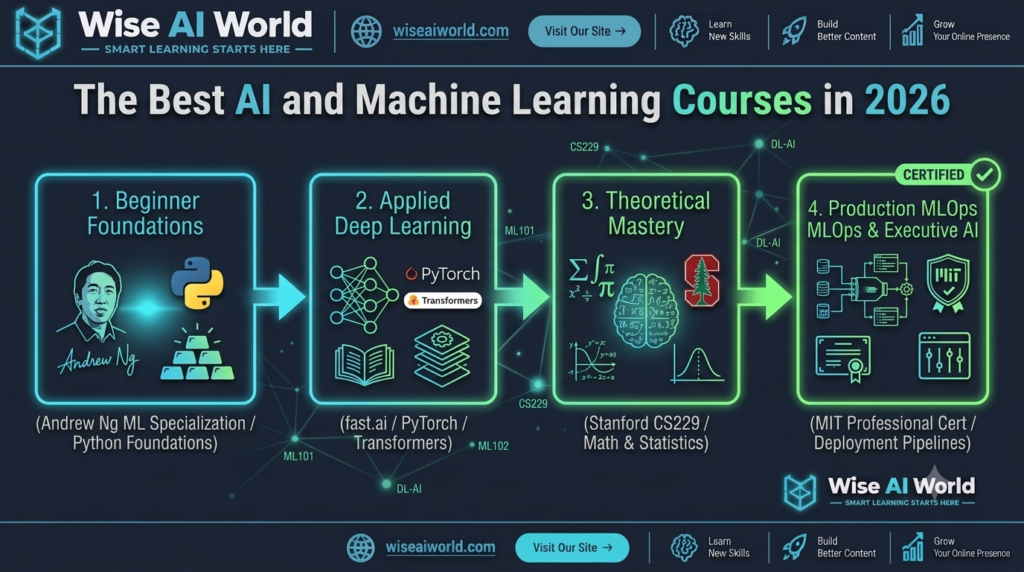
The 3 Core Categories of AI Coursework
- Theoretical Foundations: University-level rigor focused on linear algebra, multivariable calculus, probability, and foundational statistics.
- Applied Engineering: Hands-on implementation using Python, PyTorch, scikit-learn, and Hugging Face to build and fine-tune models.
- Production MLOps & LLMOps: Infrastructure-level training focused on deployment, monitoring, vector databases, and scalable pipeline orchestration.
2. Comprehensive Comparison: Top AI & Machine Learning Courses
Here is an executive overview comparing the top free and paid artificial intelligence programs available in 2026.
| Course / Program | Provider | Cost | Best For | Prerequisites |
|---|---|---|---|---|
| Machine Learning Specialization | DeepLearning.AI / Stanford | Free Audit (Paid Cert) | Beginner Foundations | Basic Python & Algebra |
| Practical Deep Learning for Coders | fast.ai | 100% Free | Hands-On Engineers | Intermediate Python |
| Deep Learning Specialization | DeepLearning.AI | Free Audit (Paid Cert) | Intermediate Neural Networks | Python, Linear Algebra |
| CS229: Machine Learning | Stanford University (YouTube/OpenCourseWare) | 100% Free | Advanced Mathematical Depth | Multivariable Calculus, Linear Algebra |
| Professional Certificate in Machine Learning & AI | MIT Professional Education | Paid ($2,500+) | Executives & Senior Tech Leaders | Degree / Engineering Background |
3. Deep Dive: Top Free AI and Machine Learning Courses
1. Machine Learning Specialization by Andrew Ng (DeepLearning.AI & Stanford)
Taught by AI pioneer Andrew Ng, this course remains the gold standard starting point for anyone entering the field. It breaks down complex mathematical concepts into clear visual intuitions without sacrificing technical precision.
- Key Highlights: Covers Supervised Learning (Regression, Classification), Unsupervised Learning (Clustering, Dimensionality Reduction), and Recommender Systems.
- Practical Stack: Python, NumPy, scikit-learn, TensorFlow.
- Verdict: The absolute best entry point for beginners who want a balanced mix of fundamental math and hands-on coding.
2. Practical Deep Learning for Coders by fast.ai
Unlike traditional academic courses that teach math before code, fast.ai uses a top-down teaching philosophy. You train state-of-the-art computer vision and natural language processing models in Lesson 1, then progressively peel back the layers to learn how they work underneath.
- Key Highlights: Focuses on PyTorch, fastai library, modern Transformer architectures, fine-tuning, and model deployment.
- Practical Stack: PyTorch, Python, Hugging Face, Jupyter Notebooks.
- Verdict: Ideal for software developers who prefer learning by building projects rather than studying proofs.
3. Stanford CS229: Machine Learning (Free OpenCourseWare)
If you prefer rigorous mathematical theory over high-level abstractions, Stanford’s flagship CS229 course is unmatched. Available freely on YouTube and Stanford Online, it dives deep into vector calculus, gradient descent proofs, support vector machines, and statistical learning theory.
4. Deep Dive: Top Paid AI and Executive Programs
1. Deep Learning Specialization (DeepLearning.AI / Coursera)
Building on the foundational ML Specialization, this 5-course series goes deep into neural network architectures. You build convolutional networks (CNNs), recurrent networks (RNNs), and Transformers from scratch in Python.
- Cost: Included with Coursera Plus subscription (~$49/month).
- Best For: Engineers moving into specialized AI roles like Computer Vision or Natural Language Processing.
2. MIT Professional Certificate in Machine Learning & AI
Designed for tech executives, engineering directors, and product leaders, MIT’s professional programs combine structured online lectures with live faculty sessions. It emphasizes enterprise application, strategic roadmap planning, and technical governance.
5. Decision Framework: How to Choose the Right Course
To avoid abandoning a course halfway through, select your path based on your primary objective:
| Your Current Profile | Recommended Starting Point | Expected Outcome |
|---|---|---|
| Complete Programming Beginner | Python for Data Science (Free Code Camp) → Andrew Ng ML Specialization | Solid baseline in ML concepts and basic scripting. |
| Experienced Software Engineer | fast.ai Practical Deep Learning for Coders | Ability to build, train, and deploy PyTorch models into production. |
| Data Analyst / Statistician | DeepLearning.AI Deep Learning Specialization | Transition from descriptive analytics to predictive ML modeling. |

Manish Prakash Dubey is an AI educator and technology writer based in India. He founded WiseAIWorld to make artificial intelligence simple and practical for students, professionals, and beginners. His work focuses on AI basics, machine learning, deep learning, NLP, computer vision, and real-world AI tools.
