
Five years ago, AI careers were the domain of PhD researchers and specialized engineers at a handful of technology companies. Today, the picture looks completely different. AI skills are now relevant to software developers, marketers, teachers, healthcare workers, financial analysts, and small business owners alike. The challenge for most people is not whether to get involved with AI, but how to actually start, and the internet is full of conflicting, overly technical, or vague advice.
This article gives you a clear, realistic, step-by-step roadmap for starting a career in AI in 2026, covering the skills that actually matter, the career paths available, realistic timelines, salary expectations, and how to build credibility even if you are starting from zero.
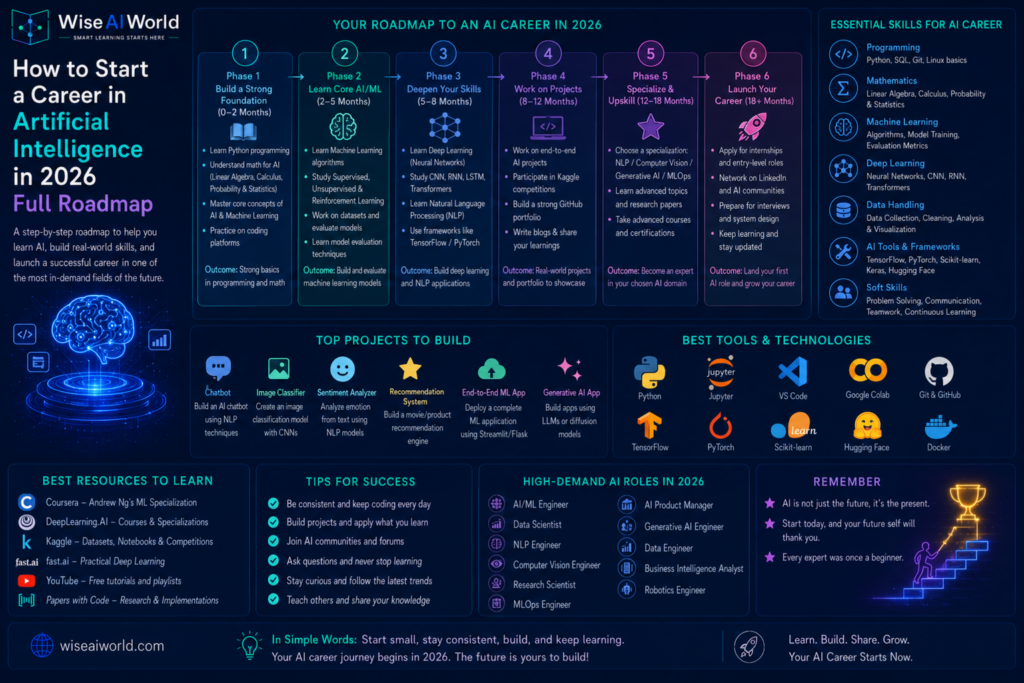
Why AI Careers Are Booming Right Now
The numbers behind the current AI job market are genuinely extraordinary. According to the World Economic Forum’s Future of Jobs Report, cited by JobCannon, AI and machine learning specialists are projected to be the fastest-growing role category through 2030, with demand increasing by 40 percent globally. At the same time, the supply of qualified professionals has not kept pace. LinkedIn’s 2025 Workforce Report found that AI job postings outnumber qualified candidates by a ratio of 3.5 to 1.
This imbalance has real consequences for anyone considering an AI career. It means salaries are unusually high, companies are increasingly open to hiring non-traditional candidates without computer science degrees, and the barrier to entry is lower than most people assume, provided you follow a sensible learning path rather than trying to learn everything at once.
According to DataExpert, AI engineering job openings increased by 143 percent year over year in early 2026. The broader economic context matters too. PwC research cited by NetCom Learning estimates that AI will contribute 15.7 trillion US dollars to the global economy by 2030, and AI is expected to reshape around 85 percent of job roles in some way.
Step 1: Understand That AI Skills Exist in Tiers
The single biggest mistake people make when starting an AI career is assuming they need to become a machine learning engineer or researcher from day one. According to Skill Upgrade Hub, AI skills in 2026 fall into three distinct tiers, and most wasted learning time happens because people pursue advanced skills when a foundational tier is all they actually need.
Tier 1 is AI literacy. This means understanding what AI, machine learning, and generative AI tools can and cannot do, and being able to use tools like ChatGPT, Gemini, and Copilot effectively in your existing job. According to Pluralsight, basic AI skills are now considered table stakes, with 95 percent of organizations using AI familiarity as a hiring factor across roles, not just technical ones.
Tier 2 is applied AI. This is for professionals who want to build AI-powered features into products, automate workflows using AI tools and APIs, or work as AI product managers, business analysts, or prompt specialists. This tier requires more hands-on skill but does not necessarily require deep mathematical or research background.
Tier 3 is AI specialist. This includes roles like machine learning engineer, AI research scientist, and data scientist, which require strong programming, mathematics, and machine learning theory. This is the most competitive tier but also the highest paid.
Knowing which tier matches your goals, current skills, and available time is the most important decision you will make, because it determines everything else in your roadmap.
Step 2: Build Foundational AI Knowledge
Regardless of which tier or career path you pursue, a solid foundation in how AI actually works will serve you throughout your career. According to Global Tech Council, beginners should start with AI literacy before moving into more technical areas like Python, data fundamentals, and automation.
Start by understanding what AI is and why it matters and how AI actually works at a conceptual level. From there, build a clear understanding of the difference between AI, machine learning, and deep learning, since this distinction comes up constantly in interviews and on the job, and confusing these terms is one of the fastest ways to signal that you do not actually understand the field.
If you are interested in working with language models specifically, which is where a large portion of current hiring demand sits, build an understanding of natural language processing and how AI understands human language. This foundational layer typically takes four to eight weeks of consistent study for someone starting from zero, and it pays off across every career path described below.
Step 3: Choose Your Track
Once you have foundational knowledge, the next step is choosing a track that matches your background, interests, and the amount of time you can realistically invest. According to uCertify, AI careers broadly split into technical and non-technical tracks, and both offer strong opportunities in 2026.
Technical Track: AI or Machine Learning Engineer
Machine learning engineers and AI engineers build and deploy AI systems. According to Dataquest, the modern AI engineer role focuses on connecting large language models to real products, such as customer support systems, internal search tools, and automated workflows, rather than training models from scratch. Core skills include Python, working with large language model APIs, retrieval-augmented generation, and AI agent frameworks.
Dataquest estimates a realistic timeline of 8 to 12 months from a standing start to being able to deploy production AI systems, with salary ranges between 130,000 and over 250,000 US dollars depending on experience in the US market. According to DataExpert, entry-level roles in this track typically start between 100,000 and 150,000 US dollars annually in the US, with core tools including Python 3.10 and above, MLOps tools like Docker and Kubernetes, frameworks like PyTorch and TensorFlow, and vector databases such as Pinecone and Weaviate.
Technical Track: Data Scientist
Data scientists focus on extracting insights from data, building predictive models, and helping organizations make data-driven decisions. According to Pluralsight, the average salary range in data science sits between 121,000 and 196,000 US dollars per year, with SQL considered a baseline requirement alongside Python and statistics.
This path suits people who enjoy working with data, statistics, and visualization, and who want to understand machine learning concepts like supervised and unsupervised learning deeply enough to apply them to real business problems.
Non-Technical Track: AI Product Manager
AI product managers bridge the gap between technical teams and business goals, deciding what AI features to build, prioritizing roadmaps, and ensuring AI products actually solve real user problems. This role requires a solid conceptual understanding of AI capabilities and limitations, including AI ethics and responsible AI considerations, but does not require deep coding ability.
Non-Technical Track: AI Business Analyst and Strategy Roles
According to uCertify, AI business analysts, AI project managers, and AI strategy and transformation roles are growing rapidly as organizations need people who can assess where AI fits into existing business processes, manage AI implementation projects, and guide governance and compliance. These roles often command strong salaries due to the complexity of bridging technical capability with business needs, even without hands-on coding work.
Specialist Track: Prompt Engineering and AI Agent Design
A newer category of roles focuses specifically on designing effective prompts, workflows, and AI agents that use tools like ChatGPT and Google Gemini to automate multi-step tasks. This track has a relatively low technical barrier to entry compared to machine learning engineering, while still commanding strong demand as businesses look for people who can squeeze maximum value out of existing AI tools.
Step 4: Build Real Skills Through Practical Projects
According to Towards Data Science, the most effective way to build AI skills is not through endless theory but through real, usable projects that demonstrate your ability to solve problems. AI is too large a field for anyone to master everything, and no recruiter expects that. What matters is demonstrating that you can take a problem from start to finish.
A practical example from Towards Data Science illustrates this well: building a simple salary prediction tool. The project starts by gathering publicly available salary data segmented by role, location, and experience, then building a basic regression or tree-based model to predict salary based on a person’s profile and a target role. The goal is not perfect accuracy, but understanding which factors matter and how to prepare data, build a simple model, and present results in a usable way.
Projects like this matter because they translate directly into a portfolio you can show employers, they force you to deal with real messy data rather than clean textbook examples, and they give you concrete things to discuss in interviews rather than abstract claims about what you have studied.
Step 5: Get Certifications That Actually Matter
Certifications are not a substitute for real skills and projects, but they can help validate your knowledge, particularly for non-traditional candidates without a computer science degree. The most valuable certifications in 2026 tend to come from major cloud providers and platforms that companies actually use, such as Google Cloud, AWS, and Microsoft Azure, plus structured courses from established platforms covering machine learning fundamentals, deep learning, and applied AI.
The key is to treat certifications as a supplement to a portfolio of real projects, not a replacement for one. A certification combined with two or three solid projects you can explain in depth is far more compelling to employers than a stack of certificates with nothing built to show for them.
Step 6: Build Your Portfolio and Online Presence
Once you have completed a few projects, presenting them effectively matters enormously. According to Skill Upgrade Hub, even people in non-technical roles benefit from explicitly listing AI tool proficiency on their resumes and LinkedIn profiles, then backing it up with measurable impact statements, such as describing how using AI tools to automate a specific reporting task saved a defined amount of time each week.
For technical tracks, a GitHub profile showcasing your projects with clear documentation, explanations of your approach, and honest discussion of what worked and what did not, is one of the most valuable assets you can build. For non-technical tracks, case studies describing AI projects you led or contributed to, even informally within your current job, demonstrate exactly the kind of practical AI experience employers are looking for.
Step 7: Network and Apply Strategically
Given that AI job postings outnumber qualified candidates by 3.5 to 1 according to LinkedIn’s 2025 Workforce Report, the job search process in 2026 looks different from a typical competitive job market. Companies are actively looking for capable people and are increasingly willing to consider candidates without traditional credentials if they can demonstrate real skills.
This means networking, engaging with AI communities, contributing to open discussions about AI tools and techniques, and reaching out directly to companies working on problems that interest you can be unusually effective. Demonstrating genuine curiosity and practical ability often matters more than ticking every box in a job description, particularly for entry-level and applied AI roles.
Realistic Timeline Expectations
Based on the roadmaps from Dataquest and Global Tech Council, here is a realistic picture of timelines for someone starting from scratch.
Months one and two typically cover AI literacy and foundational concepts, including understanding how AI, machine learning, and deep learning relate, and gaining hands-on comfort with tools like ChatGPT and Gemini for everyday tasks.
Months three through six, for technical tracks, focus on learning Python, working with data, and building an understanding of machine learning fundamentals including supervised and unsupervised learning, plus starting on your first real project.
Months seven through twelve involve deepening skills in your chosen specialization, whether that is large language model APIs and AI agents for AI engineering, statistical modeling for data science, or AI strategy and product frameworks for non-technical tracks, while building out two to three portfolio projects and beginning to apply for roles.
For non-technical tracks, this timeline can often be compressed significantly, since the focus is less on deep technical skill-building and more on developing strong conceptual understanding and demonstrable practical experience using AI tools within your existing professional context.
Common Mistakes to Avoid
The most common mistake is trying to learn everything at once, jumping between courses on deep learning, robotics, computer vision, and reinforcement learning without finishing any of them or building anything real. This leads to broad but shallow knowledge that does not translate into employable skills.
A second common mistake is believing that prompt writing alone constitutes an AI career. While prompt engineering and effective AI tool use are valuable skills, especially in Tier 1 and Tier 2, building a sustainable career typically requires combining these skills with domain expertise in an industry or function, such as marketing, finance, healthcare, or software development.
A third mistake is neglecting the fundamentals of how AI actually works in favor of jumping straight to tools. Understanding concepts like overfitting in machine learning or how deep learning differs from traditional machine learning gives you the vocabulary and conceptual grounding to learn new tools quickly as the field evolves, which it will continue to do rapidly.
Key Takeaways
- AI and machine learning roles are projected to be the fastest-growing job category through 2030, with demand outpacing qualified candidates by 3.5 to 1 according to LinkedIn.
- AI skills fall into three tiers: AI literacy for everyone, applied AI for professionals building AI-powered workflows, and AI specialist for technical roles like machine learning engineer.
- Technical tracks like AI engineering and data science offer strong salaries, with entry-level AI engineering roles often starting between 95,000 and 150,000 US dollars in the US.
- Non-technical tracks including AI product management, business analysis, and strategy roles are growing rapidly and do not require deep coding skills.
- Real projects and a portfolio matter more than certifications alone, though certifications from major platforms can help validate skills for non-traditional candidates.
- A realistic timeline from zero to job-ready is roughly 8 to 12 months for technical tracks, often faster for non-technical tracks built on existing professional experience.
Conclusion
Starting a career in AI in 2026 is less about perfection and more about starting at all, then following a structured path rather than chasing every new tool and trend. The opportunity is genuinely significant, with strong demand, high salaries, and a growing willingness from employers to look beyond traditional credentials toward demonstrated skill.
Begin by building solid foundational knowledge of AI and machine learning, choose a track that matches your background and goals, and commit to building real projects rather than only consuming content. The path is well-trodden, the demand is real, and the opportunity has never been more accessible to people willing to put in consistent, focused effort.
Sources
- JobCannon: AI Career Roadmap 2026
- Dataquest: How to Become an AI Engineer in 2026
- Pluralsight: AI Career Paths 2026 Job Guide
- Skill Upgrade Hub: AI Skills Career Guide 2026
- DataExpert: AI Engineering Career Path Guide 2026
- Global Tech Council: AI Career Roadmap for Beginners

Manish Prakash Dubey is an AI educator and technology writer based in India. He founded WiseAIWorld to make artificial intelligence simple and practical for students, professionals, and beginners. His work focuses on AI basics, machine learning, deep learning, NLP, computer vision, and real-world AI tools.
