
Artificial Intelligence often feels like a sudden breakthrough that appeared overnight with the rise of modern chatbots and generative models. However, the foundational concepts powering today’s AI systems were forged over seven decades ago. What we witness today is the culmination of decades of mathematical theory, engineering setbacks, computational breakthroughs, and massive architectural shifts.
To understand where AI is heading, software engineers and business leaders must first understand where it came from. From early symbolic logic and rule-based systems to the harsh winters of funding cuts, and finally to modern deep learning and generative models, AI’s evolution is a story of continuous invention.
In this comprehensive historical guide, we break down the major eras of artificial intelligence from the 1950s to today into clear, accessible phases.
1. The Complete AI Historical Era Timeline
Before diving into specific technological milestones, let’s examine the macro timeline that defines the six primary eras of artificial intelligence development.
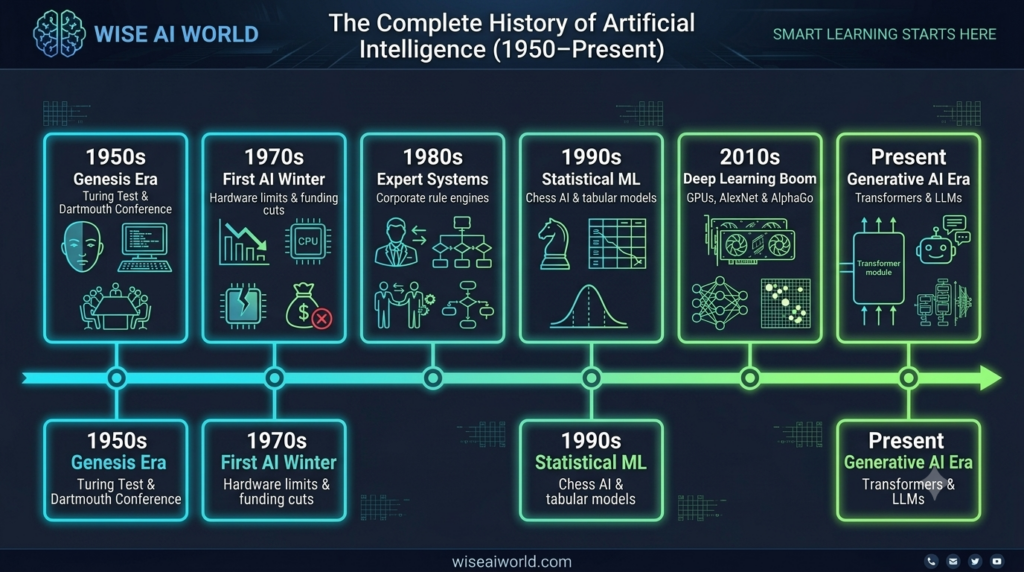
The 6 Core Eras of Artificial Intelligence
- 1. The Genesis Era (1950–1969): Foundations of computing theory, the Turing Test, Dartmouth Conference, and early symbolic logic.
- 2. The First AI Winter (1970–1979): Overhyped expectations meet hardware limitations, leading to severe funding cuts.
- 3. The Expert Systems Era (1980–1986): Commercial adoption of rule-based knowledge engines in corporate enterprise.
- 4. The Second AI Winter & Statistical Shift (1987–1997): Collapse of specialized Lisp hardware and the pivot toward statistical machine learning.
- 5. The Deep Learning & Big Data Revolution (2006–2020): GPU acceleration, ImageNet, and multi-layer neural network breakthroughs.
- 6. The Generative AI & Transformer Era (2021–Present): Self-attention mechanisms, Large Language Models (LLMs), and agentic automation.
2. Era 1: The Birth of Artificial Intelligence (1950s–1960s)
The formal history of artificial intelligence began in 1950, when British mathematician and computer scientist Alan Turing published his landmark paper, “Computing Machinery and Intelligence.” In it, Turing posed a simple yet profound question: “Can machines think?”
To measure machine intelligence, he introduced the Imitation Game (now known as the Turing Test). If a human judge communicating via text cannot reliably distinguish whether their conversational partner is a human or a computer program, the machine passes the test.
Key Milestones of the Genesis Era
- 1956 Dartmouth Conference: Organizers John McCarthy, Marvin Minsky, Nathaniel Rochester, and Claude Shannon coined the term “Artificial Intelligence” during a summer research project at Dartmouth College.
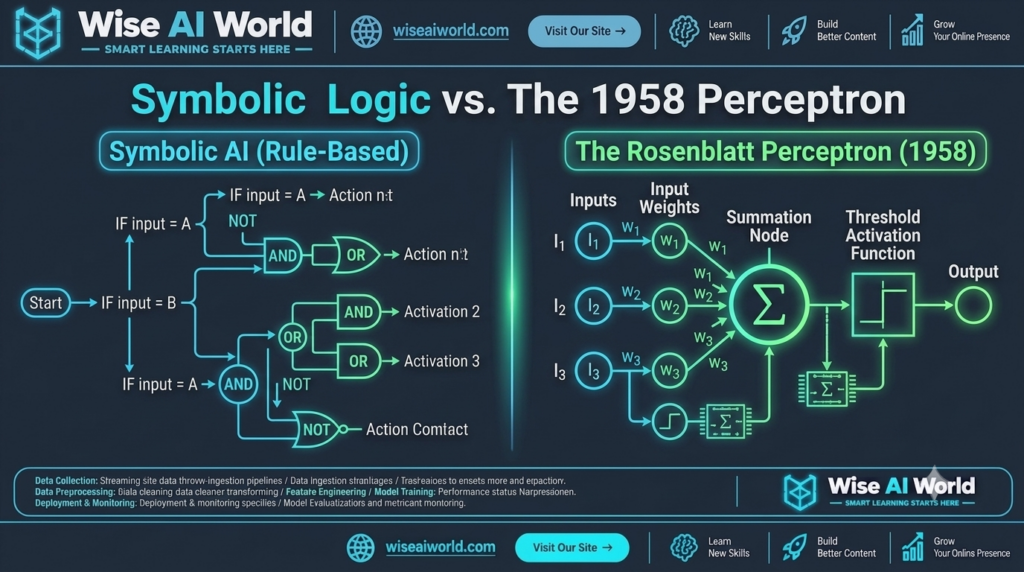
- 1958 Rosenblatt Perceptron: Frank Rosenblatt developed the Perceptron at Cornell Aeronautical Laboratory—the earliest artificial neural network built in hardware.
- 1966 ELIZA: Joseph Weizenbaum built ELIZA at MIT, an early natural language processing program capable of simulating a Rogerian psychotherapist using pattern-matching rules.
3. Era 2 & 3: AI Winters and the Rise of Expert Systems (1970s–1990s)
Early optimism led researchers to make extravagant predictions, claiming fully autonomous human-level AI was only a decade away. However, 1970s computer hardware could not handle the exponential combinatorial explosion required for real-world logic systems.
This gap between expectation and reality triggered the **First AI Winter (1974–1980)**, marked by massive government funding cancellations (including the UK’s Lighthill Report and US DARPA cutbacks).
The Rise and Fall of Corporate Expert Systems
AI resurrected in the 1980s through Expert Systems—programs designed to emulate the decision-making ability of human experts by processing thousands of hand-coded IF/THEN rules. Corporations deployed systems like XCON (Digital Equipment Corporation) to automate sales and hardware configuration.
By the late 1980s, expert systems proved expensive, fragile to maintain, and incapable of learning from new experience. When specialized desktop hardware failed to compete with cheaper PC microprocessors, the **Second AI Winter (1987–1993)** hit the industry.
4. Era 4: The Pivot to Statistical Machine Learning (1990s–2000s)
Recognizing the limits of hand-coded rules, computer scientists pivoted from symbolic logic to **statistical machine learning**. Rather than teaching computers rigid rules, scientists built algorithms capable of inferring statistical patterns from empirical data sets.
| Historical Milestone | Year | Architectural Significance |
|---|---|---|
| IBM Deep Blue vs. Kasparov | 1997 | Demonstrated brute-force tree search evaluation capable of defeating world chess champion Garry Kasparov. |
| MNIST Handwritten Digit Dataset | 1998 | Yann LeCun published LeNet-5, establishing Convolutional Neural Networks (CNNs) for image pattern recognition. |
| IBM Watson on Jeopardy! | 2011 | Combined natural language parsing, information retrieval, and statistical scoring to defeat human champions. |
5. Era 5: The Deep Learning Boom (2012–2020)
The modern era of AI exploded in October 2012 at the ImageNet Large Scale Visual Recognition Challenge. Alex Krizhevsky, Ilya Sutskever, and Geoffrey Hinton entered **AlexNet**—a deep convolutional neural network trained on graphics processing units (GPUs).
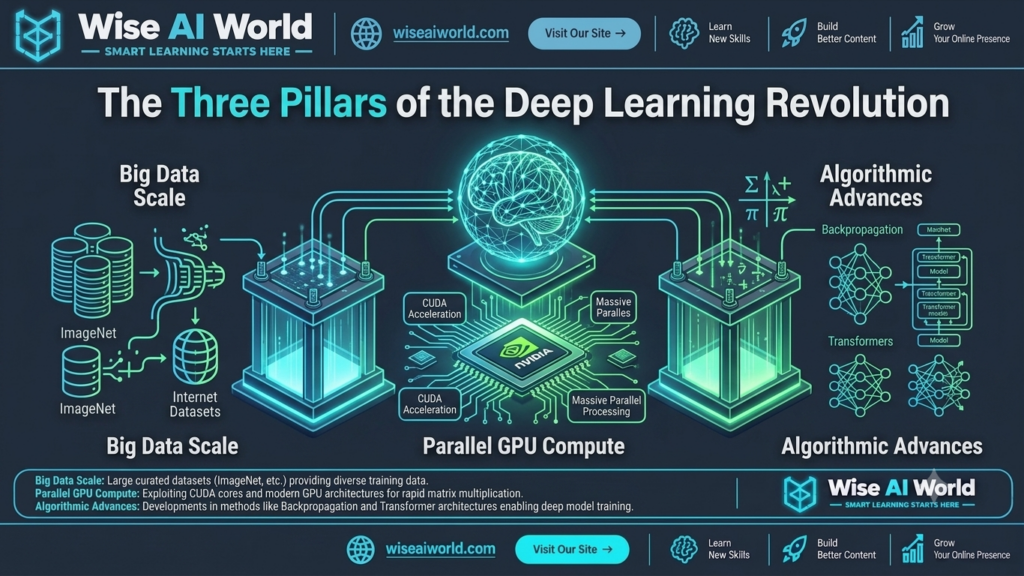
AlexNet smashed previous image classification records, reducing error rates from 26% to 15%. This landmark victory proved that deep neural networks—when supplied with massive datasets and accelerated GPU hardware—could solve complex perception tasks that previously stumped software engineers.
Key Breakthroughs of the 2010s
- 2014 Generative Adversarial Networks (GANs): Ian Goodfellow introduced GANs, pitting two neural networks (Generator and Discriminator) against each other to create synthetic images.
- 2016 DeepMind AlphaGo: DeepMind’s AlphaGo defeated world Go champion Lee Sedol 4-1 using deep reinforcement learning and Monte Carlo tree search—a milestone experts predicted was decades away.
- 2017 Transformer Architecture: Google researchers published “Attention Is All You Need,” introducing the Transformer model and self-attention mechanisms that replaced recurrent networks.
6. Era 6: The Modern Generative AI Era (2021–Present)
The invention of the Transformer architecture paved the way for modern **Large Language Models (LLMs)** and multimodal foundation models capable of understanding and generating code, text, images, and audio seamlessly.
Today, AI has evolved beyond simple predictive analytics into **Agentic Systems**—autonomous pipelines capable of executing multi-step enterprise workflows, orchestrating databases, and generating production-ready code.
7. Summary & Historical Comparison Matrix
Understanding these historical transitions helps engineers evaluate which computational paradigm suits specific technical requirements.
| Era | Dominant Paradigm | Primary Data Input | Primary Bottleneck |
|---|---|---|---|
| 1950s–1970s | Symbolic Logic & Perceptrons | Hand-coded mathematical rules | Memory and processing power |
| 1980s | Expert Knowledge Systems | Structured IF/THEN domain rules | High maintenance cost & inflexibility |
| 1990s–2000s | Statistical Machine Learning | Structured tabular datasets | Manual feature engineering requirement |
| 2010s–Present | Deep Neural Networks & Transformers | Massive unstructured data (Text, Video, Audio) | Compute cost, energy, and data quality |

Manish Prakash Dubey is an AI educator and technology writer based in India. He founded WiseAIWorld to make artificial intelligence simple and practical for students, professionals, and beginners. His work focuses on AI basics, machine learning, deep learning, NLP, computer vision, and real-world AI tools.
