When a chatbot answers your question in seconds, when your phone recognizes your face, or when a music app plays exactly the kind of song you were in the mood for, it can feel like magic. It is not magic. It is a logical, learnable process built on data, mathematics, and pattern recognition.

This article breaks down exactly how AI works, step by step, in plain language. By the end, you will understand what happens behind the scenes every time you interact with an AI-powered tool, why AI sometimes gets things wrong, and what the difference is between an AI that classifies information and one that generates new content.

How artificial intelligence actually works beginner friendly explanation with diagrams
AI works by recognising patterns in data and using those patterns to make predictions.

The Core Idea Behind All AI

Every AI system, whether it is a spam filter, a voice assistant, a medical imaging tool, or a generative chatbot, is built on one central idea: learn patterns from data and use those patterns to produce useful outputs on new data.

That is it. The technology that makes it happen varies enormously in complexity, but the underlying principle does not. AI does not think the way humans think. It does not understand the world, feel emotions, or have intentions. It processes input, matches it against learned patterns, and produces the statistically most appropriate output.

If you have not yet read our introduction to the field, start with before continuing here.

The Three Building Blocks of Every AI System

Regardless of what an AI system does, it is built from three fundamental components: data, algorithms, and models. Understanding these three things unlocks the whole subject.

Data: What AI Learns From

Data is the raw material of AI. Without large amounts of good data, even the most sophisticated algorithm cannot produce a useful system.

Data can take almost any form. Text from websites, books, and articles. Images and videos from cameras. Audio recordings. Numbers from sensors, financial transactions, or medical devices. User behavior like clicks, searches, purchases, and viewing history. Every AI system is trained on some form of this information.

The quality and quantity of data directly determines how well an AI system can perform. According to research cited by MindInventory, poor data quality is the number one reason approximately 85 percent of AI and machine learning projects fail to deliver useful results. A system trained on biased data will produce biased outputs. A system trained on outdated data will give outdated answers. A system trained on too little data will not generalize well to new situations.

Algorithms: How AI Learns

An algorithm is a set of step-by-step instructions. In AI, algorithms define the method by which a system processes data and learns patterns from it.

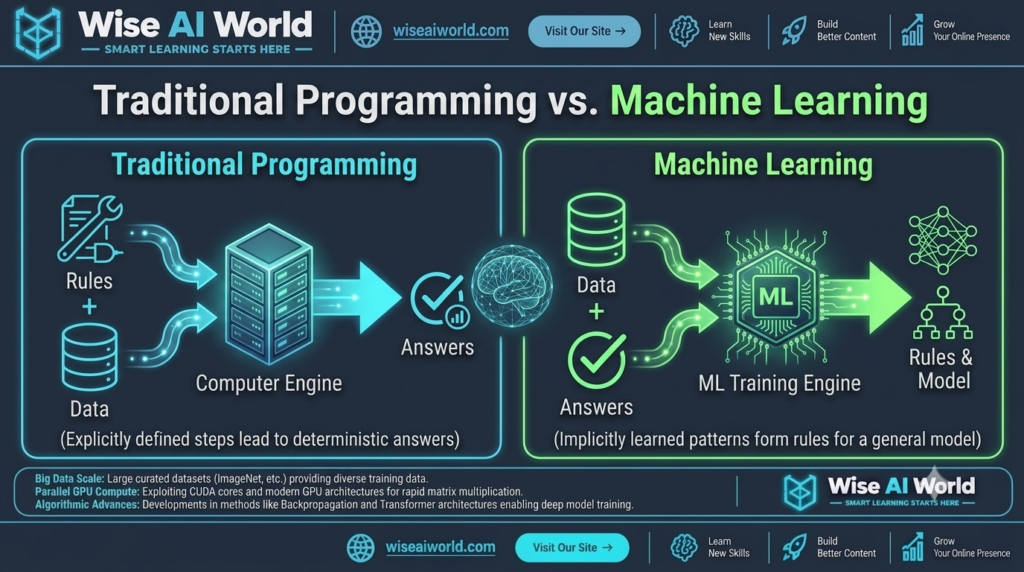
Think of an algorithm as the teaching method, and data as the textbook. The algorithm tells the system how to study the data, how to compare its predictions against correct answers, and how to adjust itself to improve. Different AI tasks use different types of algorithms. Some are simple and fast. Others, like the deep neural networks behind tools such as ChatGPT, involve billions of parameters and take weeks to train on specialized hardware.

You do not need to understand the mathematics to use AI effectively. But knowing that algorithms are what determine how a system learns, rather than how much it knows, helps clarify why training data matters so much.

Models: The Result of Training

A model is what you get after an algorithm has finished learning from data. It is the trained system that can now take new inputs and produce outputs, whether that is a classification, a prediction, a translation, or a generated piece of text.

When you use ChatGPT, you are interacting with a language model. When Gmail filters your spam, it is using a classification model. When Google Maps suggests the fastest route, it is using a predictive model trained on traffic data. The model is the end product of the entire AI training process.

How AI Learns: The Training Process Explained

Training is the process by which an AI model learns from data. It is the most important and resource-intensive part of building any AI system. Here is how it works in practice.

Imagine you want to build an AI system that can identify whether a photo contains a dog or a cat. You start by gathering a large dataset of labeled photos, perhaps 500,000 images, each labeled by a human as either dog or cat.

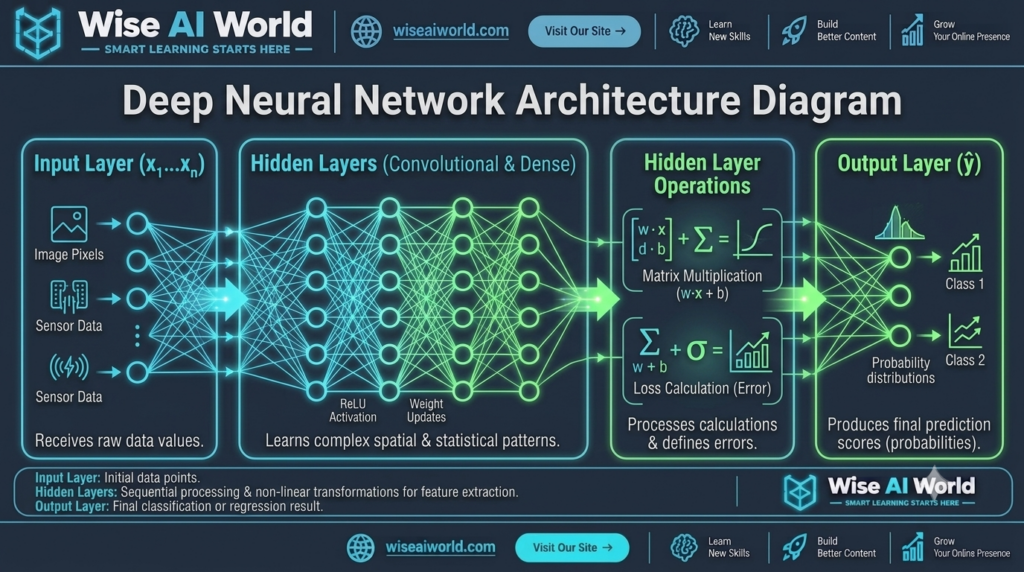
You feed those images into a neural network, which is the type of algorithm used for image recognition. At the very start of training, the network knows nothing. Its internal settings are random. When it looks at the first image, it might guess cat when the correct answer is dog. The training process calculates how wrong that guess was and makes tiny adjustments to the network’s internal settings to reduce the error.

This happens millions of times across the entire dataset. Gradually, the network learns that certain patterns of pixels, shapes, textures, and structures tend to appear in dog photos and others in cat photos. After training, when it sees a new photo it has never encountered before, it can make a confident and usually correct prediction.

This same process, at vastly larger scale, is how models are built for language, images, speech, and video. GPT-4, the model underlying ChatGPT, was trained on an estimated one trillion words of text from across the internet, books, and other sources, adjusted billions of times through the same basic error-correction process described above.

Testing and Validation: How We Know If AI Works

Training a model is only half the job. Before any AI system is deployed in a real product, it must be tested to confirm it actually works on data it has never seen before.

This matters because a model can appear to perform perfectly on its training data while completely failing on new data. This problem is called overfitting, and it is one of the most common issues in . An overfitted model has essentially memorized its training examples rather than learning the underlying patterns. You can read more about this in our detailed article on .

To test properly, developers hold back a portion of their data, typically 10 to 20 percent, during training. This held-back data, called the test set, is only used after training is complete to measure real-world performance. If the model performs well on the test set, it is ready for further evaluation. If not, developers go back and adjust the training process.

How AI Makes Predictions

Once a model is trained and tested, it is deployed and starts making predictions on real input. Every prediction is essentially a probability estimate, not a certainty.

When a spam filter evaluates a new email, it does not simply decide it is spam or not spam. It calculates a probability, something like a 94 percent chance this is spam based on the patterns it has learned. If that probability exceeds a threshold, perhaps 80 percent, the email goes to the spam folder.

When a language model like ChatGPT generates a response, it is not retrieving a stored answer. It is predicting, one word at a time, which word is most likely to come next given everything that came before it in the conversation. The entire response is assembled through thousands of sequential probability calculations happening in fractions of a second.

This probability-based nature of AI predictions is why AI can be wrong, even when it sounds very confident. The model produces what is statistically most likely, not what is necessarily true.

How Generative AI Creates New Content

Generative AI deserves its own explanation because it works somewhat differently from classification or prediction models. Tools like ChatGPT, Google Gemini, DALL-E, and Midjourney do not just classify existing information. They create new content that did not exist before.

A large language model is trained on hundreds of billions of words of text. Through that training, it learns the statistical relationships between words, phrases, sentences, topics, and styles. When you type a prompt, the model uses those learned relationships to generate a response, predicting the most contextually appropriate sequence of words.

Image generation models work similarly but with pixels instead of words. They are trained on hundreds of millions of images paired with text descriptions. When you enter a prompt like a red bicycle leaning against a stone wall in the rain, the model generates an image by using learned visual patterns associated with each element of that description.

According to Planable, generative AI alone could create 4.4 trillion US dollars in economic value across industries. That extraordinary figure reflects how broadly applicable the ability to generate language, images, code, and other content has turned out to be. You can explore specific tools in our guides on and .

Why AI Makes Mistakes

Understanding why AI fails is just as important as understanding how it works. There are five main reasons AI systems produce wrong or harmful outputs.

Poor or Biased Training Data

If the data used to train a model contains errors, gaps, or historical biases, the model will learn those problems and reproduce them in its outputs. This is not a theoretical concern. Documented cases include hiring algorithms that discriminated against women because they were trained on historical hiring data from male-dominated industries, and facial recognition systems that performed significantly worse on darker-skinned faces because training datasets skewed heavily toward lighter-skinned images.

Hallucination in Language Models

Large language models can generate text that is fluent, confident, and completely false. This problem is called hallucination. Because these models predict the most statistically likely next word rather than retrieving verified facts, they can invent citations, dates, names, and statistics that sound plausible but do not exist. This is why every important claim produced by a language model should be verified against a reliable source.

Outdated Knowledge

Most AI models have a training cutoff date. They know nothing about events that happened after their training data was collected. If you ask a model about something that occurred after its cutoff, it may either say it does not know or, more dangerously, generate a plausible-sounding but invented answer.

Overfitting

As discussed above, a model that has overfitted its training data performs well on familiar examples but poorly on new situations that differ from what it has seen before. Real-world data is often messier and more varied than training data, which is why real-world performance sometimes disappoints after impressive results in testing.

Missing Context

AI systems do not experience the world. They process the inputs they are given. If an input is ambiguous, sarcastic, culturally specific, or depends on knowledge the model does not have, the output may be inappropriate or wrong. Human beings use enormous amounts of shared cultural knowledge and contextual judgment when they communicate. AI currently cannot replicate that fully.

A Real-World Walkthrough: How a Spam Filter Works

The best way to make all of this concrete is to walk through one real example from start to finish. A spam filter is the perfect case study because it is simple, widely understood, and touches every concept covered in this article.

First, developers collect a large dataset of emails. Each email is labeled by humans as either spam or legitimate. This labeled dataset might contain millions of examples.

Second, a machine learning algorithm is trained on that data. It learns patterns associated with spam, such as certain trigger phrases, suspicious links, unusual formatting, known scam sender addresses, and urgency language. It also learns patterns associated with legitimate email.

Third, the model is tested on a held-back set of emails it has never seen. If it correctly identifies spam with high accuracy and rarely misclassifies legitimate email as spam, it is ready for deployment.

Fourth, the model is deployed in a live email service. Every new email that arrives is scored by the model in milliseconds. If the spam probability exceeds the threshold, it goes to the spam folder.

Fifth, the system keeps improving. When users mark something as spam that got through, or retrieve something from spam that was wrongly classified, that feedback is used to improve the model over time. Google has reported that Gmail’s filter now blocks more than 99.9 percent of spam using this kind of continuously improving machine learning system.

This five-stage cycle of collect, train, test, deploy, and improve is how virtually every AI system in the world operates.

Key Takeaways

  • All AI systems work by learning patterns from data and using those patterns to produce outputs on new data.
  • The three building blocks of every AI system are data, algorithms, and models.
  • Training is the process of showing a model many examples so it can learn patterns. Testing confirms whether those patterns generalize to new data.
  • AI predictions are probability estimates, not certainties. A confident-sounding AI output can still be wrong.
  • Generative AI creates new content by predicting statistically likely sequences of words, pixels, or other outputs based on patterns learned during training.
  • AI fails due to biased data, hallucination, outdated knowledge, overfitting, and missing context. Human review remains essential.

Conclusion

AI is not magic and it is not mysterious. It is a process: gather data, teach an algorithm to find patterns in that data, build a model from what was learned, test that model, deploy it, and keep improving it. Once you understand that cycle, every AI product you encounter becomes less intimidating and more understandable.

The next step is to go deeper into the specific techniques that power modern AI. Read our guide on to understand the learning methods in more detail, and then explore to understand the neural networks behind the most powerful AI tools in use today.

Sources

By Manish Prakash Dubey

Manish Prakash Dubey is an AI educator and technology writer based in India. He founded WiseAIWorld to make artificial intelligence simple and practical for students, professionals, and beginners. His work focuses on AI basics, machine learning, deep learning, NLP, computer vision, and real-world AI tools.