
Artificial Intelligence can often feel like magic. When you type a prompt into an AI assistant and receive a nuanced essay, a working code snippet, or a photorealistic image in seconds, it is easy to assume the machine possesses actual human comprehension.
In reality, artificial intelligence operates strictly through mathematical structures, statistical pattern matching, and computational pipelines. There is no conscious understanding, intuition, or awareness inside the software. Instead, AI systems process massive quantities of data, discover statistical relationships, and use probability to predict the most accurate response.
In this beginner-friendly guide, we will peel back the technical layers and explain step-by-step how AI actually works behind the scenes—without relying on confusing academic jargon.
1. The Core Philosophy: From Rigid Rules to Pattern Recognition
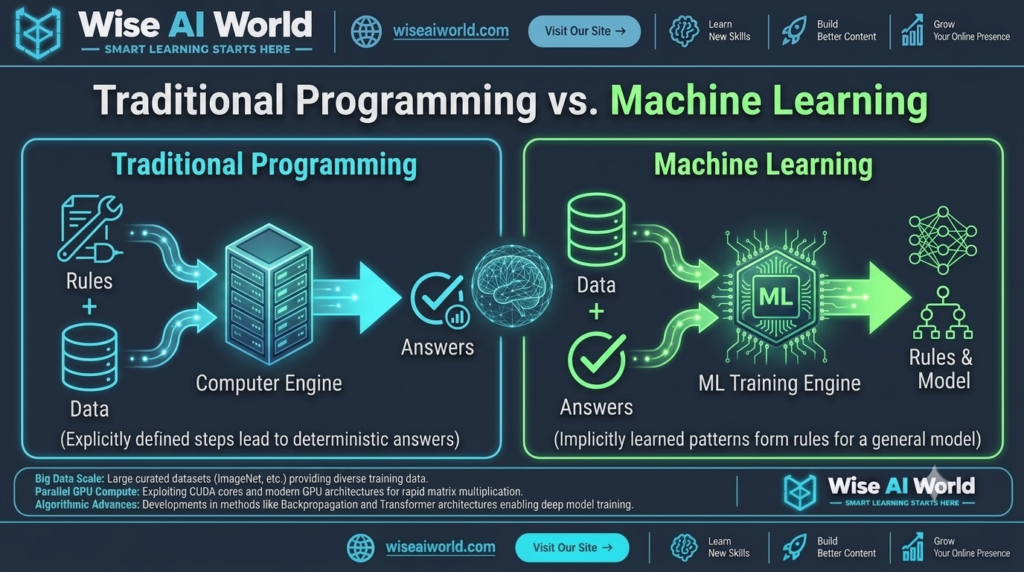
To understand modern AI, we must first look at how traditional software development works compared to machine learning.
In traditional computer programming, human developers write explicit, step-by-step instructions. For example, if a developer wants to build a spam detection filter using classical software engineering, they manually write code containing explicit logical conditions:
IF email_subject CONTAINS "Win Free Money" THEN mark_as_spam()This approach works well for simple rules, but it completely breaks down when applied to complex real-world tasks like identifying a cat in a photo, driving a car, or translating conversational human speech.
The Machine Learning Shift
Rather than hand-coding every possible rule, modern **Machine Learning (ML)** flips the paradigm. Engineers feed a computer algorithm vast amounts of sample data along with the desired output, allowing the mathematical model to discover its own rules and statistical patterns.
2. How AI Models Learn: Data, Features, and Weights
At its foundation, training an AI model is similar to how a human student prepares for an exam using flashcards. The learning process relies on three fundamental concepts:
- 1. Training Data: The textbook or study material given to the model (e.g., millions of labeled images, financial records, or books).
- 2. Features: The specific measurable characteristics extracted from the input data (e.g., pixel contrast, word frequencies, or numerical values).
- 3. Weights & Biases: Mathematical knobs inside the algorithm that adjust during training to increase prediction accuracy.
The 4-Step Training Pipeline
- Data Ingestion: Raw input data (such as thousands of cat and dog photos) is cleaned and converted into numerical values that computers can process.
- Initial Prediction (Inference): The untrained model makes a random guess about an input image based on default mathematical settings.
- Error Calculation (Loss Function): A mathematical function compares the model’s prediction against the true answer, calculating the exact margin of error.
- Parameter Adjustment (Backpropagation): The algorithm works backward through its neural network to adjust its internal weights, reducing error for future guesses.
This four-step cycle repeats millions or billions of times until the model achieves a high accuracy rate across diverse scenarios.
3. What Is a Neural Network? (Demystifying the Brain Analogy)
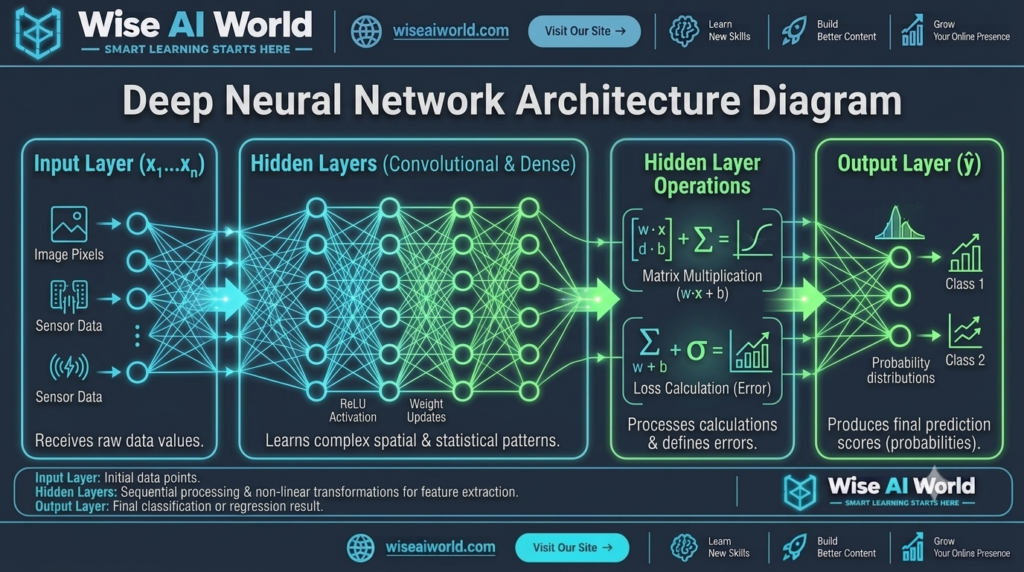
You have likely heard AI compared to the human brain. While modern **Artificial Neural Networks (ANNs)** were originally inspired by biological neurons, they operate purely through matrix mathematics.
A typical neural network consists of layers of interconnected computational nodes:
| Layer Component | Functionality | Real-World Analogy |
|---|---|---|
| Input Layer | Receives raw data (pixels, audio frequencies, or text tokens). | The human eyes or ears receiving sensory signals. |
| Hidden Layers | Processes patterns, edges, textures, and statistical correlations through multiple mathematical transformations. | The brain synthesizing complex information in the background. |
| Output Layer | Produces the final prediction score, probability distribution, or output string. | Stating a final conclusion or decision aloud. |
4. How Generative AI Works: Prediction One Word at a Time
When you interact with Large Language Models (LLMs) like modern AI assistants, it feels like having a conversation with an intelligent human. But how do these generative models actually build sentences?
At their core, Large Language Models are sophisticated **next-token prediction engines**. They do not “think” about an entire thought in advance. Instead, they calculate the probability of the single most logical word (or token) that should follow based on the provided context.
The Vector Embeddings Mechanism
Computers do not understand text directly. To solve this, AI systems convert words into dense numerical vectors within a multi-dimensional mathematical space. Words with similar semantic meanings (like “king” and “queen”, or “doctor” and “physician”) are positioned close together in vector space.
When you submit a text prompt, the model calculates the mathematical relationship between all input words using self-attention mechanisms, selecting the next token with the highest mathematical probability.
5. Summary & Comparison Table: AI Training vs. Inference
Understanding the distinction between how AI models are trained versus how they run in production is crucial for evaluating real-world tech stacks.
| Phase | What Happens | Resource Requirement | Frequency |
|---|---|---|---|
| Model Training | System analyzes billions of data samples to adjust internal mathematical weights. | Massive GPU clusters, high energy consumption, weeks/months of computation. | Occasional (e.g., periodic updates or fine-tuning runs). |
| Model Inference | Trained static model receives new user prompt and generates an immediate response. | Standard server compute, low latency, milliseconds to seconds execution. | Continuous (every user query triggers inference). |

Manish Prakash Dubey is an AI educator and technology writer based in India. He founded WiseAIWorld to make artificial intelligence simple and practical for students, professionals, and beginners. His work focuses on AI basics, machine learning, deep learning, NLP, computer vision, and real-world AI tools.
