Artificial intelligence feels like a modern phenomenon. ChatGPT, image generators, voice assistants, and self-driving cars dominate technology headlines in 2026. But the ideas behind these tools were planted more than 70 years ago, by mathematicians, computer scientists, and philosophers who asked a deceptively simple question: can machines think?
The history of AI is not a straight line of continuous progress. It is a story of extraordinary optimism, humbling setbacks, patient rebuilding, and eventual breakthroughs that exceeded even the most ambitious early predictions. Understanding this journey helps you appreciate both the power of today’s AI and its real limitations.

Before Computers: The Idea of Thinking Machines
The dream of artificial intelligence predates computers entirely. Ancient myths from multiple cultures imagined mechanical beings brought to life. Philosophers like René Descartes in the 17th century speculated about whether animals and machines could be said to think. Charles Babbage designed his Analytical Engine in the 1830s, a mechanical general-purpose computing device that Ada Lovelace recognized could be programmed to do far more than arithmetic.
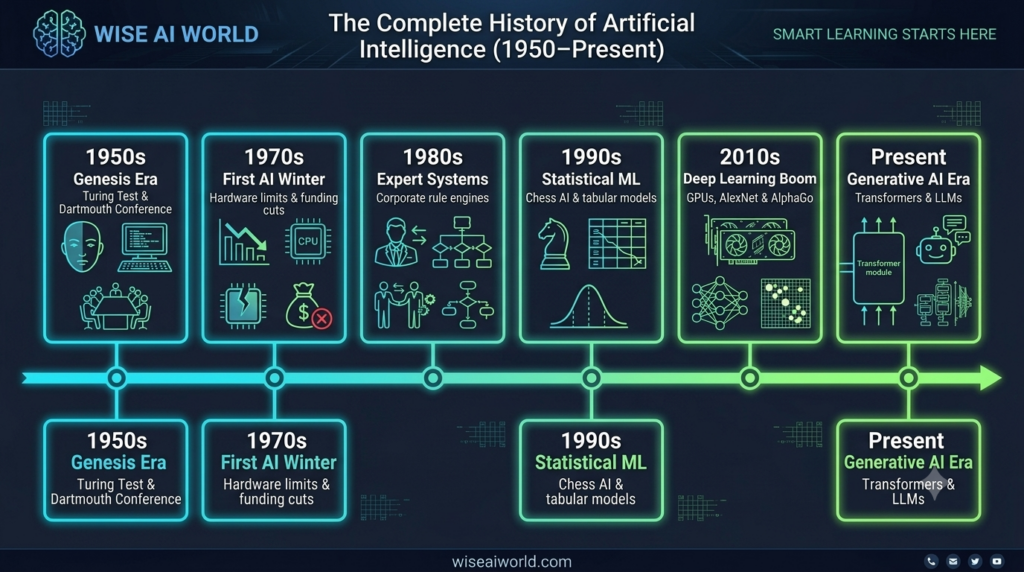
But the modern scientific foundation for AI came from one paper published in 1950. British mathematician Alan Turing wrote Computing Machinery and Intelligence, which opened with the question “Can machines think?” Turing proposed what became known as the Turing Test: if a machine could hold a conversation indistinguishable from a human, it could be considered intelligent. This framing shaped AI research for decades and remains influential today.
For context on what AI has become since Turing’s foundational question, read our guide on .
1956: AI Is Born as a Field
In the summer of 1956, a group of researchers gathered at Dartmouth College in New Hampshire for a workshop that would formally establish artificial intelligence as an academic discipline. The proposal for the workshop, written by John McCarthy, Marvin Minsky, Nathaniel Rochester, and Claude Shannon, stated that every aspect of learning and every feature of intelligence could in principle be so precisely described that a machine could be made to simulate it.
That was an extraordinary claim, and in hindsight, far too optimistic about the timeline. But it gave the field a name, a focus, and a community. John McCarthy, who coined the term artificial intelligence, went on to develop LISP, one of the earliest and most influential programming languages for AI research.
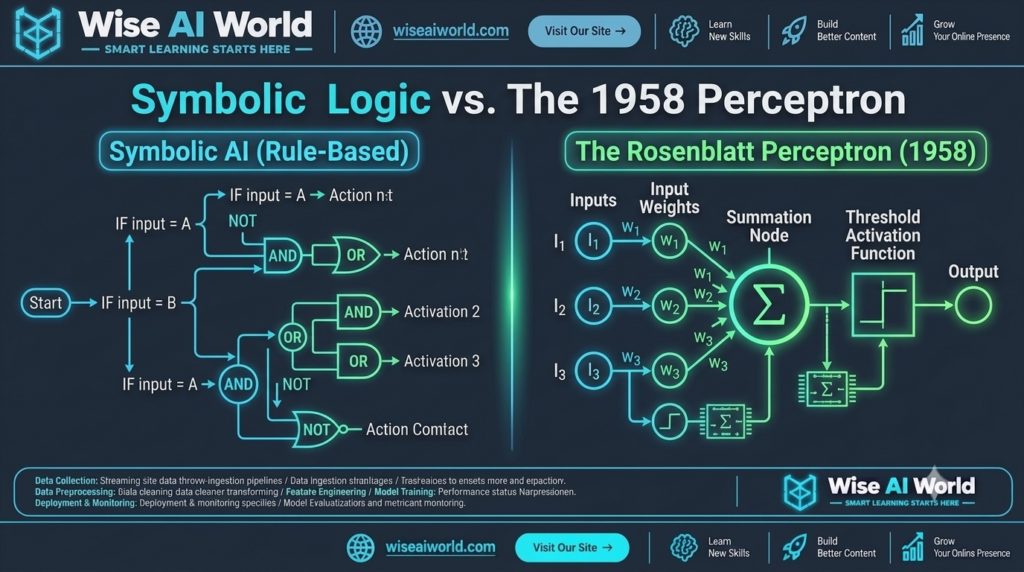
Early AI programs from this era were genuinely impressive for their time. The Logic Theorist, created by Allen Newell and Herbert Simon in 1955, proved 38 of the first 52 theorems in Whitehead and Russell’s Principia Mathematica. The General Problem Solver followed in 1957, attempting to create a universal problem-solving program. These were rule-based systems but they demonstrated that computers could handle symbolic reasoning.
The 1960s: Optimism and Government Funding
Through the 1960s, AI research attracted significant funding, particularly from the United States government through agencies like DARPA. Researchers made progress on natural language processing, machine translation, and problem-solving programs. MIT, Stanford, and Carnegie Mellon became the leading centers of AI research.
The mood was extraordinarily optimistic. Herbert Simon predicted in 1965 that machines would be capable of doing any work a human can do within twenty years. Marvin Minsky said in 1967 that within a generation, the problem of creating artificial intelligence would be substantially solved.
Those predictions proved dramatically wrong. But in the 1960s, they felt plausible because early results were so encouraging within narrow, controlled domains. The difficulty was that real-world problems were exponentially harder than controlled laboratory tasks.
The First AI Winter: 1974 to 1980
By the early 1970s, the gap between AI promises and AI results had become impossible to ignore. Machine translation systems that seemed promising in controlled settings failed badly on real documents. Problem-solving programs that worked on toy problems collapsed when applied to real-world complexity. Natural language understanding remained far harder than expected.
In 1973, the Lighthill Report, commissioned by the British government, delivered a devastating assessment of AI research, concluding that no part of the field had produced the major impact that was promised. Funding cuts followed in both the United Kingdom and the United States.
This period, roughly 1974 to 1980, became known as the first AI winter. Research continued but at reduced scale, and public interest faded significantly. The lesson that the field painfully learned was that human intelligence involves common sense, contextual understanding, and embodied experience that cannot simply be captured in rules and logic.
The 1980s: Expert Systems and Commercial AI
AI found new commercial relevance in the 1980s through expert systems. These were programs that encoded the knowledge of human specialists in specific domains, using rule bases that could be thousands of rules deep. Instead of trying to create general intelligence, researchers focused on narrow domains where expert knowledge could be systematically captured.
XCON, developed at Carnegie Mellon for Digital Equipment Corporation, configured computer systems and reportedly saved DEC around 40 million US dollars per year by the mid-1980s. MYCIN, developed at Stanford, could diagnose bacterial blood infections and recommend antibiotics with accuracy that matched specialist physicians. These were genuinely useful systems that delivered real business value.
By 1985, companies were spending over one billion US dollars per year on AI and expert systems. Japan launched its Fifth Generation Computer project, a government-funded initiative to build AI-capable hardware. The United States and United Kingdom responded with their own national programs.
Expert systems demonstrated something important: AI could deliver practical value when focused on narrow, well-defined tasks. This lesson echoes directly in today’s Narrow AI tools. Read more about this in our article on .
The Second AI Winter: 1987 to 1993
Expert systems had a critical flaw. They were brittle. They worked well within their defined domain but failed unpredictably when situations fell outside their rule base. They were expensive to build, difficult to update, and could not learn from experience. Maintaining a large expert system as the domain changed required constant manual work from expensive specialists.
When the specialized AI hardware market collapsed in 1987, companies that had invested heavily in AI infrastructure suffered significant losses. The Japanese Fifth Generation project failed to deliver its ambitious goals. Government funding again contracted sharply.
The second AI winter lasted roughly from 1987 to 1993. Once again, the field had overpromised and underdelivered. But this winter was shorter than the first, and important research continued in universities and research labs even as commercial investment pulled back.
The 1990s: Machine Learning Rises
The 1990s saw a fundamental shift in how AI researchers approached the problem. Instead of trying to encode human knowledge as rules, the focus moved toward systems that could learn from data. This was the rise of machine learning as the dominant approach in AI research.
The shift was partly philosophical and partly practical. The internet was beginning to generate enormous amounts of digital data. Search engines needed to rank results. Email systems needed to filter spam. Financial institutions needed to detect fraud. These were exactly the kinds of tasks that machine learning could handle well, and the data to train those systems was becoming available for the first time.
The most famous milestone of the decade came in May 1997, when IBM’s Deep Blue chess computer defeated reigning world champion Garry Kasparov in a six-game match by a score of 3.5 to 2.5. The match received worldwide media coverage and became a cultural landmark in the public understanding of AI capability. Deep Blue was not a machine learning system in the modern sense, but it demonstrated that computers could outperform the best human minds in at least some complex domains.
To understand how machine learning actually works, read our complete beginner guide on .
The 2000s: The Internet Fuels AI
Three forces converged in the 2000s to set the stage for the AI revolution that followed. Computers became dramatically faster and cheaper. The internet produced data at a scale previously unimaginable. And companies like Google, Amazon, and Yahoo built businesses that depended on AI-powered systems working at massive scale.
Google’s search ranking algorithm, AdSense advertising system, and spam filters were all machine learning systems processing billions of queries and transactions. Amazon’s recommendation engine, which would eventually account for a significant portion of its revenue, was built on collaborative filtering and machine learning. These were not research projects. They were production systems serving hundreds of millions of users daily.
In 2006, Geoffrey Hinton and his colleagues published research that demonstrated effective training methods for deep neural networks, reigniting serious interest in an approach that had been largely abandoned since the 1980s. The stage was set for the breakthrough decade that followed.
The 2010s: The Deep Learning Revolution
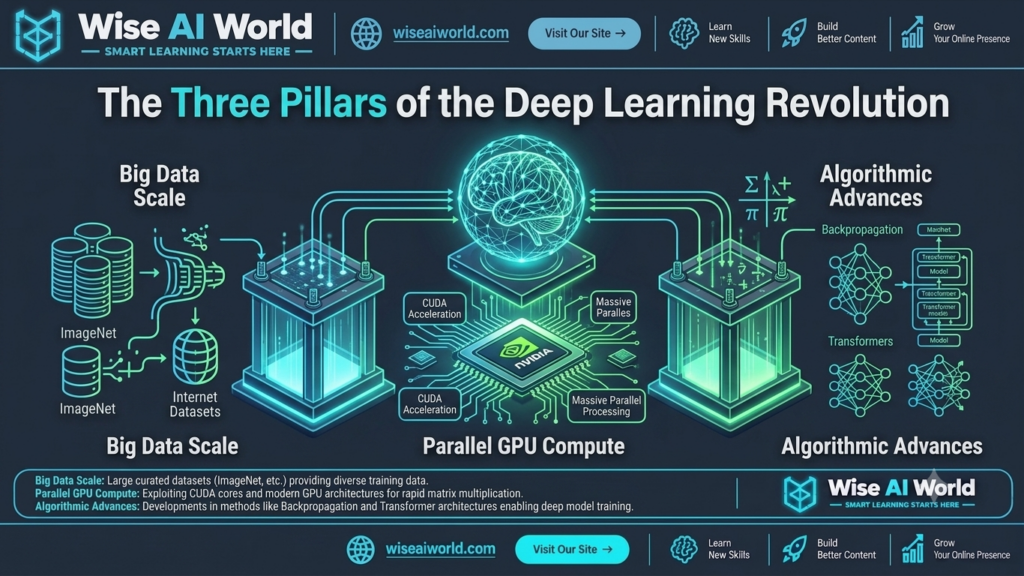
The 2010s produced breakthroughs that transformed AI from a research discipline into a mainstream technology force. The catalyst was deep learning combined with three enabling conditions: massive datasets from the internet, powerful GPU hardware that could train large neural networks efficiently, and algorithmic advances that made those networks trainable.
The turning point that announced the new era to the research community came at the ImageNet Large Scale Visual Recognition Challenge in 2012. A deep learning model called AlexNet, built by Geoffrey Hinton’s team at the University of Toronto, achieved an error rate of 15.3 percent on a benchmark image classification task. The previous best result using non-deep-learning methods was 26.2 percent. That gap of nearly 11 percentage points was not incremental improvement. It was a discontinuous leap that proved deep learning was a fundamentally different class of capability.
What followed was a decade of cascading breakthroughs. Google DeepMind’s AlphaGo defeated world Go champion Lee Sedol in 2016, a milestone considered at least a decade ahead of schedule. Google Translate switched from statistical methods to deep learning in 2016 and reported improvements larger than the previous ten years of development combined. Voice assistants became useful enough for mainstream adoption. Self-driving car research accelerated dramatically.
For a detailed explanation of why deep learning was such a breakthrough, read our guide on .
2017 to 2022: The Transformer Era
In 2017, researchers at Google published a paper titled Attention Is All You Need, introducing the Transformer architecture. This was arguably the single most consequential AI research paper since the deep learning breakthrough of 2012. The Transformer provided a new way to process sequential data like text that was dramatically more effective than previous approaches and could be scaled up in ways that earlier architectures could not.
OpenAI used the Transformer architecture to build the GPT series of language models. GPT-1 in 2018, GPT-2 in 2019, and GPT-3 in 2020 each demonstrated qualitative leaps in language ability. GPT-3 could write coherent essays, answer questions, translate languages, summarize documents, and generate code with a fluency that startled even experienced AI researchers.
Google introduced BERT in 2018, which transformed search engine understanding of natural language queries. GitHub Copilot, powered by a code-specialized version of GPT, launched in 2021 and changed how software developers wrote code. DALL-E, Stable Diffusion, and Midjourney demonstrated that the same generative principles could produce high-quality images from text descriptions.
2022 to 2026: AI Enters Everyday Life
The public launch of ChatGPT in November 2022 was the moment AI became a mainstream topic for ordinary people rather than just technologists and researchers. ChatGPT reached one million users in five days and one hundred million users in two months, the fastest consumer product adoption in history at that point.
What followed was an acceleration without precedent in the history of the technology industry. Google launched Gemini. Anthropic launched Claude. Meta released its Llama models openly. Microsoft integrated AI into its entire Office product suite. Apple integrated AI features across iOS and macOS. Hundreds of thousands of AI-powered applications launched across every industry.
According to The Global Statistics, more than one billion people now actively use AI tools every month. According to Planable’s 2026 AI statistics report, 78 percent of companies have integrated AI into at least one core business function, up from 55 percent in 2023. The global AI market is projected to exceed 757 billion US dollars in 2026, according to AI Statistics.
At the same time, 2022 to 2026 has brought serious scrutiny of AI’s risks. Misinformation generated by AI tools, copyright disputes over training data, bias in AI hiring and lending systems, privacy concerns about data collection, and the economic disruption of automation have all become major policy and social debates. The European Union passed the AI Act in 2024, the world’s first comprehensive legal framework specifically regulating AI systems. Read more about these issues in our article on .
What the History of AI Teaches Us
Seven decades of AI history carry lessons that are directly relevant to understanding the technology today.
Progress is not linear. The field has experienced genuine winters where promising approaches hit fundamental walls. The current wave of generative AI is extraordinary, but humility about future timelines is warranted given past patterns.
Narrow success does not equal general intelligence. Every AI winter was preceded by impressive performance on narrow tasks followed by failure when broader application was attempted. The same caution applies today. Impressive language performance from a chatbot does not mean it has human-like understanding.
Data and computing power are as important as algorithms. The deep learning revolution did not happen because of a single clever idea. It happened when the right algorithms met massive datasets and powerful hardware simultaneously.
Every major AI capability brings new responsibilities. The history of AI is inseparable from debates about bias, safety, employment, privacy, and control. Those debates are not distractions from the technology. They are part of it.
Key Takeaways
- AI was formally established as a research field at the 1956 Dartmouth workshop, though foundational ideas go back to Alan Turing’s 1950 paper.
- The field experienced two major AI winters in 1974 and 1987 when overpromised capabilities failed to materialize and funding collapsed.
- Machine learning replaced rule-based systems as the dominant approach in the 1990s, driven by data availability and commercial applications.
- Deep learning produced a discontinuous leap in capability in the 2010s, particularly after the 2012 ImageNet breakthrough.
- The 2017 Transformer architecture enabled modern large language models, image generators, and generative AI tools.
- Since 2022, AI has entered mainstream everyday use with over one billion monthly active users and 78 percent of companies integrating AI into core business functions.
Conclusion
The history of AI is one of the most compelling stories in the history of science and technology. From a philosophical question posed in 1950 to tools used by more than a billion people in 2026, the journey covers seventy years of human ingenuity, frustration, persistence, and ultimately transformative success.
Understanding where AI came from makes the present moment easier to interpret and the future more legible. The technology is extraordinary. It also has real limitations, real risks, and a track record of surprising both optimists and pessimists. The best way to navigate that complexity is with knowledge.
Continue your learning by exploring behind the scenes, and read about to understand the technical layers that made each era of AI history possible.
Sources
- The Global Statistics: AI Usage Statistics 2026
- Planable: 77 AI Statistics and Trends 2026
- AI Statistics: Global AI Market Size 2026
- Precedence Research: Machine Learning Market Growth
Manish Prakash Dubey is an AI educator and technology writer based in India. He founded WiseAIWorld to make artificial intelligence simple and practical for students, professionals, and beginners. His work focuses on AI basics, machine learning, deep learning, NLP, computer vision, and real-world AI tools.