
The terms Artificial Intelligence (AI), Machine Learning (ML), and Deep Learning (DL) are frequently used interchangeably in technology news, marketing campaigns, and corporate presentations. However, using them as synonymous buzzwords leads to confusion regarding what these technologies actually do, how they are engineered, and what problems they can solve.
In technical reality, AI, ML, and DL are not competing concepts. Instead, they represent nested disciplines within computer science. Artificial Intelligence is the broad overarching goal, Machine Learning is the statistical method used to achieve that goal, and Deep Learning is a specialized subfield of Machine Learning powered by multi-layered artificial neural networks.
In this guide, we will break down the structural relationships, mathematical paradigms, feature engineering requirements, and practical enterprise applications of AI, Machine Learning, and Deep Learning.
1. The Conceptual Relationship: A Nested Hierarchy
To understand how these three technologies interact, it helps to view them as a set of concentric circles, where each inner ring is a specialized implementation of the outer layer.
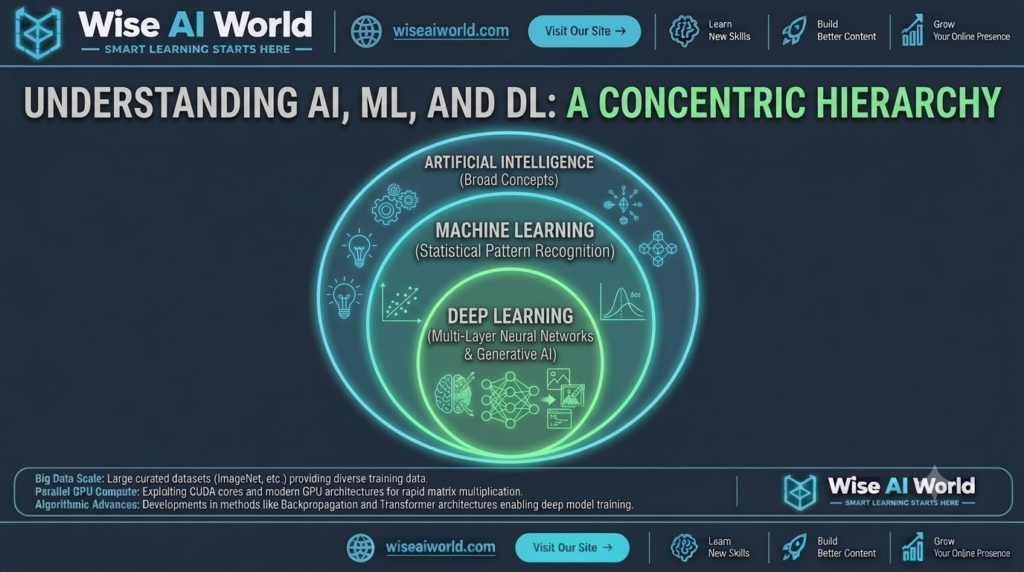
Defining the Three Pillars
- Artificial Intelligence (AI): The broadest discipline focused on creating machines or software capable of mimicking human cognitive functions, such as problem-solving, reasoning, planning, and language comprehension. This includes both rule-based expert systems and statistical models.
- Machine Learning (ML): A subfield of AI where algorithms learn patterns directly from structured data to make predictions or decisions without being explicitly programmed with hardcoded rules.
- Deep Learning (DL): A specialized subset of ML that uses artificial neural networks with multiple hidden layers (hence “deep”) to automatically discover representations from raw, unstructured data like images, audio, and unstructured text.
2. Comprehensive Technical Comparison Matrix
The table below summarizes the key operational, structural, and hardware differences across all three levels of technology.
| Feature Dimension | Artificial Intelligence (AI) | Machine Learning (ML) | Deep Learning (DL) |
|---|---|---|---|
| Scope | Overarching goal of smart machine execution. | Subfield of AI learning from data patterns. | Subfield of ML using multi-layer neural nets. |
| Data Requirement | Can run on zero data (hardcoded rules). | Requires structured/tabular datasets (thousands of rows). | Requires massive unstructured datasets (millions of parameters). |
| Feature Engineering | Hand-crafted logic and decision trees. | Requires manual feature extraction by data scientists. | Automated feature extraction through deep layers. |
| Hardware Dependency | Runs on standard CPUs. | Runs comfortably on standard multi-core CPUs. | Requires parallel hardware (GPUs, TPUs, NPUs). |
| Interpretability (“Black Box”) | High interpretability (deterministic logic). | Moderate to high (decision trees, linear regression). | Low (opaque multi-billion weight interactions). |
3. Deep Dive into Each Discipline
1. Artificial Intelligence: The Broader Vision
Artificial Intelligence originated as a academic field in the 1950s. Early AI systems relied heavily on symbolic AI or expert systems. These platforms operated via extensive “if-then” rule matrices written manually by domain specialists.
For example, an early medical diagnostic AI did not “learn” from patient records; instead, it evaluated hardcoded rules configured by doctors. While effective for predictable environments (such as chess engines or basic tax calculators), symbolic AI breaks down when confronted with unstructured real-world ambiguity.
2. Machine Learning: Learning From Data
Machine Learning shifted the paradigm from programming rules to programming data pipelines. Rather than hand-crafting logic, engineers feed an ML algorithm thousands of historical samples and allow statistical models to establish relationships between input features and target labels.
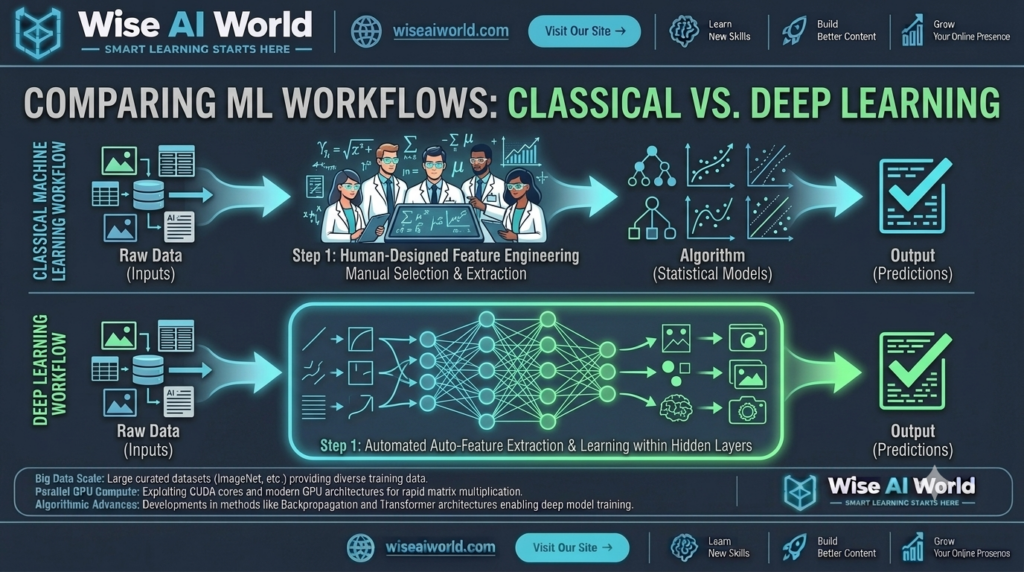
In classical Machine Learning, the critical bottleneck is feature engineering. A data scientist analyzing customer churn must manually calculate variables such as average_monthly_spend, days_since_last_login, or support_ticket_count before feeding them into algorithms like XGBoost, Random Forests, or Support Vector Machines (SVMs).
3. Deep Learning: Neural Networks at Scale
Deep Learning eliminates manual feature engineering for unstructured data formats. By constructing Artificial Neural Networks (ANNs) with dozens or hundreds of hidden layers, DL models learn hierarchical representations directly from raw inputs.
For example, when processing an image of a vehicle:
- Layer 1 (Input/Early Hidden Layers): Detects raw edge lines and contrast gradients.
- Layer 2 (Middle Hidden Layers): Combines lines to recognize geometric shapes (circles, squares, corners).
- Layer 3 (Deep Hidden Layers): Assembles shapes into recognizable features (wheels, headlights, windshields).
- Output Layer: Calculates probability scores (e.g.,
Sedan: 0.94,Truck: 0.04).
4. Real-World Use Cases: Matching Technology to Problem Scope
Choosing between classical ML and DL depends on dataset structure, compute availability, and business latency requirements.
| Industry Application | Classical Machine Learning Approach | Deep Learning Approach |
|---|---|---|
| Financial Fraud Detection | Evaluating transaction size, location distance, and time metrics via Logistic Regression or Random Forests. | Analyzing raw unstructured user interaction logs and sequential behavioral sequences via Graph Neural Networks (GNNs). |
| Healthcare & Diagnostics | Predicting patient readmission risk using structured EHR data fields (age, blood pressure, lab values). | Parsing MRI/CT scan DICOM images using Convolutional Neural Networks (CNNs) to detect early-stage tumors. |
| Customer Support | Routing support tickets based on keyword matching and naive Bayes text classification. | Deploying LLM-driven autonomous conversational agents (e.g., Llama 3, GPT-4o) for real-time contextual dialog. |
5. Decision Framework: When to Use ML vs. Deep Learning
Before committing engineering resources, evaluate your project against these technical criteria:
- Data Volume: If you have under 50,000 structured rows, classical Machine Learning (such as XGBoost or LightGBM) almost always outperforms Deep Learning with significantly lower compute cost.
- Data Type: For tabular databases, spreadsheets, and SQL exports, classical ML remains king. For audio, video, raw images, or natural language text, Deep Learning is necessary.
- Compute and Budget: Classical ML trains on commodity CPU cores in seconds to minutes. Deep Learning requires dedicated GPU clusters (NVIDIA A100/H100) and substantial energy budgets for model training and fine-tuning.
- Regulatory & Compliance Needs: If your industry requires total model explainability (such as credit scoring or loan approvals), classical ML models with SHAP/LIME interpretability tools are preferred over deep neural networks.
6. Summary & Key Takeaways
Understanding the distinction between AI, Machine Learning, and Deep Learning allows software architects, engineering managers, and executives to select the right tool for the job rather than over-engineering solutions with unnecessary complexity.
| Term | Core Mechanism | Primary Strengths |
|---|---|---|
| Artificial Intelligence | System mimicking cognitive task execution. | Broad operational vision, deterministic rule execution. |
| Machine Learning | Statistical pattern recognition on structured data. | High efficiency on tabular data, strong interpretability. |
| Deep Learning | Hierarchical representation learning via multi-layer neural networks. | Unmatched accuracy on unstructured data (vision, audio, text, generative AI). |

Manish Prakash Dubey is an AI educator and technology writer based in India. He founded WiseAIWorld to make artificial intelligence simple and practical for students, professionals, and beginners. His work focuses on AI basics, machine learning, deep learning, NLP, computer vision, and real-world AI tools.
