
Managing large, active online communities on platforms like Discord or Slack is a demanding endeavor. Human moderators frequently struggle to keep up with hundreds of simultaneous discussions, leaving the community vulnerable to toxicity, spam, phishing attacks, and violations of community guidelines.
Traditional moderation bots rely on static rule-based systems or keyword blacklists. These systems are rigid, easily bypassed by creative misspellings, and unable to process semantic context, irony, or subtle harassment. While commercial AI APIs exist, enterprise teams managing private communities often cannot rely on them due to strict data privacy requirements, latency concerns, and unpredictable API costs at scale.
The solution is an automated, self-hosted system that leverages local Large Language Models (LLMs) and standard webhooks. By deploying highly capable models like Meta’s Llama 3 or Mistral on local infrastructure, you can automate advanced semantic moderation while keeping 100% of user data within your private ecosystem.
In this comprehensive guide, we will break down how to architect and deploy a local LLM moderation engine to automate community management for Slack and Discord.
1. System Architecture: The Private LLM Moderation Pipeline
Before deploying specific code, it is essential to establish how data moves between the community platform, your local moderation server, and the hosted LLM engine.
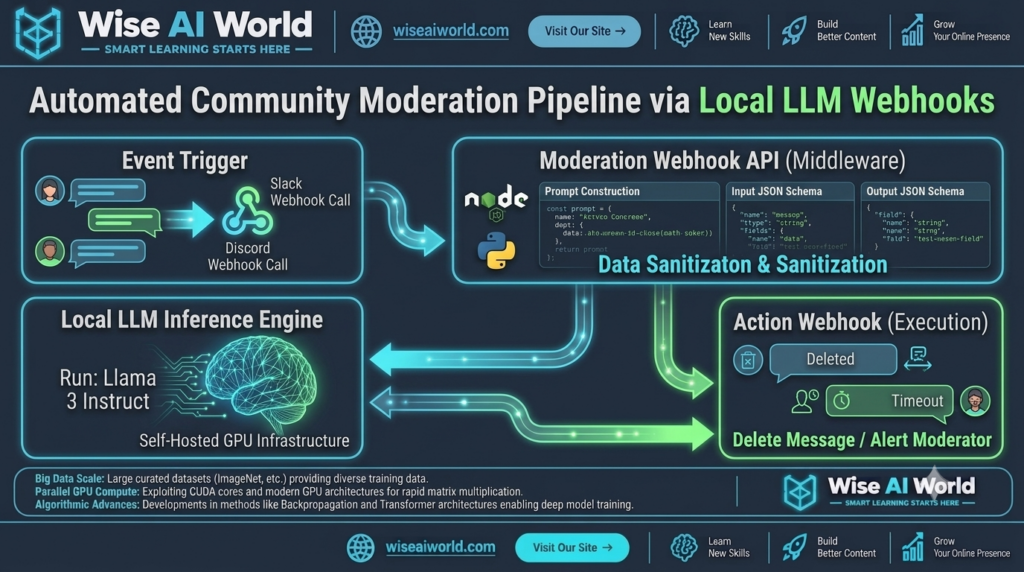
The 4 Core Architectural Components
- 1. Event Trigger (Slack/Discord): A user submits a new message. The platform’s outgoing webhook event detects this and forwards the message payload to your preconfigured endpoint.
- 2. Moderation Webhook API (Middleware): A self-hosted API (Node.js/Python) receives the payload, sanitizes the text, and constructs a precise inference prompt for the LLM.
- 3. Local LLM Engine (Inference Server): A system (e.g., using Ollama, vLLM, or LM Studio) running instruction-tuned models on private GPUs accepts the prompt and returns a moderation verdict (e.g.,
{"status": "flagged", "reason": "toxicity"}). - 4. Action Executor: Based on the LLM verdict, the API sends an incoming webhook response back to the platform to delete the message, timeout the user, or alert a human moderator.
2. The Strategic Advantages of Local LLM Deployment
Switching from rule-based filters or cloud AI APIs to local LLMs offers critical advantages for enterprise communities.
| Metric | Local LLM Automation | Cloud API (e.g., OpenAI) | Traditional Rules/Filters |
|---|---|---|---|
| Data Privacy | Absolute. Zero data leaves your network. | Variable. Requires trust in third-party providers. | Absolute. Managed locally. |
| Scalability Cost | Static hardware costs. No marginal API costs. | Exponentially expensive at high scale. | Extremely low cost. |
| Contextual Accuracy | High (semantic understanding, sarcasm, intent). | Extremely High (most capable models). | Low (vulnerable to creative avoidance). |
| Inference Latency | Network-bound vs hardware-bound (ms to sec). | Variable (internet/API load dependent). | Microseconds. |
3. Technical Implementation Step-by-Step
This implementation guide focuses on building the middleware API (Node.js/Express) that bridges platform webhooks with a local Ollama inference server running Llama 3.
Step 1: Hosting the Local LLM Engine
First, set up your inference environment. Install Ollama on a system with dedicated GPU hardware (NVIDIA RTX 3090/4090 or A100 are ideal for speed). Pull a capable moderation model:
ollama pull llama3:8b-instructOllama now serves an API endpoint (default: http://localhost:11434) capable of accepting JSON prompts and returning generated text or structured data.
Step 2: Building the Moderation Webhook API
In this Node.js example, we create a simple Express server to handle platform webhooks and forward sanitized context to the local LLM.
// simplified moderation-webhook.js
const express = require('express');
const axios = require('axios');
const app = express();
app.use(express.json());

const OLLAMA_API = 'http://localhost:11434/api/generate';
const MODEL = 'llama3:8b-instruct';

// The system prompt is critical for consistent JSON output.
const systemPrompt = `Analyze this community message. Return strictly JSON: {"status": "allowed"} OR {"status": "flagged", "reason": "toxicity/spam/hate_speech"}`;

app.post('/slack/moderation-trigger', async (req, res) => {
  // 1. Ingestion: Handle Slack Challenge or Message Event
  const { event } = req.body;
  if (!event || event.type !== 'message' || event.subtype) return res.sendStatus(200);

  const userMessage = event.text;

  try {
    // 2. Local LLM Inference
    const llmResponse = await axios.post(OLLAMA_API, {
      model: MODEL,
      prompt: `${systemPrompt}\nMessage: ${userMessage}`,
      stream: false,
      format: 'json' // crucial for deterministic results
    });

    const verdict = llmResponse.data.response; // returns structured JSON from LLM

    // 3. Action Logic: Only respond if flagged
    if (verdict.status === 'flagged') {
      console.log(`FLAGGED: ${userMessage} (${verdict.reason})`);

      // Execute Slack delete via Action Webhook
      await axios.post('https://slack.com/api/chat.delete', {
        channel: event.channel,
        ts: event.ts
      }, { headers: { Authorization: `Bearer ${process.env.SLACK_MOD_TOKEN}` } });
    }

  } catch (error) { console.error('Moderation loop error:', error); }

  res.sendStatus(200); // Always acknowledge webhook in <3s
});

app.listen(3000, () => console.log('Moderation API listening on port 3000'));
Step 3: Configuring Outgoing Webhooks
In Slack, create a new app and configure **Event Subscriptions**. Set your Request URL to your publicly accessible API endpoint (using tools like ngrok for testing). Subscribe to message.channels and message.groups events. Slack will send all new message payloads to your API for analysis.
4. Critical Considerations: Latency, Cost, and Prompt Engineering
While local LLMs solve privacy and cost issues, they introduce engineering challenges.
Solving for Latency
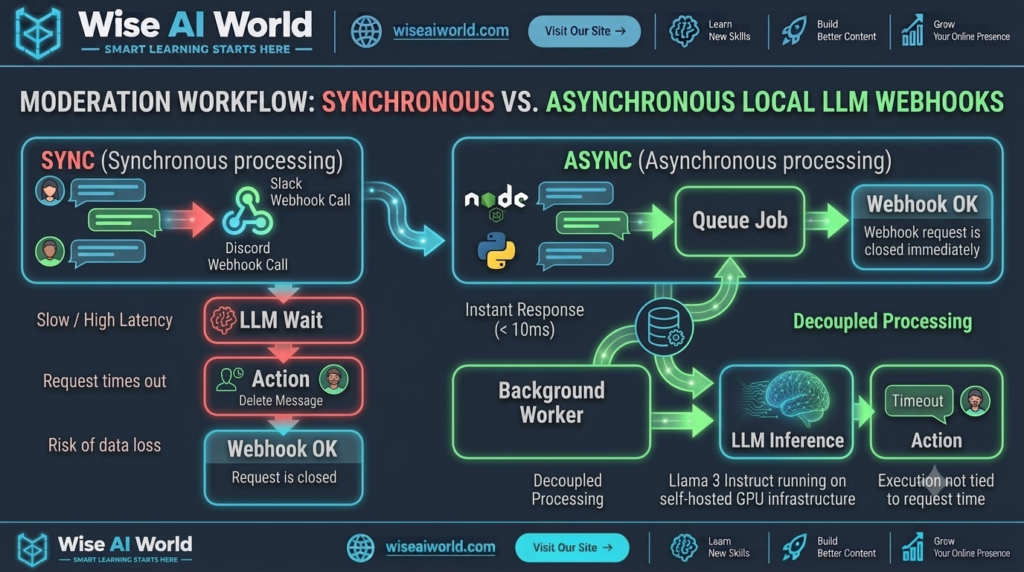
Webhook triggers typically must respond to the initiating platform within 3 seconds, or they risk timeout and retry storms. LLM inference on large models often exceeds this limit. To prevent bottlenecks, implement an **Asynchronous Moderation Queue** using Redis and BullMQ. In this architecture, the API accepts the webhook instantly (200 OK), offloads the payload to the queue, and a worker process manages the inference and subsequent actions outside the request/response cycle.
Hardware and Operational Costs
Deploying private LLMs is not “free.” You exchange marginal API costs for fixed hardware depreciation and higher operational expertise. Moderating high-volume communities (hundreds of messages per second) requires horizontal scaling of inference nodes and careful prompt optimization to reduce inference time.
Effective Prompt Engineering
Unlike conversational use cases, moderation require **deterministic**, non-creative outputs. Strict system prompts are required to force the model into behaving like a rigid classification engine. Directing the model to output specific JSON schemas (supported natively by Ollama/vLLM) guarantees that your Action Executor middleware can programmatically process the verdict every time.
5. The Strategic Case for Local LLM Moderation
Automating moderation via local LLMs through webhooks transitions community management from a reactive, vulnerable state to a proactive, semantic-aware security posture.
By self-hosting highly accurate classification engines, community leads maintain total control over their data, avoid commercial AI pricing volatility, and gain the technical capability to enforce community standards at scale. This paradigm shift secures private enterprise discussions while fostering a healthier, safer environment for large-scale digital interaction.

Manish Prakash Dubey is an AI educator and technology writer based in India. He founded WiseAIWorld to make artificial intelligence simple and practical for students, professionals, and beginners. His work focuses on AI basics, machine learning, deep learning, NLP, computer vision, and real-world AI tools.
