
Automating the Accounts Payable (AP) lifecycle is a top priority for modern finance teams. The most tedious, error-prone, and resource-intensive bottleneck in the entire process is invoice matching—the critical validation step of comparing incoming supplier invoices against purchase orders (POs) and goods receipt notes (GRNs) to ensure accuracy before payment authorization.
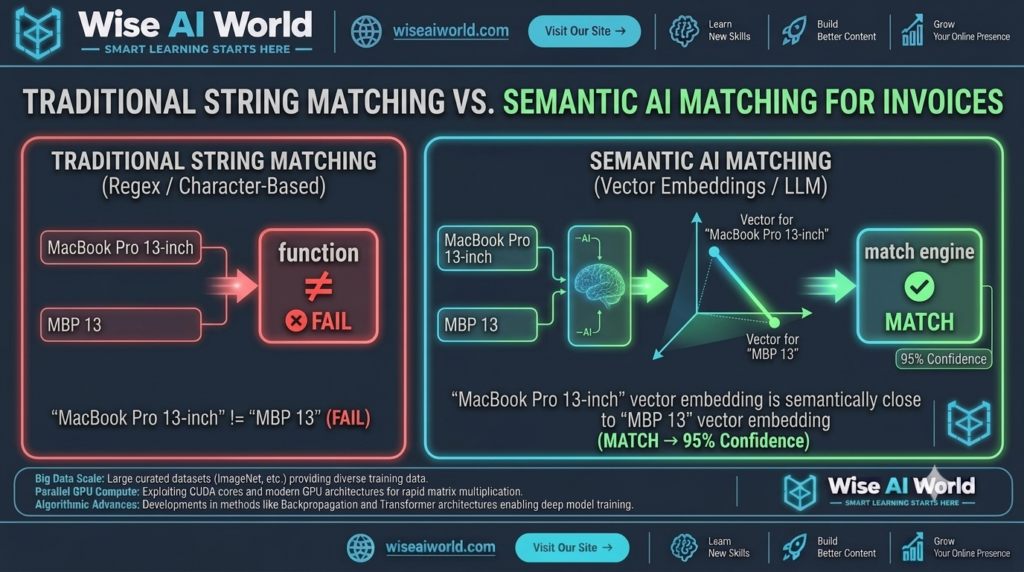
Traditional AP automation relies on rigid, template-based Optical Character Recognition (OCR) systems. These systems fail when encountered with unseen invoice layouts, require constant human maintenance, and struggle to understand the semantic context of line items (e.g., matching “13-inch MacBook Pro” on a PO to “MBP 13” on an invoice).
By leveraging generative AI, specialized Large Language Models (LLMs), and semantic vector search, engineering teams can build production-ready AI-powered invoice matching systems. These autonomous pipelines understand unstructured document context, handle infinite layout variations, and execute complex two-way or three-way matching logic without manual intervention.
In this comprehensive guide, we will break down how to architect, develop, and deploy a robust AI invoice matching system for corporate Accounts Payable.
1. System Architecture: The Autonomous Matching Pipeline
Before writing code or configuring automation nodes, we must define the technical architecture that governs data flow from document ingestion to ERP update.
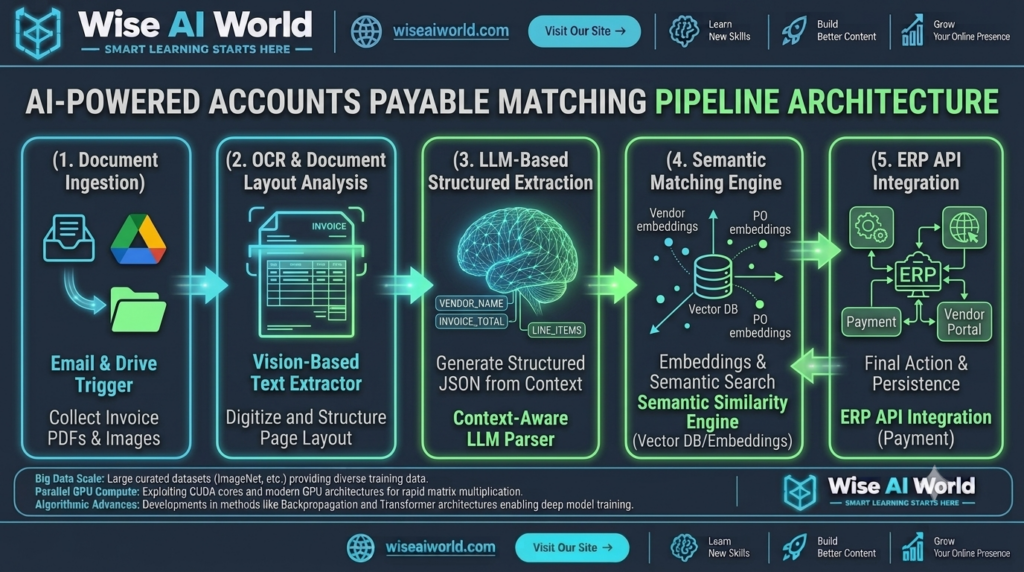
The 4 Core Architectural Modules
- 1. Document Ingestion & OCR: Captures binary PDFs or images (via email/webhooks) and converts them into searchable markdown or plain text, analyzing document structure (tables, headers, footers).
- 2. LLM Extraction Engine: Instruction-tuned models (like GPT-4o, Gemini 1.5 Pro, or Llama 3) process the unstructured OCR text against a rigid JSON schema to extract structured metadata (Invoice #, Dates, Line Items, Totals).
- 3. Vector Matching Database (Semantic Search): Line items from Purchase Orders are embedded into a vector space. The incoming invoice line items are embedded and compared via **Cosine Similarity** to identify semantic matches, bypassing exact string dependency.
- 4. Matching Logic & ERP Connector: A rules engine executes specific validation logic (Two-Way or Three-Way), applying configured tolerance thresholds (e.g., matching totals +/- 1%). Validated data is pushed to the ERP (e.g., SAP, Oracle, NetSuite) via API.
2. Core Matching Concepts: Two-Way vs. Three-Way Matching
Understanding business rules is required before implementing technical validation logic. Your matching system must support two fundamental validation types.
| Matching Type | Documents Required | Validation Goals | Typical Use Case |
|---|---|---|---|
| Two-Way Matching | Invoice + Purchase Order (PO) | Validates Invoice prices/quantities against the original PO authorization. | Service-based billing, subscriptions, recurring contracts. |
| Three-Way Matching | Invoice + PO + Goods Receipt Note (GRN) | Validates Invoice totals against *both* the PO authorization *and* the actual physical goods received. | Physical inventory, manufacturing, capital equipment. |
3. Step-by-Step implementation Guide using n8n and LLMs
In this technical implementation, we will use **n8n** (an open-source workflow automation platform) to orchestrate the pipeline and a specialized LLM for structured financial extraction.
Step 1: Document Ingestion and Layout OCR
Create a workflow in n8n triggered by an **Email Trigger** or **Webhook**. Incoming PDF invoices are received as binary data. We use a dedicated OCR engine (like AWS Textract or specialized PDF parsers) that preserves document layout and handles table structure.
Step 2: Structured financial extraction via LLM
This is where traditional OCR fails and AI succeeds. We send the raw text/markdown obtained from Step 1 to an instruction-tuned LLM node in n8n (e.g., using **Hugging Face Inference** or specialized vision models).
Use a specific prompt with a required JSON schema to force deterministic structured output:
// simplified JSON output from LLM
{
  "invoice_number": "INV-5501",
  "vendor_name": "WiseTech Global",
  "purchase_order_reference": "PO-10992",
  "invoice_total": 4500.00,
  "line_items": [
    {"description": "AI Consulting Services - Q3", "quantity": 1, "unit_price": 4500.00}
  ]
}
Step 3: Executing the Matching Logic: Vector Similarity
With structured data from the invoice (Module 1) and your existing purchase order records (Module 2, already stored in your system), we must execute the matching validation. Traditional string comparison (description_invoice === description_po) will fail consistently.
We solve this using **Semantic Vector Search**. Line item descriptions are converted into numerical vector embeddings (using models like text-embedding-ada-002 or Llama 3) and stored in a vector database (e.g., Pinecone, Qdrant, or embedded into n8n via LangChain). When an invoice arrives, its line items are embedded and compared via **Cosine Similarity** against the database.
Step 4: Handling Tolerance Thresholds and Exceptions
The rules engine (Module 3, usually a JavaScript/Python node in n8n) executes the numerical validation. We must implement matching tolerance. An invoice total may be $4500.00 while the PO authorization was for $4495.00 due to slight shipping variations. The system must accept these within configured thresholds (e.g., +/- 1% or +/- $10) and only trigger an exception for significant deviations.
4. Enterprise Considerations and Human-in-the-Loop Validation
Production AP automation requires managing reliability and failure cases gracefully.
Exception Handling (No Match / Mismatch)
When the matching logic fails (e.g., Cosine Similarity score < 85% or numerical deviations exceed tolerance), the system must *not* proceed with payment. Instead, route the problematic invoice payload to a dedicated **Exception Queue** (managed via tools like n8n’s human-in-the-loop nodes, Slack notifications, or a custom UI) for manual review by a financial analyst.
Auditing and Traceability
Financial systems require absolute traceability. For every autonomous action, your system must generate an immutable audit log detailing: the specific LLM used for extraction, the OCR confidence scores, the precise Cosine Similarity results for semantic matches, and the timestamps of all matching logic executions.
5. Summary & Technical Blueprint Summary
Building an autonomous invoice matching system transitions AP operations from manual drudgery to automated exception management. By utilizing layout OCR for structure, LLMs for schema enforcement, and vector databases for semantic context, engineering teams can build resilient pipelines that secure corporate funds while optimizing operational throughput.
| System Module | Dominant Paradigm | Typical Tooling |
|---|---|---|
| Document Ingestion | Workflow Orchestration | n8n / Slack Trigger / IMAP node |
| Text Extraction & OCR | Computer Vision / PDF Parsing | AWS Textract / native PDF parser node |
| Schema Extraction | Generative LLM | Hugging Face / OpenAI node + Instruction Prompt |
| Line Item Matching | Semantic Search (Vector Embeddings) | LangChain node + Pinecone / Qdrant / OpenAI Embeddings |
| Payment Authorization | API Integration (REST) | ERP Specific Node (SAP / Oracle NetSuite / QuickBooks) |

Manish Prakash Dubey is an AI educator and technology writer based in India. He founded WiseAIWorld to make artificial intelligence simple and practical for students, professionals, and beginners. His work focuses on AI basics, machine learning, deep learning, NLP, computer vision, and real-world AI tools.
