Have you ever asked a chatbot a question and received a useful answer within seconds? Or used a voice assistant that understood your command even when you spoke casually? These tools may feel almost human, but they work through a series of technical steps.
AI understands human language using a field called Natural Language Processing, or NLP. It helps machines process text, identify meaning, understand context, detect intent, and generate useful responses.
For beginners, the process may sound complex, but it becomes much easier when broken into simple steps. AI does not understand language like a human with emotions and life experience. Instead, it analyzes patterns in words, sentences, and context to produce the most useful output.
What Does It Mean for AI to Understand Language?
When people say AI “understands” language, they usually mean that it can process human words and respond in a useful way.
AI can perform language tasks such as:
- Answering questions
- Translating text
- Summarizing documents
- Detecting sentiment
- Classifying messages
- Finding important information
- Generating replies
- Correcting grammar
- Understanding search queries
For example, if you type “best way to learn machine learning as a beginner,” an AI system may understand that you want learning guidance, not just pages containing those exact words.
However, AI understanding is different from human understanding. A human connects language with memory, emotion, experience, culture, and common sense. AI works by analyzing patterns in data.
A simple way to explain it is this:
AI breaks language into pieces, studies patterns, identifies context, predicts meaning, and generates a response.
If you are new to this topic, first read What Is Natural Language Processing NLP Explained for Beginners.
Step 1: The AI Receives Text or Speech
The first step is input.
The user gives the AI some form of language. This may be typed text, spoken words, a search query, a document, or a message.
Examples include:
- “What is machine learning?”
- “Translate this sentence into Hindi.”
- “Summarize this article.”
- “Set an alarm for 6 AM.”
- “Is this customer review positive or negative?”
If the input is already text, the system can process it directly.
If the input is speech, the AI first needs speech recognition. Speech recognition converts spoken audio into written text.
For example, when you say, “Call Rahul,” a voice assistant first converts your voice into text. Then NLP helps understand the command.
A real-world example is voice typing on smartphones. You speak naturally, and the system turns your words into written text before analyzing or displaying them.
Step 2: The Text Is Cleaned and Prepared
After receiving the input, the AI may clean and prepare the text.
Text from real users can be messy. People may use spelling mistakes, slang, emojis, short forms, punctuation errors, or incomplete sentences.
For example:
“plz tell me wat is ai??”
A human can understand this easily. AI systems also need ways to handle this kind of input.
Text preparation may include:
- Lowercasing words
- Removing unnecessary spaces
- Handling punctuation
- Correcting spelling
- Expanding short forms
- Removing irrelevant symbols
- Identifying sentence boundaries
Not every AI system uses the same cleaning steps. Modern language models can handle many messy inputs directly, but preparation still matters in many NLP systems.
For example, a customer support system may clean messages before classifying them into categories like refund, delivery, billing, or technical issue.
Good input preparation helps the AI avoid confusion and produce better results.
Step 3: The Text Is Broken Into Tokens
The next step is tokenization.
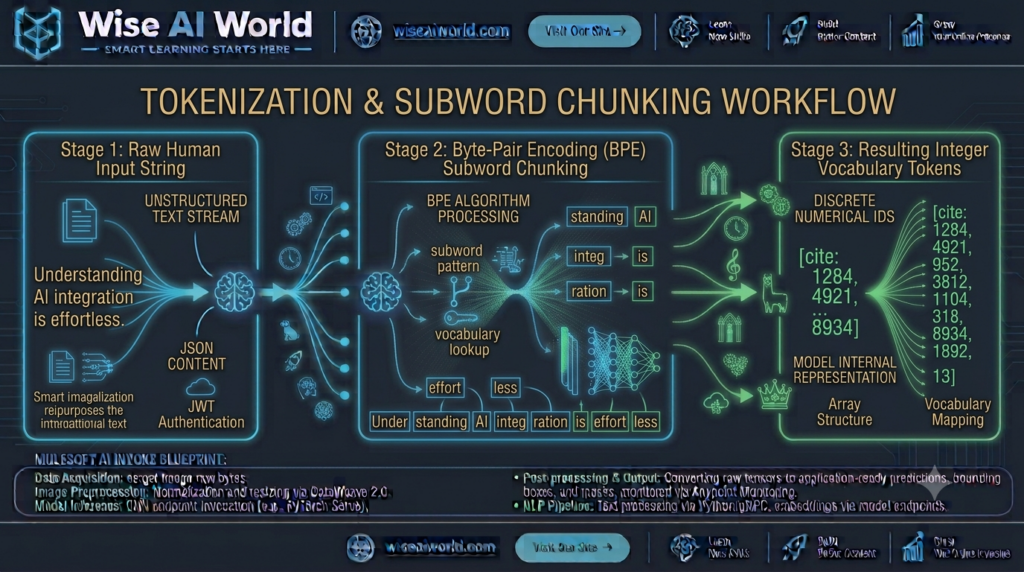
Tokenization means breaking text into smaller pieces called tokens.
A token can be:
- A word
- Part of a word
- A punctuation mark
- A number
- A symbol
For example, the sentence:
“AI helps students learn faster.”
May be broken into tokens like:
- AI
- helps
- students
- learn
- faster
- .
Modern AI models sometimes break words into smaller pieces. This helps them handle uncommon words, names, spelling variations, and different languages.
For example, a long word may be split into smaller meaningful parts.
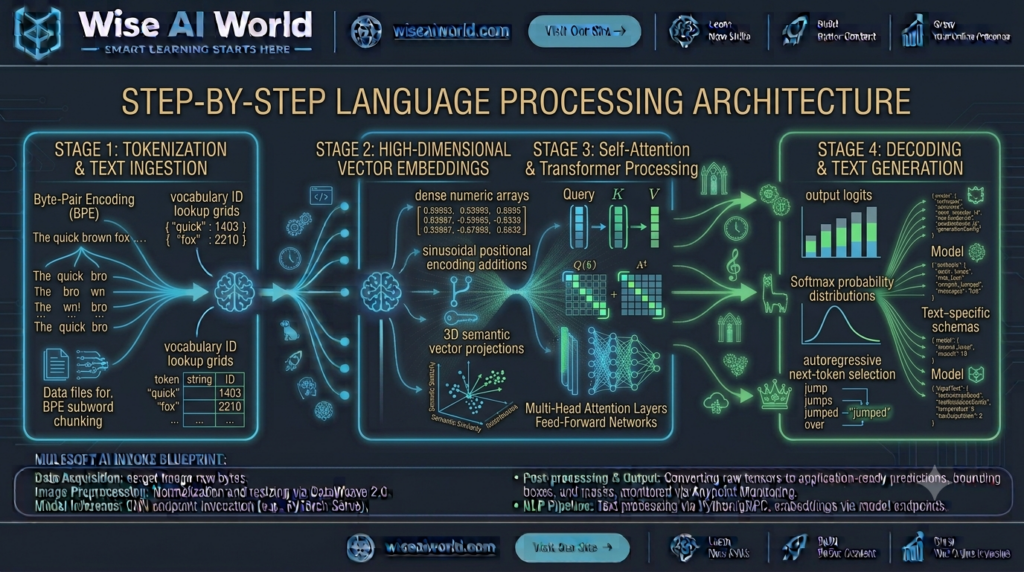
Tokenization is important because AI models do not process language as full paragraphs the way humans read. They process tokens mathematically.
A practical example is a chatbot. Before generating a response, it breaks your prompt into tokens and analyzes how those tokens relate to each other.
Step 4: Tokens Are Converted Into Numbers
Computers do not understand words directly. They process numbers.
After tokenization, each token is converted into numerical form. These numbers represent language patterns that the AI model can analyze.
One important idea is called embeddings.
An embedding is a numerical representation of a word, phrase, or token. It helps the AI understand relationships between words.
For example, words like “king,” “queen,” “man,” and “woman” may have related numerical patterns because they appear in related contexts.
Similarly, words like “doctor,” “hospital,” “patient,” and “medicine” may be close in meaning.
Embeddings help AI understand that words can be related even if they are not identical.
For example, if someone searches “cheap mobile phone,” the AI may understand that “budget smartphone” is related, even though the words are different.
This is one reason modern search engines and chatbots can understand meaning better than old keyword-based systems.
Step 5: The AI Looks for Meaning and Context
Human language depends heavily on context.
The same word can mean different things in different situations.
For example:
- “I went to the bank” may mean a financial bank.
- “I sat near the river bank” means the side of a river.
AI must look at surrounding words to understand the correct meaning.
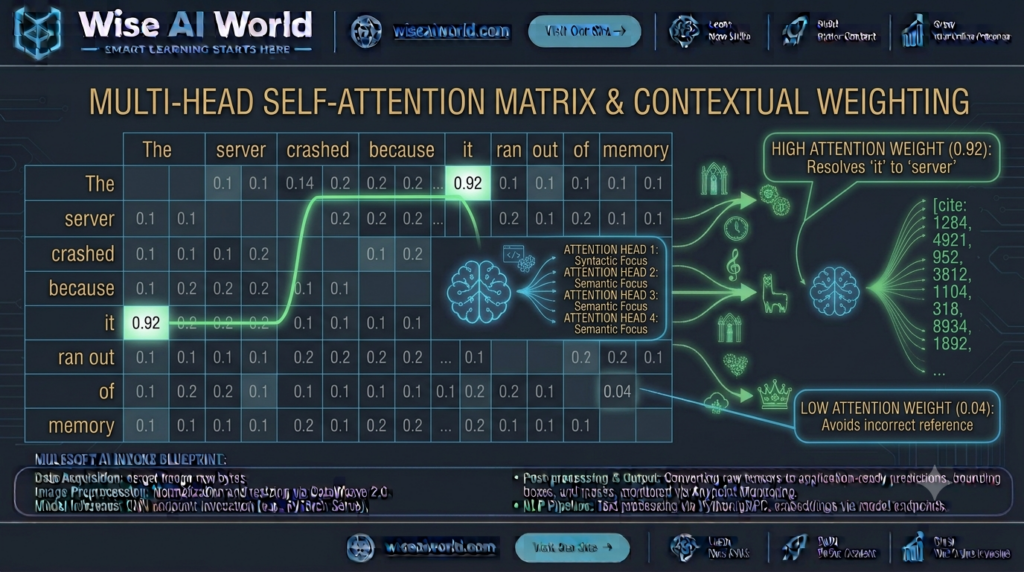
This is called context understanding.
Modern AI models analyze how words relate to nearby words and sometimes to the full sentence or paragraph.
For example, in the sentence:
“Apple released a new iPhone.”
The word “Apple” likely means the company.
But in the sentence:
“She ate an apple after lunch.”
The word “apple” means the fruit.
A good language model uses context to choose the correct interpretation.
Context is also important in conversations. If you ask:
“What is machine learning?”
Then follow with:
“How is it different from deep learning?”
The AI should understand that “it” refers to machine learning.
This ability makes conversations feel more natural.
Step 6: The AI Detects Intent
Intent means what the user wants to do.
Understanding intent is very important in chatbots, search engines, and voice assistants.
For example, the sentence:
“Can you show me nearby restaurants?”
The intent is not just asking whether the assistant has the ability. The user wants restaurant suggestions.
Common user intents include:
- Asking a question
- Requesting a summary
- Making a booking
- Searching for information
- Giving a command
- Asking for translation
- Reporting a problem
- Requesting a recommendation
A customer support chatbot may classify messages by intent.
For example:
- “Where is my order?” means order tracking.
- “I want my money back” means refund request.
- “I forgot my password” means account recovery.
- “The app is not opening” means technical support.
Intent detection helps the AI choose the right action or response.
Step 7: The AI Uses Its Model to Predict the Best Output
Once the AI processes tokens, numbers, context, and intent, it uses its trained model to produce an output.
A model is the trained AI system that has learned patterns from data.
For a chatbot, the model predicts what response is most likely to be useful.
For a translation tool, the model predicts the correct sentence in another language.
For a sentiment analysis tool, the model predicts whether the text is positive, negative, or neutral.
For example, if you type:
“Explain AI in simple words.”
The model may generate a beginner-friendly explanation because it recognizes the user wants a simple explanation, not a technical research paper.
Modern language models generate text step by step, often predicting the next token based on the previous tokens and context.
This is why prompts matter. A clear prompt gives the model better direction.
For example:
“Explain neural networks in simple language with an example”
will usually produce a better answer than:
“neural network?”
Step 8: The AI Generates a Response
After predicting the best output, the AI generates a response.
The response may be:
- A sentence
- A paragraph
- A list
- A summary
- A translation
- A label
- A command action
- A recommendation
For example, a chatbot may answer a question. A search engine may show ranked results. A grammar tool may suggest corrections. A voice assistant may set an alarm.
The quality of the response depends on several things:
- The user’s input
- The model’s training
- Available context
- Data quality
- System design
- Safety rules
- Current information access
For example, if a user asks a vague question, the AI may give a broad answer. If the user provides specific details, the AI can respond more accurately.
This is why learning how to ask clear questions is useful when using AI tools.
Step 9: The AI May Learn From Feedback
Some AI systems improve through feedback.
Feedback can come from users, developers, reviewers, or updated data.
For example:
- A user marks a chatbot answer as helpful.
- A user corrects an email spam filter.
- A person clicks one search result instead of another.
- A customer support agent labels a message correctly.
- Developers update the model with better training examples.
Feedback helps improve future performance.
However, not every AI tool learns instantly from each user conversation. Many systems collect feedback, review it, and use it later to improve models safely.
A practical example is an email app. If you mark an email as “not spam,” the system may use that feedback to improve future spam filtering.
Why AI Still Makes Language Mistakes
AI language systems are powerful, but they are not perfect.
They can make mistakes because language is complex.
Common problems include:
- Misunderstanding sarcasm
- Missing cultural context
- Confusing similar meanings
- Producing outdated information
- Giving confident but incorrect answers
- Struggling with vague questions
- Reflecting bias from training data
- Misinterpreting emotional tone
For example, if someone writes:
“Great, another software bug.”
The word “great” is positive, but the sentence is likely sarcastic. AI may struggle if it misses the tone.
Another example is vague wording. If someone asks:
“Is this good?”
The AI may not know what “this” refers to unless more context is provided.
This is why human review is important, especially for serious topics like health, finance, law, education, and career decisions.
AI should support human thinking, not replace it completely.
Real-World Example: How a Chatbot Understands a Question
Let’s walk through a simple chatbot example.
User asks:
“How do I learn AI from scratch?”
The AI may process it like this:
- Receives the text input.
- Breaks the sentence into tokens.
- Converts tokens into numerical representations.
- Understands that “AI” means artificial intelligence.
- Detects the intent: the user wants beginner learning guidance.
- Looks at context: “from scratch” means beginner level.
- Predicts a helpful answer.
- Generates a step-by-step learning path.
- May suggest related topics like machine learning, deep learning, and NLP.
A good response might include:
- Start with AI basics.
- Learn machine learning fundamentals.
- Study Python basics.
- Practice with small projects.
- Explore deep learning later.
- Use beginner-friendly tools and tutorials.
This example shows how language understanding is built from many smaller steps.
You can also read How Does AI Actually Work A Beginner Friendly Explanation to understand the broader AI process.
Key Takeaways
- AI understands human language through Natural Language Processing.
- The process starts with text or speech input.
- Text is broken into tokens and converted into numbers.
- AI models analyze meaning, context, and user intent.
- The model predicts and generates a useful output.
- AI can handle many language tasks, but it can still misunderstand context, sarcasm, or vague questions.
Conclusion
AI understands human language by following a series of steps: receiving input, preparing text, breaking it into tokens, converting tokens into numbers, analyzing context, detecting intent, and generating a response. The process may feel natural to users, but behind the scenes it is based on data, patterns, and prediction.
For beginners, the most important idea is simple: AI does not understand language exactly like humans do. It uses mathematical patterns to process words and produce useful answers. This makes it powerful, but not perfect.
Next, you can learn about large language models and how they power modern AI chatbots. Which part of AI language understanding feels most interesting to you: tokens, context, intent, or response generation?
Manish Prakash Dubey is an AI educator and technology writer based in India. He founded WiseAIWorld to make artificial intelligence simple and practical for students, professionals, and beginners. His work focuses on AI basics, machine learning, deep learning, NLP, computer vision, and real-world AI tools.