Searching for “best AI course” in 2026 returns an overwhelming wall of options. Free courses from Google and Microsoft sit alongside paid specializations from Stanford-affiliated instructors, certification programs from AWS, and budget courses on Udemy. Most of these resources are genuinely good, which makes the real challenge not finding a course, but choosing the right one for your specific goals and avoiding the trap of collecting certificates without building real skills.

This article cuts through the noise with a curated list of the best free and paid AI and machine learning courses available in 2026, what each one actually teaches, who it is best suited for, and how to combine these resources into a learning path that genuinely builds toward a career or practical skill set, as outlined in our guide on .

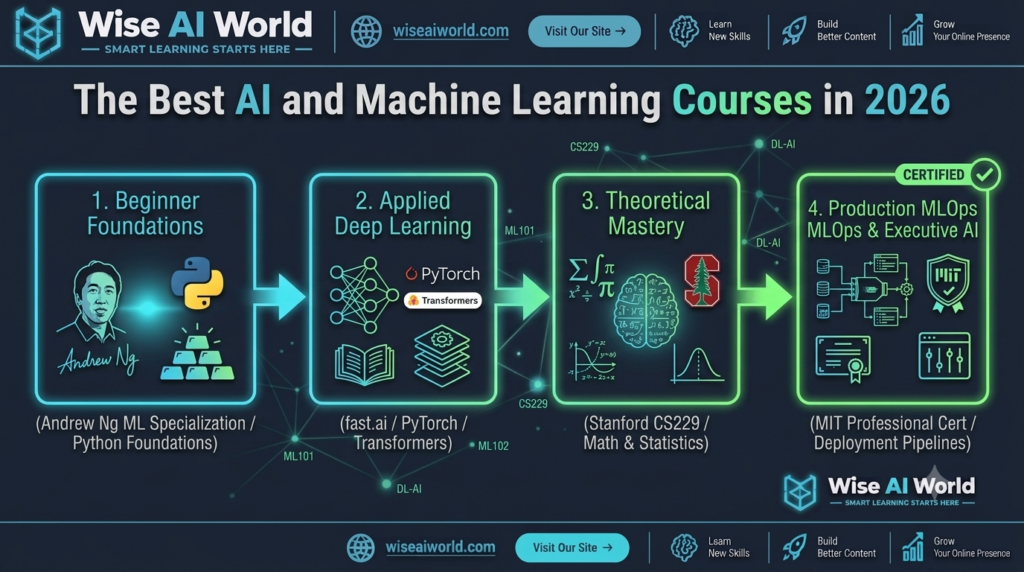
Infographic showcasing the best free and paid AI and Machine Learning courses in 2026, including beginner and advanced learning paths, online certifications, Python, deep learning, NLP, data science, and career-focused AI education resources.
A comprehensive infographic highlighting the best AI and Machine Learning courses in 2026, featuring free and paid learning options, essential skills, career paths, certifications, and recommended platforms for beginners and professionals.

How to Choose Between Free and Paid Courses

Before diving into specific courses, it helps to understand what free and paid options actually offer differently, because the difference is not always what people assume.

Free courses from major technology companies are often excellent in content quality. According to ScriptByAI, companies like Google, Microsoft, and NVIDIA release premium education for free because they want learners to build on their platforms. The content itself is frequently comparable in quality to paid alternatives. What free courses typically lack is a recognized certificate or credential that carries weight on a resume, and sometimes structured cohort support or guided projects.

Paid courses and certifications add value primarily through brand recognition, structured curricula with graded assignments, and in some cases access to instructors or communities. According to Dataquest, a certification with a strong brand name behind it can create immediate credibility on a resume, particularly for career changers without a traditional technical background.

According to EduBracket’s 2026 comparison, the combination that actually gets people hired is a recognized certificate paired with a portfolio of three or more real projects using genuine data, plus the ability to explain those projects and their business value clearly. No single course, free or paid, does all of this on its own.

Best Free Courses for Absolute Beginners

Google AI Essentials

Google AI Essentials is consistently recommended as the best starting point for complete beginners. According to CloudSoftSol, the course covers generative AI fundamentals, productivity applications, effective prompting techniques, and responsible AI practices, all in under 10 hours. It requires no coding background and is designed for professionals, students, educators, and small business owners who want practical AI literacy rather than technical depth.

This course is offered through Grow with Google and is free to access, with a shareable completion certificate suitable for LinkedIn profiles. It pairs well with our beginner guide on for building conceptual understanding alongside practical skills.

Google Machine Learning Crash Course

For those ready to move beyond AI literacy into actual machine learning concepts, Google’s Machine Learning Crash Course is widely regarded as one of the best free structured introductions available. According to EduBracket, the course runs approximately 15 hours, is well produced, and focuses on TensorFlow, Google’s open-source machine learning framework.

The course is completely free, hosted directly on developers.google.com with no account required and no paywall. It was originally created for Google’s own engineers and made public, then updated in 2024 and 2025 to include large language models and modern best practices.

Microsoft AI for Beginners

Microsoft publishes a comprehensive 24-lesson curriculum as open-source material on GitHub, covering symbolic AI, neural networks, , , and AI ethics. According to ScriptByAI, this is completely free with all lessons, labs, and code examples hosted on GitHub, and notably includes a dedicated module on Transformers, the architecture behind modern large language models, which some older free curricula from 2019 do not cover.

This course is particularly well suited for learners who prefer self-paced, code-along learning and want broad coverage across multiple AI subfields in one structured curriculum.

fast.ai Practical Deep Learning

fast.ai takes a fundamentally different teaching approach from most courses. According to EduBracket, it uses a top-down method where you build a production-quality image classifier in the very first lesson, then progressively understand the underlying theory as you go, rather than spending weeks on mathematical foundations before writing any code.

This course is completely free and is particularly well suited for people who learn best by building things first and understanding theory through practice, rather than through traditional lecture-based instruction. It connects well with concepts covered in our guide on .

Best Paid Courses for Building Real Machine Learning Skills

Machine Learning Specialization by Andrew Ng (DeepLearning.AI and Stanford)

This course is repeatedly described as the gold standard for learning machine learning. According to Dataquest, over 4.8 million people have taken Andrew Ng’s machine learning courses, and the curriculum covers supervised learning including regression and classification, neural networks, decision trees, and recommender systems, alongside best practices for real machine learning projects.

According to The Interview Guys, the course costs between 98 and 399 US dollars depending on how quickly you complete it, since Coursera charges a monthly subscription of around 49 US dollars and most learners finish in two to three months. The review notes the Stanford and DeepLearning.AI branding combined with Andrew Ng’s reputation creates immediate credibility on a resume, though it is honest that the certification alone will not make you a machine learning engineer. What you do after completing it, building projects, networking, and continuing to learn, determines whether the investment pays off.

This course was updated in 2024 to use Python instead of the older Octave-based version, and now incorporates deep learning fundamentals alongside traditional machine learning, making the older 2011 version obsolete according to EduBracket.

Deep Learning Specialization by Andrew Ng (DeepLearning.AI)

For learners who have completed foundational machine learning and want to go deeper into neural networks, the Deep Learning Specialization is the natural next step. According to Dataquest, this five-course program covers neural networks and deep learning fundamentals, convolutional neural networks for image tasks, recurrent neural networks for sequences, and the Transformer architecture that powers modern language models.

The cost is approximately 59 US dollars per month on Coursera, with most learners completing it in around five months for a total of roughly 295 US dollars. According to The Interview Guys, deep learning engineers earn between 132,000 and 192,000 US dollars in total compensation in the US market, making this one of the highest return-on-investment certifications available for under 300 US dollars. The review notes that learners will still need to supplement this with practical experience in PyTorch, generative AI, and MLOps tools to be fully competitive for 2026 roles, and that complete beginners with no Python experience should build basic programming skills first.

Deep Learning AI Specialization for Generative AI

For learners specifically interested in working with large language models and generative AI tools rather than traditional machine learning, newer specializations from DeepLearning.AI focus on prompt engineering, retrieval-augmented generation, fine-tuning, vector databases, and building applications with generative AI agents. According to Coursera, these courses cover practical skills including PyTorch, large language modeling, and generative AI agent development, which directly map to the applied AI engineering roles described in our career roadmap.

Best Budget-Friendly Practical Option

Machine Learning A-Z on Udemy

For learners who want broad, hands-on coverage of machine learning algorithms without the cost of a subscription-based specialization, Machine Learning A-Z on Udemy is frequently recommended. According to EduBracket, this course is available for around 15.99 US dollars during Udemy’s frequent sales and provides comprehensive coverage of every major machine learning algorithm with working Python implementations.

This option is particularly well suited for learners who want a single, one-time purchase rather than a recurring subscription, and who prefer learning through a large volume of practical coding examples covering a wide range of algorithms in one place.

Certifications vs Certificates: Understanding the Difference

An important distinction that confuses many learners is the difference between a certification and a certificate. According to Dataquest, a certification requires passing a standardized exam, such as the AWS Certified Machine Learning Engineer credential, while a certificate simply means you completed a structured course or program, such as Andrew Ng’s Machine Learning Specialization.

Certifications involve formal testing and are often required or preferred by specific employers, particularly for cloud-related roles. Certificates demonstrate completion of structured learning and projects but do not involve a standardized exam. Neither is strictly necessary for employment, since many employers prioritize the ability to build working systems over formal credentials, but both can help, particularly when breaking into the field or switching careers, and work best when combined with a portfolio of real projects.

How to Build a Learning Path From These Courses

Rather than picking one course and hoping it covers everything, the most effective approach combines free and paid resources strategically based on your starting point and goals.

If you are completely new to AI, start with Google AI Essentials for general literacy, which takes under 10 hours and costs nothing. From there, if you want to understand AI conceptually without coding, our own foundational guides on and provide free context that makes any subsequent course easier to follow.

If your goal is a technical role such as machine learning engineer or data scientist, Andrew Ng’s Machine Learning Specialization remains the most consistently recommended starting point for building genuine conceptual and practical foundations, followed by the Deep Learning Specialization if you want to work with neural networks, computer vision, or natural language processing professionally.

If budget is the primary constraint and you want maximum hands-on coding practice, fast.ai’s free Practical Deep Learning course combined with Udemy’s Machine Learning A-Z provides extensive practical experience at minimal or no cost, though without the brand recognition of the Coursera specializations.

Regardless of which courses you choose, the consistent advice across every source is the same: courses alone do not lead to jobs. Building real projects with your own data, documenting them clearly, and being able to discuss the decisions you made and why, is what ultimately matters most when applying for roles.

Key Takeaways

  • Google AI Essentials is the best free starting point for complete beginners, covering generative AI fundamentals in under 10 hours with no coding required.
  • Google’s Machine Learning Crash Course and Microsoft’s AI for Beginners on GitHub are excellent free structured introductions to core machine learning and AI concepts.
  • Andrew Ng’s Machine Learning Specialization, taken by over 4.8 million people, remains the gold standard paid course for building genuine machine learning foundations, costing roughly 98 to 399 US dollars.
  • The Deep Learning Specialization is the natural next step for neural networks, computer vision, and language model foundations, costing around 295 US dollars for most learners.
  • Machine Learning A-Z on Udemy offers broad practical coverage for around 16 US dollars as a one-time purchase, ideal for budget-conscious learners.
  • No course alone leads to a job. The combination that works is a recognized certificate, a portfolio of real projects, and the ability to explain those projects clearly.

Conclusion

The good news for anyone learning AI and machine learning in 2026 is that excellent resources exist at every price point, including completely free options from Google and Microsoft that rival paid alternatives in content quality. The real work lies not in finding a course, but in choosing one that matches your goals, completing it with genuine effort, and translating what you learn into real projects you can show.

For a complete picture of how courses fit into a broader career strategy, including timelines, salary expectations, and portfolio building, read our full guide on .

Sources

By Manish Prakash Dubey

Manish Prakash Dubey is an AI educator and technology writer based in India. He founded WiseAIWorld to make artificial intelligence simple and practical for students, professionals, and beginners. His work focuses on AI basics, machine learning, deep learning, NLP, computer vision, and real-world AI tools.

Leave a Reply

Your email address will not be published. Required fields are marked *