
Three years ago, artificial intelligence was something most small business owners read about in technology headlines but did not feel was relevant to their day-to-day operations. That has changed completely. According to the US Chamber of Commerce, the rate of AI adoption among small businesses jumped from 23 percent in 2023 to 40 percent in 2024 to 58 percent in 2025, and AdAI News reports that 76 percent of small businesses are now either actively using AI or exploring it.
The most significant shift is not the adoption rate itself but what is driving it. Small businesses are not adopting AI because of hype. They are adopting it because it delivers measurable results in the specific workflows where they need the most help, particularly marketing, customer service, and administration, and because the tools have become affordable and accessible enough to use without technical expertise.
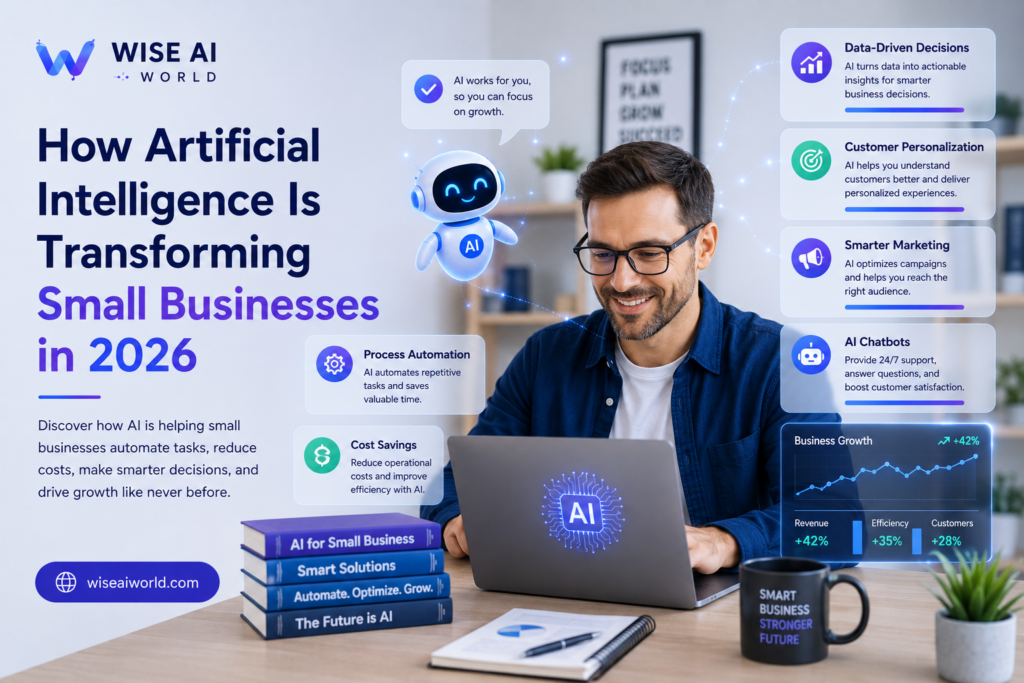
Why AI Matters Differently for Small Businesses Than Large Ones
Large enterprises have always had access to expensive custom software, dedicated IT teams, and specialized staff for every function. Small businesses have historically competed at a structural disadvantage because they cannot afford those resources. is changing this dynamic in a meaningful way.
According to ColorWhistle’s 2026 analysis, over two-thirds of US small businesses now use AI regularly to automate tasks, personalize customer service, and optimize marketing, enabling growth without requiring deep technical skills or large teams. A sole trader with a laptop and a 20 US dollar per month AI subscription can now produce marketing content, respond to customer inquiries around the clock, analyze sales data, and manage scheduling at a level that previously required a team of specialists.
According to AdAI News, growing small and medium businesses are 83 percent likely to have adopted AI compared to 55 percent of declining businesses, and 91 percent of small businesses using AI report that it boosts their revenue according to Salesforce data. The correlation between AI adoption and business performance has become one of the most consistent findings in small business research.
The Five Areas Where AI Is Transforming Small Businesses Most
1. Marketing and Content Creation
Marketing is the entry point where more small businesses experience their first AI return on investment than any other function. According to Capsule CRM’s 2026 adoption statistics, 55 percent of AI-using small businesses use it for content generation including emails, social posts, marketing copy, and product descriptions, and 54 percent use AI marketing tools, with another 27 percent planning adoption within the next 12 months.
The time savings are significant and well documented. According to HubSpot’s 2025 State of Marketing report, cited by Stealth Agents, AI-using small businesses save 5 to 15 hours per week on content work alone. At a conservative 25 US dollars per hour, that represents between 6,500 and 19,500 US dollars in reclaimed time annually from a single use case.
A practical example from Digital Applied illustrates this clearly: a marketing coordinator who previously spent four hours drafting a week’s worth of social media posts can produce the same output in under an hour with AI assistance. This is not a marginal improvement. For a small business owner who handles marketing alongside operations, sales, and customer service, it can represent the difference between having a consistent marketing presence and having none at all.
AI tools used most commonly for small business marketing in 2026 include and for content drafting and ideation, Canva AI for visual design, and platform-native AI features within Google Ads and Meta Ads for campaign optimization.
2. Customer Service and Chatbots
Customer service is the second most impactful area, and for many small businesses it is the one that delivers the most immediately visible ROI. According to Omago’s SME adoption analysis, 51 percent of US small businesses that have adopted AI are using it for customer service, answering enquiries, handling frequently asked questions, and managing after-hours messages. This is the most common entry point because the return on investment is immediate and measurable.
AI-powered chatbots can handle 40 to 60 percent of routine customer inquiries without human intervention, including order status checks, return policy questions, appointment scheduling, and basic troubleshooting according to Digital Applied. For a small business that cannot afford dedicated customer support staff, this is genuinely transformative. Case studies cited by Omago consistently show 30 percent faster response times, three times more qualified leads captured, and 30 percent higher conversion rates after implementing AI messaging for customer-facing interactions.
The barrier to entry is also lower than most small business owners expect. Platforms like Tidio, Intercom, and similar tools offer free tiers or trials that allow businesses to deploy a basic AI customer service layer in 15 to 20 minutes without any technical background.
3. Data Analysis and Business Intelligence
According to Capsule CRM, using Thryv data from July 2025, data analysis is the most common AI use case among small businesses at 62 percent, driven by the measurable return on investment of faster reporting and forecasting. Small businesses are using AI tools to analyze sales data, identify trends in customer behavior, forecast inventory needs, and generate reports that previously required a dedicated analyst or several hours of manual spreadsheet work.
4. Administration and Workflow Automation
Administrative tasks including email management, scheduling, invoicing, and document preparation are consistent time drains for small business owners who typically wear multiple hats. AI tools are now addressing these systematically.
Email AI features in Gmail and Outlook can draft replies, summarize long threads, and categorize incoming messages automatically. Scheduling tools powered by AI can manage appointment booking, send reminders, and handle rescheduling without manual intervention. Automation platforms like Zapier can connect AI tools to existing business software, so that a customer inquiry from a website form automatically triggers a personalized AI-drafted response, a CRM entry, and a follow-up task, all without human involvement.
According to Capsule CRM, 63 percent of AI-using small businesses have embedded AI into their daily workflows rather than using it occasionally, reflecting how quickly these tools move from experiment to operational necessity once they start delivering reliable results.
5. Financial Management and Decision Making
AI is increasingly helping small businesses with cash flow forecasting, expense categorization, and financial reporting. Modern accounting platforms including QuickBooks and Xero have integrated AI features that automatically categorize transactions, flag anomalies, and generate plain-language summaries of financial performance.
Beyond bookkeeping, AI is supporting better business decision-making. Small business owners are using AI tools to research competitors, analyze market trends, evaluate pricing strategies, and stress-test business plans, tasks that previously required expensive consultants or simply went undone. According to AdAI News, small business owners who invest in AI are nearly twice as likely to report year-over-year revenue growth, with the correlation strengthening as AI-enabled businesses compound efficiency gains year over year.
Real-World Example: What AI Adoption Looks Like in Practice
Consider a small retail business with five employees. Before AI adoption, the owner spent two hours every Monday drafting the week’s social media posts, another hour responding to routine customer emails, and half a day at month end compiling sales reports.
After AI adoption, social media content is drafted by ChatGPT from a brief weekly summary and reviewed in 20 minutes. A Tidio chatbot handles 50 percent of routine customer inquiries automatically. Excel with Copilot generates the monthly sales report in under 10 minutes from a data export. The owner has reclaimed roughly 10 hours per week, which can be redirected toward customer relationships, new product development, or simply working fewer hours.
This pattern, not exotic AI but practical automation of specific repetitive tasks, is what the data consistently shows drives real ROI for small businesses. According to Stealth Agents, most small businesses find their first real ROI within the first 60 days, usually in marketing or customer service.
The Barriers Small Businesses Still Face
Despite strong adoption momentum, meaningful barriers remain. According to AdAI News, 51 percent of small business owners describe themselves as AI explorers, testing tools without full commitment. The three most common barriers are lack of clear ROI evidence cited by 74 percent, tools that are not easy enough to use cited by 73 percent, and lack of practical training cited as the top support need.
According to USM Systems, only 8 percent of businesses reach advanced AI adoption levels, with most remaining in early or experimental stages, investing in one or two use cases without a broader strategy for how AI fits into the business longer term. The businesses that benefit most are not necessarily the ones with the largest budgets but the ones with the clearest policies, trained teams, and the discipline to measure results before scaling.
Privacy and security concerns also deserve attention. Any AI tool processing customer data needs to comply with relevant privacy regulations, and small business owners should check the privacy policies of tools they use to understand how data is handled. You can read more about these considerations in our article on .
How to Start: A Practical Approach for Small Business Owners
The most consistent advice from small business AI adoption research is to start with one specific, high-frequency, low-risk task rather than attempting a broad transformation. According to Digital Applied, the competitive advantage does not come from using AI. It comes from using AI well, which means targeting high-ROI workflows, establishing basic governance, and following a phased approach that builds capability without overwhelming your team or your budget.
A practical starting point for most small businesses is choosing one of the three highest-ROI entry points: content creation using ChatGPT or Gemini for marketing materials, customer service using a chatbot platform like Tidio or Intercom, or data analysis using AI features in existing accounting or spreadsheet software. According to Omago, the jump from “not using AI” to “AI handles my after-hours customer messages” is smaller than most business owners expect, often just 15 to 20 minutes of setup.
For a framework to choose which tool is right for your specific needs, read our guide on .
Key Takeaways
- Small business AI adoption jumped from 23 percent in 2023 to 58 percent in 2025, with 76 percent of small businesses now either using or actively exploring AI.
- 91 percent of small businesses using AI report it boosts their revenue according to Salesforce, and growing businesses are 83 percent more likely to have adopted AI than declining ones.
- The five highest-impact areas are marketing and content creation, customer service chatbots, data analysis, workflow automation, and financial management.
- AI-using small businesses save 5 to 15 hours per week on marketing tasks alone according to HubSpot, equivalent to 6,500 to 19,500 US dollars in reclaimed time annually at 25 US dollars per hour.
- AI-powered chatbots handle 40 to 60 percent of routine customer inquiries without human intervention, with documented results of 30 percent faster response times and three times more qualified leads.
- Most small businesses find their first real ROI within 60 days, typically starting with marketing or customer service as the entry point.
Conclusion
The transformation of small businesses through AI is not a future possibility. It is a current reality playing out across every industry and every size of business. The gap between small businesses using AI strategically and those still waiting to see what happens is widening measurably every month, and the data consistently shows that the businesses investing in AI are growing faster, working more efficiently, and competing more effectively than those that are not.
The good news is that the starting point has never been more accessible. One tool, one use case, 60 days of consistent use, and the results become clear enough to guide the next step. To continue learning about how AI is reshaping specific industries and functions, read our articles on , , and .
Sources
- Capsule CRM: Small Business AI Adoption Statistics 2026
- AdAI News: Small Business AI Statistics 2026
- Stealth Agents: AI Adoption Statistics for Small Businesses 2026 Report
- Omago: SME AI Adoption in 2026 What the Data Actually Shows
- Digital Applied: Small Business AI Adoption 68 Percent Use It Most Wing It 2026
- ColorWhistle: Artificial Intelligence Statistics for Small Business 2026
- USM Systems: Small Business AI Adoption Statistics 2025

Manish Prakash Dubey is an AI educator and technology writer based in India. He founded WiseAIWorld to make artificial intelligence simple and practical for students, professionals, and beginners. His work focuses on AI basics, machine learning, deep learning, NLP, computer vision, and real-world AI tools.
