
Architecting enterprise AI automation pipelines requires choosing between two fundamentally different infrastructure paradigms: a cloud-native visual integration platform like Make.com, or a fair-code, self-hostable orchestration engine like n8n.
For simple CRUD webhooks and low-frequency tasks, both platforms perform admirably. However, when building high-throughput AI agent loops, vector database embeddings, and large language model (LLM) orchestration pipelines, the technical differences in execution limits, memory footprint, data privacy compliance, and cost scaling become critical factors.
In this technical benchmark, we evaluate n8n against Make.com across execution architecture, API payload limits, security boundaries, and real-world operational costs at scale.
Architectural Overview: Node Engine vs Cloud Queue
The core distinction between n8n and Make.com lies in how execution workloads are queued, processed, and memory-allocated.
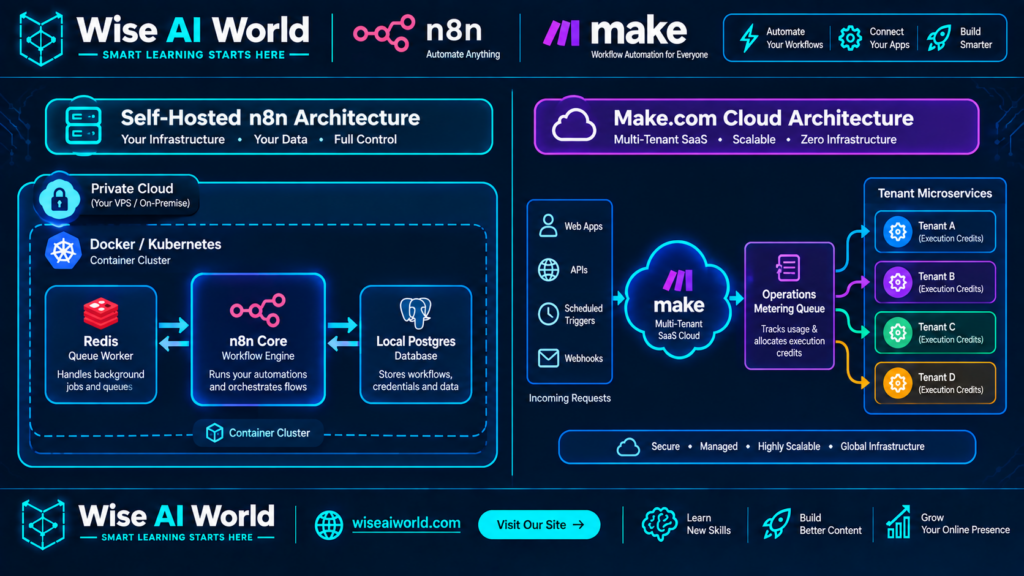
1. Make.com: Cloud-Managed Multi-Tenant Engine
Make.com operates as a fully managed SaaS infrastructure. Every action, HTTP request, or conditional router execution counts as a discrete “operation.” While this eliminates DevOps overhead, it introduces hard concurrency throttles and execution timeouts (typically 40 seconds per module attempt), making long-running AI chain loops challenging to manage without modular webhook chaining.
2. n8n: Native JavaScript/Node.js Workflow Orchestrator
n8n is built on a Node.js engine and can be self-hosted on your own infrastructure (AWS EC2, GCP Cloud Run, or on-premise Kubernetes). Instead of billing per modular step, n8n executes complete workflow runs. In a self-hosted instance, your operational ceiling is governed directly by your server’s vCPU and RAM provisioning rather than synthetic operations counters.
| Architecture Dimension | Make.com (SaaS) | n8n (Self-Hosted / Cloud) |
|---|---|---|
| Billing Metric | Per Operation (Each module step = 1 unit) | Per Execution (Self-hosted: Unlimited steps) |
| Execution Timeout | Hard limit (40s – 300s depending on plan) | Configurable via EXECUTIONS_TIMEOUT env var |
| Payload Size Ceiling | Strict 5MB – 40MB file payload limit | Hardware bound (Configurable Node memory limit) |
| Custom Code Support | Basic JavaScript formulas & IML expressions | Full JavaScript / Python runtime execution |
| LangChain & Vector Integration | Requires manual HTTP endpoints or third-party wrappers | Native LangChain AI sub-nodes & vector stores |
AI Automation Workloads: Vector Embeddings & LLM Chains
When running AI workloads—such as batch processing PDF documents for Retrieval-Augmented Generation (RAG)—the difference between these platforms becomes immediately clear.
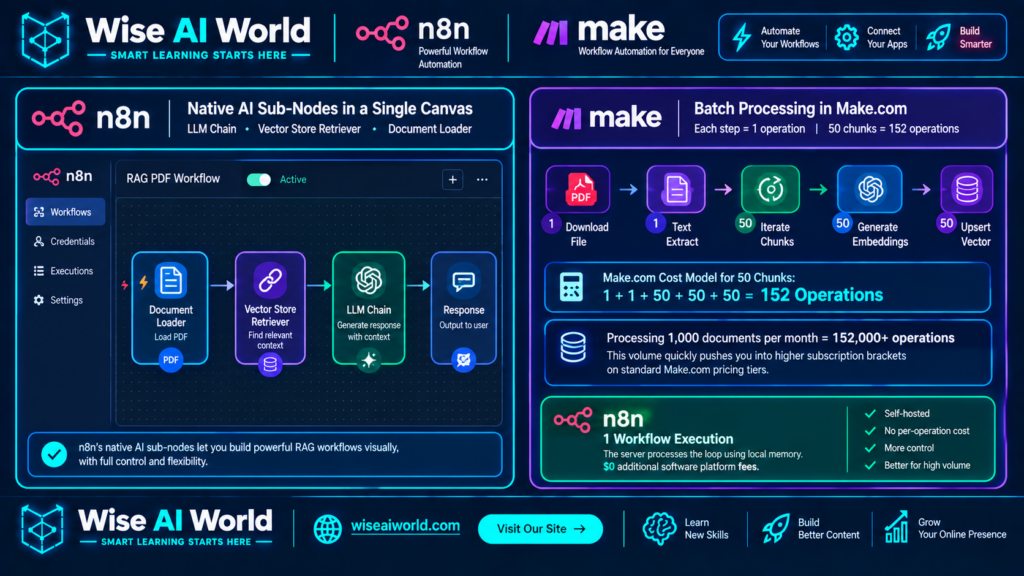
Batching and Payload Ingestion
In Make.com, processing a 50-page PDF document involves parsing text, splitting it into semantic chunks, generating OpenAI embeddings, and writing to Pinecone. Each chunk iteration consumes operations at every step:
Make.com Cost Model for 50 Chunks:
1 (Download File) + 1 (Text Extract) + 50 (Iterate Chunks) + 50 (Generate Embeddings) + 50 (Upsert Vector) = 152 Operations.
If you process 1,000 documents per month, that single pipeline consumes over 152,000 operations. On standard Make.com pricing tiers, this volume quickly pushes you into higher subscription brackets.
In a self-hosted n8n environment, that exact same 152-step vector chunking process counts as 1 single workflow execution. The server processes the loop using its local memory, costing $0 in additional software platform fees.
Cost Analysis: Small, Medium, and Scale Benchmarks
To quantify total cost of ownership (TCO), we benchmarked both platforms across three distinct operational scales over a 12-month evaluation period.
| Monthly Usage Scale | Pipeline Description | Make.com Estimated Cost | n8n Self-Hosted Cost |
|---|---|---|---|
| Tier 1: Starter (~10,000 Operations / mo) | Simple CRM lead routing, Slack alerts, basic email categorization. | ~$10.50 / month (Core Plan) | ~$6.00 / month (Hetzner / DigitalOcean VPS) |
| Tier 2: Mid-Scale AI (~120,000 Operations / mo) | Support ticket triaging, daily RAG embedding syncing, web scraping. | ~$100.00 / month (Pro / Team Expansion) | ~$18.00 / month (4 vCPU / 8GB RAM VPS) |
| Tier 3: Enterprise Scale (~1,500,000 Operations / mo) | Multi-agent autonomous tasks, real-time audio parsing, continuous data syncing. | ~$850.00+ / month (Enterprise Custom Tier) | ~$80.00 / month (Dedicated Server + Redis Cluster) |
Security, Data Governance, and Compliance
For healthcare (HIPAA), financial services (SOC2), and European operations (GDPR), data residency requirements heavily influence platform selection.
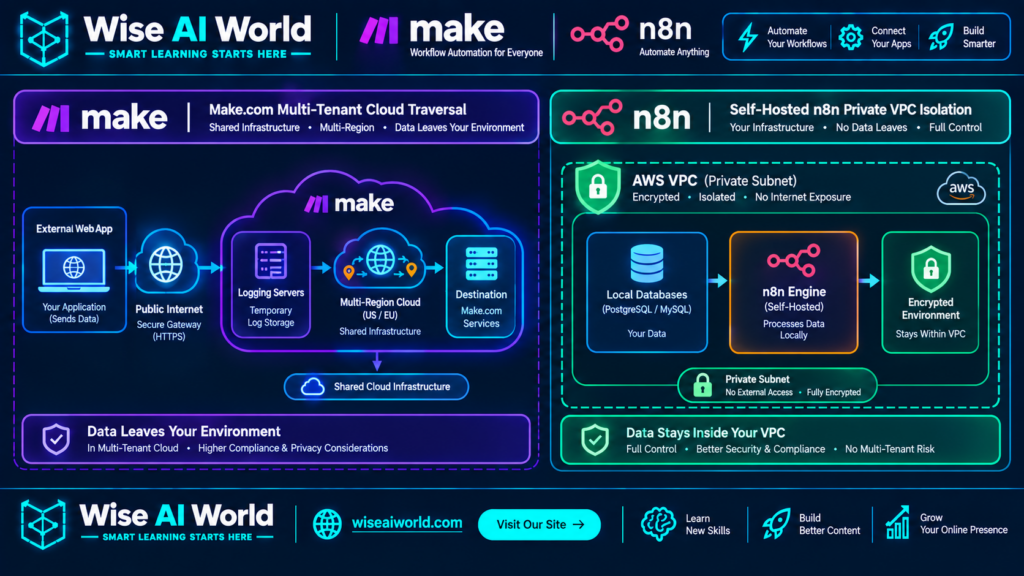
Make.com Compliance Model
Make.com processes payloads through its managed cloud infrastructure across US and EU data regions. While compliant with standard frameworks, payload data briefly resides in Make’s execution logs unless zero-data-retention parameters are explicitly enabled on enterprise agreements. This makes third-party API processing visible to external cloud environments.
n8n Self-Hosted Compliance Model
Self-hosting n8n inside a private Virtual Private Cloud (VPC) ensures customer payload data never leaves your infrastructure perimeter. Payload execution logs, API credentials, and database queries remain isolated within your local environment, making it ideal for strict compliance environments.
Self-Hosted n8n Docker Setup (Production Blueprint)
To deploy a production-grade n8n instance backed by PostgreSQL and Docker Compose, use this deployment blueprint:
version: '3.8'

services:
  postgres:
    image: postgres:16-alpine
    container_name: n8n_postgres
    restart: always
    environment:
      - POSTGRES_USER=n8n_admin
      - POSTGRES_PASSWORD=SecureProductionPassword99!
      - POSTGRES_DB=n8n_db
    volumes:
      - postgres_storage:/var/lib/postgresql/data
    healthcheck:
      test: ["CMD-SHELL", "pg_isready -U n8n_admin -d n8n_db"]
      interval: 5s
      timeout: 5s
      retries: 5

  n8n:
    image: docker.n8n.io/n8nio/n8n:latest
    container_name: n8n_engine
    restart: always
    ports:
      - "5678:5678"
    environment:
      - DB_TYPE=postgresdb
      - DB_POSTGRESDB_HOST=postgres
      - DB_POSTGRESDB_PORT=5432
      - DB_POSTGRESDB_DATABASE=n8n_db
      - DB_POSTGRESDB_USER=n8n_admin
      - DB_POSTGRESDB_PASSWORD=SecureProductionPassword99!
      - N8N_ENCRYPTION_KEY=super-secret-encryption-key-phrase
      - WEBHOOK_URL=https://automation.yourdomain.com/
      - EXECUTIONS_DATA_PRUNE=true
      - EXECUTIONS_DATA_MAX_AGE=168
    volumes:
      - n8n_storage:/home/node/.n8n
    depends_on:
      postgres:
        condition: service_healthy

volumes:
  postgres_storage:
  n8n_storage:
Summary & Decision Matrix
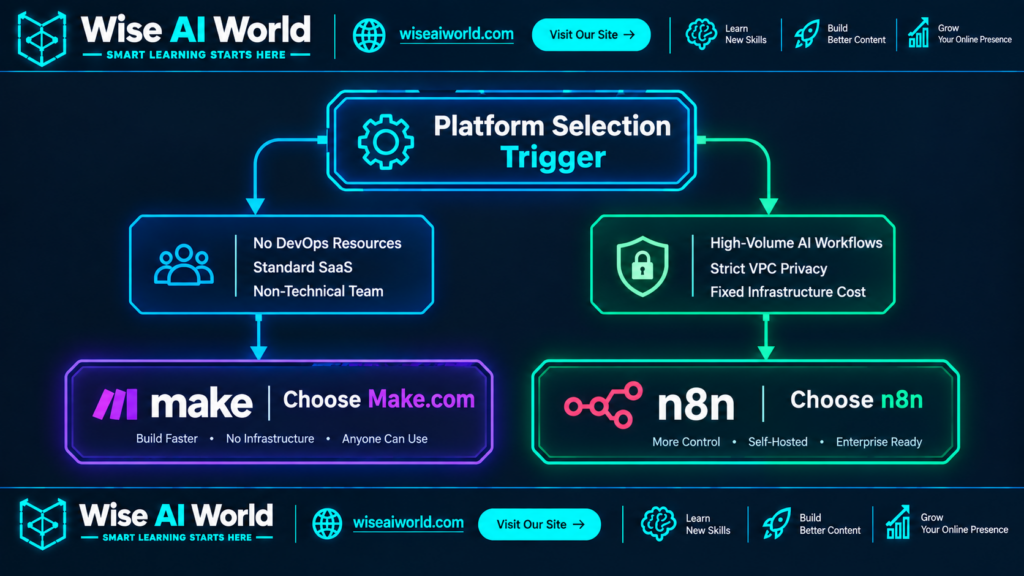
Choose Make.com If:
- Your team lacks dedicated DevOps resources to manage server maintenance, Docker containers, and database backups.
- Your integration needs consist primarily of standard SaaS webhooks (e.g., Gmail to HubSpot to Slack) with low-to-medium transaction volumes.
- You prefer an intuitive visual builder that non-technical team members can easily inspect and configure.
Choose n8n If:
- You are building high-volume AI workflows involving vector database chunking, multi-step LLM chains, or heavy data extraction.
- Strict data privacy requirements dictate that customer payloads must remain entirely within your private cloud infrastructure.
- You want predictable infrastructure costs without per-operation price scaling as your workflow traffic grows.

Manish Prakash Dubey is an AI educator and technology writer based in India. He founded WiseAIWorld to make artificial intelligence simple and practical for students, professionals, and beginners. His work focuses on AI basics, machine learning, deep learning, NLP, computer vision, and real-world AI tools.
