
In a Manhattan bank branch in 2026, a loan officer spends her mornings reviewing AI-generated insights rather than stacks of paperwork. Clients around her interact with intelligent virtual assistants and approve transactions using facial recognition. Fraud that once took days to detect is being intercepted in milliseconds. What would have sounded like science fiction a decade ago is the operational reality of modern banking.
According to the ABA Banking Journal’s 2026 analysis, up to 91 percent of financial services companies are in the process of adopting or already using across their operations, from fraud detection and risk management to marketing and customer engagement. The banking sector is projected to spend over 73 billion US dollars on AI technologies by the end of 2025 according to CoinLaw’s comprehensive statistics report, a 17 percent year-over-year increase that reflects how central AI has become to banking strategy at every level.
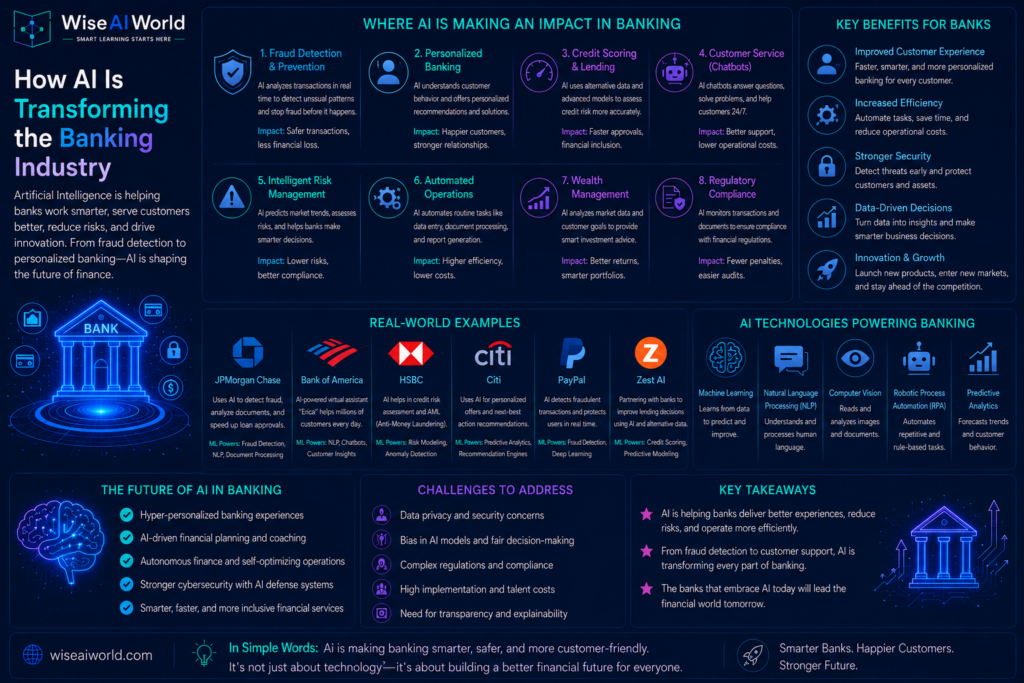
The Scale of AI in Banking in 2026
The numbers behind AI adoption in banking are striking by any measure. According to CoinLaw, 92 percent of global banks reported active AI deployment in at least one core banking function as of early 2025, with 99 percent of US banks implementing AI in at least one major banking operation. The global AI in banking market was valued at 19.87 billion US dollars in 2023 and is projected to reach 143.56 billion US dollars by 2030, growing at a compound annual rate of 31.8 percent according to Grand View Research.
The economic stakes are equally significant. A McKinsey report cited by Uptech estimates that generative AI could contribute between 200 billion and 340 billion US dollars annually to the global banking sector through productivity gains, while global banks expect AI to contribute 9 percent to operating income by 2025, equating to 340 billion US dollars according to GitNux’s banking AI statistics. By 2030, AI is expected to unlock one trillion US dollars in banking value creation globally.
AI in Fraud Detection: The Frontline of Financial Security
Fraud prevention is the area where AI has made the deepest and most documented impact in banking, and where the gap between AI-powered and traditional approaches is most stark.
Traditional fraud detection relied on rule-based systems with static thresholds. A transaction over a certain amount would trigger a review. A purchase in an unusual location would flag an alert. These systems were easy to understand but easy to circumvent, and they generated enormous numbers of false positives that frustrated customers and consumed analyst time.
-based fraud detection works fundamentally differently. Rather than following fixed rules, it learns the behavioral patterns of individual customers and flags deviations from those specific patterns. Where a rule-based system might flag any transaction over 10,000 US dollars, an AI system might flag a 9,500 US dollar transaction as suspicious because it deviates from a specific customer’s typical behavior, according to the ABA Banking Journal.
The results of this shift are measurable. According to CoinLaw, AI-driven fraud detection systems are now used by 87 percent of global financial institutions, and as of late 2025, these systems are intercepting 92 percent of fraudulent activities before transaction approval. US banks report that AI has reduced false fraud alerts by up to 80 percent, dramatically improving the customer experience. Real-time fraud detection using AI has led to a 41 percent drop in financial losses due to cyberattacks.
The business impact is similarly striking. According to Mastercard’s 2026 payment fraud prevention research, 42 percent of card issuers and 26 percent of acquirers have saved more than 5 million US dollars in fraud attempts over the past two years thanks to AI. Visa’s AI-powered fraud prevention system saved 25 billion US dollars in 2023 alone according to GitNux. NatWest in the UK achieved a 90 percent reduction in new account fraud since implementing AI systems, according to Uptech.
The threat environment is also evolving rapidly. According to Mastercard, fraudsters are now using generative AI to create convincing deepfakes, synthetic voice clones, and forged documents to run social engineering scams at scale. The global financial impact of fraud exceeded 485 billion US dollars in 2023 and is expected to grow as AI lowers the barrier for criminals to launch sophisticated attacks. Banks are responding with increasingly sophisticated AI countermeasures including behavioral biometrics and graph analytics that detect patterns across networks of transactions rather than individual transactions in isolation.
AI in Credit and Lending: Faster Decisions, Broader Access
Credit underwriting is the second major area where AI is fundamentally changing banking, with implications not just for efficiency but for financial inclusion.
Traditional credit scoring relies primarily on credit history, which systematically disadvantages people who are new to credit, young, or who have managed their finances through informal rather than institutional channels. AI-powered credit models can incorporate a much broader range of data including income verification, employment history, education, online payment behavior, and other alternative data sources to produce more accurate and more inclusive risk assessments.
The impact on both efficiency and inclusion is documented. According to CoinLaw, AI-enhanced credit scoring models have increased loan approval rates for underbanked individuals by 22 percent in 2025. Machine learning has reduced loan processing time to less than 6 minutes in digital-only banks. Banks employing alternative data models via AI have decreased loan defaults by 18 percent. AI-based risk engines are reducing manual intervention in underwriting by up to 90 percent.
According to GitNux, AI in credit underwriting has cut loan default rates by 25 percent and processing time by 70 percent for early adopters. Over 85 percent of fintech lenders use AI to adjust lending criteria dynamically based on real-time borrower behavior.
There are important caveats. Credit scoring algorithms can perpetuate or amplify existing biases if not carefully designed and monitored. According to Emburse’s 2026 fraud detection guide, removing bias in AI models requires ongoing vigilance and systematic testing, including diverse training data and regular evaluation of model performance across demographic groups to identify disparate impacts. The Colorado AI Act, taking effect June 30, 2026, specifically targets high-risk AI systems that influence consequential decisions like loan approvals, requiring institutions to implement risk management programs and impact assessments. You can read more about the broader ethical dimensions of these issues in our article on .
AI in Customer Service: Personalization at Scale
Customer service is the most visible face of AI in banking for most consumers, and it is an area where adoption has been particularly rapid.
AI chatbots and virtual assistants now handle a substantial proportion of routine customer interactions including balance inquiries, transaction history, payment processing, account alerts, and product information. According to GitNux, AI chatbots handled 80 percent of customer queries in leading banks, reducing service costs by 30 percent per interaction. AI in the banking industry is expected to reduce overall customer service costs by 30 percent. By 2028, AI is projected to handle 95 percent of customer interactions autonomously.
Beyond simple query handling, AI is enabling personalized financial guidance at scale. Banks are using AI to analyze customer transaction data and proactively recommend relevant products, flag potential issues like upcoming overdrafts, and provide spending insights that help customers manage their finances more effectively. NatWest’s AI-powered personalization resulted in five times more customer clicks on product offers according to Uptech, demonstrating how AI-driven personalization translates into direct commercial results.
The shift from reactive to proactive customer service is one of the most significant changes AI enables. Rather than waiting for a customer to call about a problem, AI-powered systems can detect the preconditions of a problem and reach out with relevant information or solutions before the customer even realizes the issue exists.
Modern has made these interactions dramatically more natural. According to SAS’s 2026 banking predictions from 13 industry experts, generative AI is becoming for unstructured data what traditional statistics has long been for structured data, giving banks the ability to extract meaning and insight at scale from customer communications, complaints, and interactions that were previously difficult to analyze systematically.
AI in Risk Management and Compliance
Risk management is the single largest application area for AI in banking by revenue, reflecting how central risk assessment is to the entire banking business model. According to Grand View Research, risk management accounted for the largest market revenue share of any AI banking application in the most recent market analysis, followed by natural language processing applications.
AI tools are helping banks manage credit risk, market risk, liquidity risk, and operational risk through continuous real-time monitoring of conditions that would be impossible to track manually at the required speed and scale. According to GitNux, AI risk assessment has cut provisioning costs by 18 percent, and compliance AI tools have cut regulatory fine risks by 35 percent, saving the industry an estimated 2 to 5 billion US dollars per year.
Regulatory compliance is an area of particular importance given the speed of regulatory change in financial services. According to the ABA Banking Journal, risk and compliance professionals face the challenge of keeping abreast of rapidly changing technology alongside a patchwork of emerging regulatory expectations. Banks in the UK report a 75 percent usage rate of AI specifically for compliance monitoring. AI ethics framework adoption is expected to reach 85 percent of banks by 2026, reflecting regulatory pressure for explainability and accountability in AI decision-making systems.
AI in Investment and Wealth Management
The investment side of banking has also been substantially transformed by AI, with implications for both institutional trading and retail wealth management.
In institutional banking, AI is expected to raise productivity in investment banks by 27 percent and boost front-office productivity by 27 to 35 percent by 2026, according to research cited by Uptech. AI-optimized trading desks have boosted returns by 5 to 10 percent annually for investment banks according to GitNux, and ChatGPT-like tools in banking have boosted productivity by 40 percent in research teams.
In retail wealth management, robo-advisors powered by AI now serve millions of retail investors who could not previously access personalized investment advice due to minimum wealth requirements. South Korea’s financial sector is using AI in robo-advisory tools that serve over 4 million customers according to CoinLaw. AI in wealth management has increased assets under management growth by 15 percent through better client matching and personalized portfolio construction according to GitNux.
The Challenges and Risks That Come With AI in Banking
The transformation of banking through AI is real and well-documented, but it comes with significant challenges that regulators, technologists, and bank executives are actively grappling with.
Explainability is a central concern. According to Emburse, financial institutions must be able to explain to regulators, auditors, and customers why specific transactions were flagged or accounts restricted. Regulations increasingly require banks to explain automated decisions, and the models that power the most accurate AI systems are often difficult to interpret. This drives demand for explainable AI techniques that transform black-box algorithms into transparent systems supporting accountability.
Legacy system integration is a persistent challenge. According to Emburse, many financial institutions store data in outdated formats that require extensive transformation before AI systems can process them, and consolidating data across dozens of systems into unified datasets that AI models can use requires significant technical effort and ongoing maintenance.
The arms race with fraudsters is a structural challenge with no permanent solution. According to SAS experts, AI has made financial institutions faster, smarter, and sometimes too confident, and the same generative AI tools that help banks fight fraud are being used by fraudsters to create more convincing attacks. The question in 2026 is no longer whether AI will transform banking but whether institutions are prepared for the consequences of the accelerating transformation already underway.
What AI in Banking Means for Customers
For individual banking customers, AI is changing the experience of financial services in several concrete ways. Fraud protection is faster and more accurate, meaning fewer legitimate transactions are blocked and fewer fraudulent ones get through. Loan applications that previously took weeks are now processed in minutes or hours. Customer service is increasingly available around the clock through AI-powered chat interfaces. Personalized financial insights, previously available only to wealth management clients, are becoming standard features in retail banking apps.
The risks to customers are also real. Algorithmic decisions about credit can be opaque and difficult to challenge. AI-generated fraud alerts can still produce errors that temporarily block access to funds. And the data collection required to power personalized banking AI raises legitimate privacy questions that banking customers should understand. Being aware of how AI is used in your bank’s decisions gives you a basis to ask questions and request human review when automated decisions seem wrong.
Key Takeaways
- 91 percent of financial services companies are adopting or already using AI, with the banking sector projected to spend over 73 billion US dollars on AI in 2025.
- AI fraud detection systems are intercepting 92 percent of fraudulent activities before approval, reducing false alerts by 80 percent and saving billions annually across the industry.
- AI credit scoring has increased loan approval rates for underbanked individuals by 22 percent while reducing loan defaults by 18 percent and cutting processing time to under 6 minutes in digital banks.
- AI chatbots handle 80 percent of customer queries in leading banks, reducing customer service costs by 30 percent per interaction.
- AI is expected to raise productivity in investment banks by 27 percent and could contribute 200 to 340 billion US dollars annually to the global banking sector through productivity gains.
- Significant challenges remain around model explainability, legacy system integration, bias in lending decisions, and the evolving arms race with AI-powered fraudsters.
Conclusion
Banking has always been a data-intensive industry that rewards speed, accuracy, and risk management. AI excels at all three in ways that human teams working with traditional tools simply cannot match at modern scale. The transformation already underway is not incremental. It is structural, reshaping how loans are approved, how fraud is caught, how customers are served, and how risk is managed across the entire financial system.
For customers, the benefits are increasingly real and tangible. So are the responsibilities that come with understanding how these systems affect your financial life. To explore how AI is transforming other major sectors, read our articles on , , and .
Sources
- ABA Banking Journal: Banking on AI 2026
- CoinLaw: AI in Banking Statistics 2025 Adoption Savings and Customer Impact
- GitNux: AI in the Banking Industry Statistics Market Data Report 2026
- Mastercard: AI Is Helping Banks Save Millions by Transforming Payment Fraud Prevention 2026
- SAS: Banking AI Reckoning 13 Expert Predictions for 2026
- Grand View Research: Artificial Intelligence in Banking Market Size Report 2030
- Emburse: AI Fraud Detection in Banking 2026 Guide
- Uptech: Top 15 AI Trends in Banking for 2025 and 2026

Manish Prakash Dubey is an AI educator and technology writer based in India. He founded WiseAIWorld to make artificial intelligence simple and practical for students, professionals, and beginners. His work focuses on AI basics, machine learning, deep learning, NLP, computer vision, and real-world AI tools.
