Artificial intelligence is transforming the entertainment industry faster than ever before.
In 2026, AI is helping filmmakers, television producers, editors, animators, visual effects artists, and content creators work more efficiently while expanding creative possibilities.
From generating concept art and enhancing visual effects to assisting with script analysis and video editing, AI has become an important tool throughout the production process.
While AI is not replacing human creativity, it is changing how movies and TV shows are planned, produced, edited, marketed, and distributed.
This article explores how AI is changing the way movies and television shows are made, the benefits it offers, the challenges it presents, and what the future of AI-powered entertainment may look like.
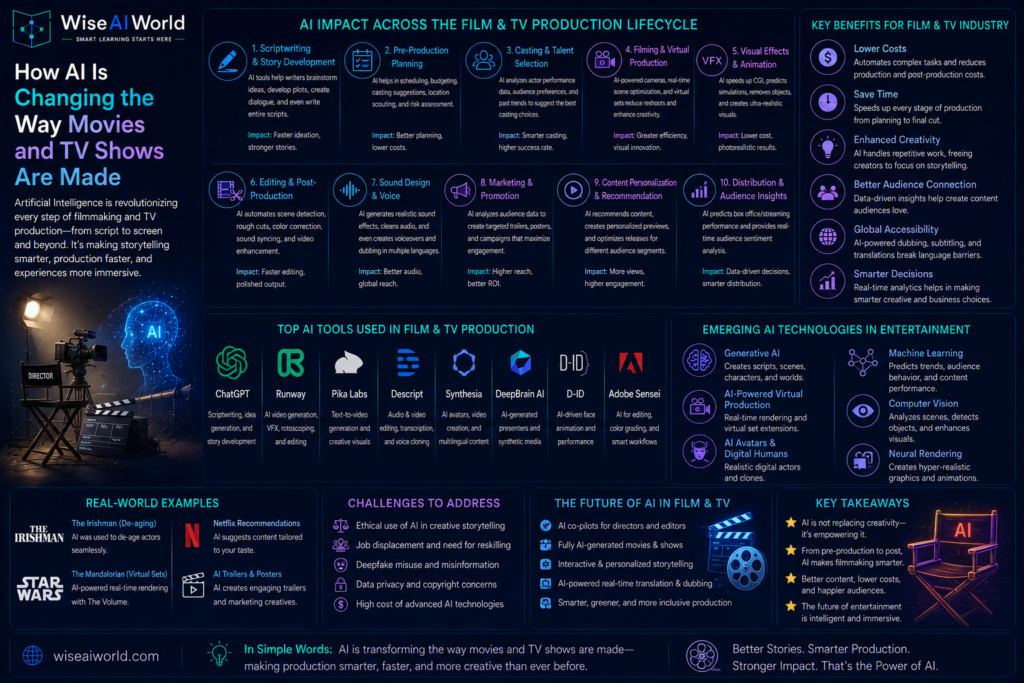
What Is AI in Film and Television Production?
Artificial intelligence refers to computer systems that can analyze data, recognize patterns, generate content, and assist with decision-making.
In film and television production, AI can help with:
- Script analysis
- Story development
- Casting support
- Production planning
- Visual effects
- Animation
- Video editing
- Voice generation
- Dubbing and translation
- Audience analysis
- Marketing campaigns
Rather than replacing creative professionals, AI is primarily used to streamline workflows and reduce repetitive tasks.
AI-Assisted Script Development
One of the earliest stages of production is scriptwriting.
AI tools are increasingly helping writers and producers evaluate ideas.
Generating Creative Ideas
Writers can use AI to:
- Brainstorm story concepts
- Develop character profiles
- Explore plot variations
- Create dialogue suggestions
- Generate alternative endings
AI serves as a creative assistant rather than an author.
Script Analysis
Production companies can use AI tools to analyze scripts for:
- Story structure
- Character balance
- Pacing
- Scene length
- Audience engagement patterns
This helps creators identify areas that may need refinement.
AI in Pre-Production Planning
Before filming begins, extensive planning is required.
Production Scheduling
AI can help organize:
- Shooting schedules
- Location planning
- Resource allocation
- Crew coordination
This can reduce delays and improve efficiency.
Budget Forecasting
AI-powered analytics can estimate production costs based on:
- Script requirements
- Filming locations
- Visual effects needs
- Equipment usage
This helps producers make informed financial decisions.
AI-Powered Casting Support
Casting remains a human-driven process, but AI can assist with analysis.
Matching Roles and Talent
AI tools can help identify actors who match certain character profiles based on project requirements.
This can speed up the casting research process.
Audition Analysis
Some production teams use AI to organize and review audition materials more efficiently.
Final casting decisions remain the responsibility of directors and casting professionals.
AI and Visual Effects (VFX)
Visual effects are one of the most visible areas where AI is making an impact.
Faster VFX Production
AI can assist artists with:
- Object tracking
- Background replacement
- Scene enhancement
- Motion analysis
- Automated cleanup tasks
This reduces time spent on repetitive work.
Realistic Digital Environments
AI helps create:
- Digital landscapes
- Crowd simulations
- Environmental effects
- Enhanced CGI assets
Artists can focus more on creative direction and refinement.
AI in Animation
Animation studios are increasingly adopting AI-powered tools.
Accelerating Animation Workflows
AI can assist with:
- Character rigging
- Lip synchronization
- Motion generation
- Background creation
- Frame interpolation
This can significantly reduce production time.
Supporting Animators
Rather than replacing animators, AI handles repetitive technical tasks while artists focus on storytelling and design.
AI-Assisted Video Editing
Editing is one of the most time-intensive parts of production.
Automated Editing Support
AI can help editors:
- Organize footage
- Identify key moments
- Generate rough cuts
- Remove mistakes
- Suggest transitions
Editors maintain creative control while benefiting from faster workflows.
Content Summarization
AI can automatically create:
- Trailers
- Highlight reels
- Promotional clips
- Social media snippets
This simplifies content distribution and marketing.
AI in Voice Generation and Dubbing
Global audiences consume content in many languages.
AI-Powered Dubbing
AI tools can assist with:
- Language translation
- Voice matching
- Lip-sync adjustments
This helps studios localize content more efficiently.
Accessibility Improvements
AI-generated captions and subtitles make content more accessible to broader audiences.
Virtual Production and AI
Virtual production techniques are becoming increasingly popular.
Real-Time Environments
AI can support virtual production systems by helping create and manage digital environments in real time.
This allows filmmakers to:
- Visualize scenes instantly
- Reduce location costs
- Improve creative flexibility
Enhanced Planning
Directors can preview complex scenes before filming, improving decision-making and reducing production risks.
AI in Audience Analysis
Understanding audiences is important for entertainment companies.
Predicting Viewer Preferences
AI can analyze:
- Viewing habits
- Audience feedback
- Engagement patterns
- Content trends
This helps studios understand what audiences enjoy.
Marketing Optimization
AI assists marketing teams by identifying:
- Target audiences
- Promotional opportunities
- Campaign strategies
This can improve marketing efficiency and reach.
AI for Independent Filmmakers
AI is making professional tools more accessible to smaller creators.
Lower Production Costs
Independent filmmakers can use AI for:
- Editing assistance
- Script development
- Visual effects support
- Marketing content creation
This reduces barriers to entry.
Faster Content Creation
Small teams can accomplish tasks that previously required larger production crews.
Benefits of AI in Film and Television
Faster Production
AI automates repetitive tasks and reduces manual workload.
Lower Costs
Efficient workflows can reduce production expenses.
Enhanced Creativity
Creative teams can spend more time on storytelling and artistic decisions.
Improved Accessibility
AI-powered dubbing, subtitles, and translations expand global reach.
Better Audience Insights
Studios gain valuable information about viewer preferences and behavior.
Challenges and Concerns
Despite its advantages, AI also raises important questions.
Copyright and Ownership
Questions remain regarding:
- AI-generated content
- Intellectual property rights
- Creative ownership
The industry continues to develop standards and regulations.
Job Impact Concerns
Some professionals worry about automation affecting certain production roles.
Most experts expect AI to change jobs rather than eliminate creative careers entirely.
Authenticity and Creativity
Audiences often value human creativity, originality, and artistic vision.
AI should enhance creative work rather than replace it.
Ethical Considerations
The use of AI-generated voices, likenesses, and digital recreations requires careful ethical oversight and consent.
Best Practices for Using AI in Entertainment
Studios and creators should:
Maintain Human Creativity
Creative decisions should remain in human hands.
Use AI Transparently
Be clear about how AI is being used in production.
Respect Intellectual Property
Ensure content creation follows legal and ethical guidelines.
Prioritize Quality
AI-generated outputs should be reviewed and refined by professionals.
The Future of AI in Movies and Television
The next generation of AI tools may enable:
- More realistic visual effects
- Faster animation production
- Smarter editing systems
- Advanced virtual production
- Improved dubbing and localization
- Personalized viewing experiences
AI is likely to become a standard part of film and television workflows rather than a specialized technology.
Common Myths About AI in Entertainment
AI Will Replace Filmmakers
Filmmaking requires creativity, storytelling, emotion, and artistic judgment that AI cannot fully replicate.
AI Can Create Entire Movies Without Humans
AI can assist with production tasks, but successful films still require human direction, creativity, and decision-making.
AI Makes Production Effortless
Producing high-quality entertainment remains a complex process requiring skilled professionals.
Key Takeaways
- AI is transforming how movies and TV shows are written, produced, edited, and distributed.
- Script development, visual effects, animation, and editing are among the biggest areas of impact.
- AI helps reduce repetitive work and improve production efficiency.
- Independent creators can access powerful tools that were once available only to major studios.
- Human creativity remains essential to storytelling and entertainment.
- Ethical, legal, and creative considerations continue to shape AI adoption in the industry.
Conclusion
Artificial intelligence is changing the way movies and television shows are made by helping creators work faster, reduce production costs, and unlock new creative possibilities.
From script analysis and visual effects to editing, animation, dubbing, and virtual production, AI has become an important tool throughout the entertainment industry.
The future of filmmaking is unlikely to be fully automated. Instead, it will be shaped by collaboration between talented creative professionals and intelligent technologies that enhance their abilities.
As AI continues to evolve, the most successful filmmakers and studios will be those that use technology to support creativity while preserving the human storytelling that audiences value most.
Related Articles
- What Is Artificial Intelligence and Why Does It Matter in 2026
- How AI Is Revolutionizing Healthcare in 2026
- How AI Is Changing the Way Students Learn in 2026
- How Artificial Intelligence Is Transforming Small Businesses in 2026
- The Best AI Tools to Boost Your Productivity in 2026

Manish Prakash Dubey is an AI educator and technology writer based in India. He founded WiseAIWorld to make artificial intelligence simple and practical for students, professionals, and beginners. His work focuses on AI basics, machine learning, deep learning, NLP, computer vision, and real-world AI tools.
