
Cities around the world are becoming more connected, data-driven, and intelligent.
As urban populations continue to grow, city governments face increasing challenges related to transportation, public safety, energy consumption, infrastructure management, and environmental sustainability.
Artificial intelligence is helping address these challenges by enabling smarter decision-making and more efficient city operations.
In 2026, AI-powered technologies are helping cities reduce traffic congestion, improve emergency response times, optimize energy usage, enhance public services, and create safer environments for residents.
This article explores how AI is making our cities smarter and safer, the technologies behind these changes, their benefits, challenges, and what the future of smart cities may look like.
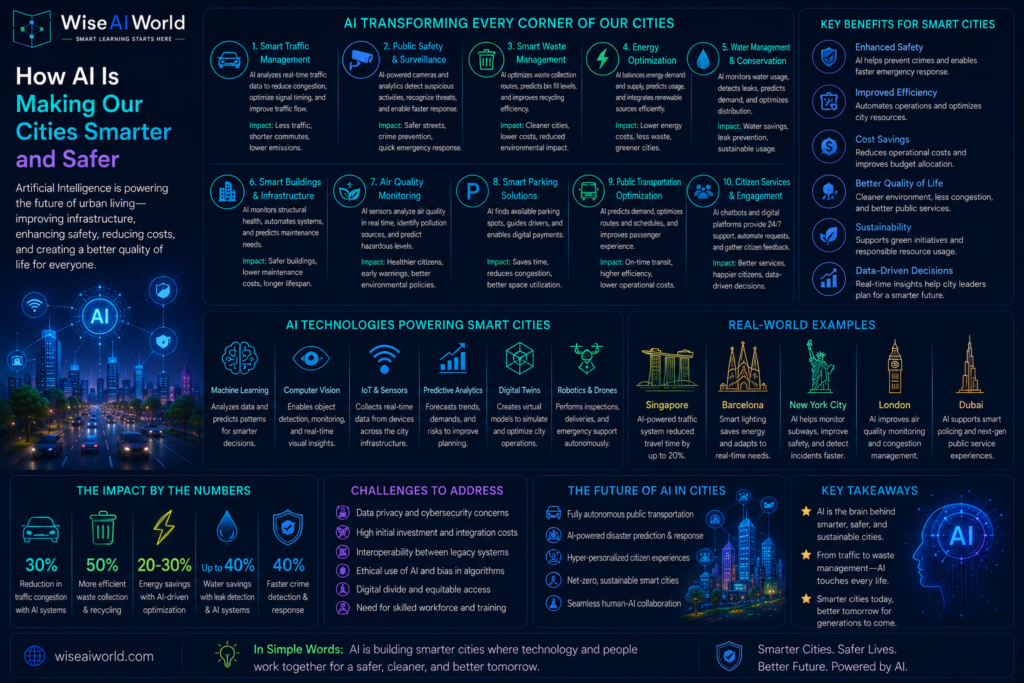
What Is a Smart City?
A smart city uses digital technologies, sensors, data analytics, and artificial intelligence to improve urban services and quality of life.
These technologies collect and analyze information from various sources, including:
- Traffic systems
- Public transportation
- Energy grids
- Water networks
- Surveillance systems
- Environmental sensors
- Emergency services
- Public infrastructure
The goal is to make cities more efficient, sustainable, and responsive to residents’ needs.
Why Cities Are Adopting AI
Urban populations continue to expand, creating pressure on city resources.
Common challenges include:
- Traffic congestion
- Air pollution
- Rising energy demands
- Infrastructure maintenance
- Public safety concerns
- Emergency response coordination
AI helps cities process vast amounts of data and identify solutions faster than traditional systems.
AI-Powered Traffic Management
Traffic congestion is one of the biggest challenges in modern cities.
Smart Traffic Signals
AI-powered traffic systems can analyze:
- Vehicle flow
- Traffic density
- Road conditions
- Peak travel times
Traffic lights can automatically adjust timing based on real-time conditions.
This helps reduce:
- Congestion
- Fuel consumption
- Travel delays
Traffic Prediction
AI can forecast traffic patterns before congestion becomes severe.
City planners can proactively manage transportation networks and improve traffic flow.
Smarter Public Transportation
Public transportation systems generate enormous amounts of operational data.
Route Optimization
AI helps transit agencies:
- Optimize routes
- Adjust schedules
- Reduce delays
- Improve service reliability
This benefits both commuters and transportation operators.
Passenger Demand Forecasting
AI can predict passenger demand during:
- Rush hours
- Special events
- Holidays
- Weather disruptions
This helps cities allocate resources more efficiently.
AI and Public Safety
Public safety is one of the most important areas where AI is making a difference.
Emergency Response Support
AI systems can help emergency services by:
- Analyzing incoming reports
- Identifying priority incidents
- Suggesting optimal response routes
- Coordinating resources
Faster response times can improve outcomes during emergencies.
Situational Awareness
AI helps city authorities monitor developing situations and allocate resources more effectively during large-scale events or emergencies.
AI-Powered Smart Surveillance
Many cities use AI-enhanced monitoring systems to improve public safety.
Real-Time Monitoring
AI can analyze video feeds to detect:
- Traffic accidents
- Suspicious activities
- Road hazards
- Public safety incidents
These systems help authorities respond more quickly.
Privacy Considerations
Smart surveillance must be implemented carefully to balance safety benefits with privacy protections and legal requirements.
Smart Energy Management
Cities consume significant amounts of energy.
AI helps improve efficiency.
Intelligent Power Grids
AI-powered smart grids can:
- Predict energy demand
- Reduce waste
- Improve reliability
- Detect outages
This helps utilities operate more efficiently.
Energy Conservation
AI systems can optimize:
- Street lighting
- Building energy use
- Public facilities
- Municipal operations
Reducing energy consumption lowers costs and environmental impact.
AI and Environmental Monitoring
Environmental sustainability is a major priority for many cities.
Air Quality Tracking
AI can analyze data from environmental sensors to monitor:
- Air pollution
- Temperature
- Humidity
- Emissions levels
City officials can identify pollution hotspots and take corrective actions.
Climate Adaptation
AI helps cities prepare for:
- Extreme weather
- Heat waves
- Flood risks
- Environmental changes
This supports long-term resilience planning.
Smart Waste Management
Waste collection is an essential city service.
Optimized Collection Routes
AI can determine the most efficient collection schedules and routes.
This reduces:
- Fuel usage
- Operating costs
- Traffic disruption
Smart Waste Bins
Connected waste containers can notify collection teams when they are full.
This improves efficiency and reduces unnecessary trips.
AI and Infrastructure Maintenance
Cities manage extensive infrastructure networks.
Predictive Maintenance
AI can monitor:
- Roads
- Bridges
- Water systems
- Electrical infrastructure
By detecting early warning signs of deterioration, cities can perform maintenance before major failures occur.
Cost Savings
Preventive maintenance often costs less than emergency repairs.
AI helps cities use resources more effectively.
AI for Water Management
Water systems are critical urban infrastructure.
Leak Detection
AI can identify unusual patterns that may indicate leaks or system inefficiencies.
This helps reduce water waste.
Resource Optimization
Cities can better manage water distribution and consumption using predictive analytics.
AI and Urban Planning
Long-term city planning benefits greatly from AI-driven insights.
Data-Driven Decision-Making
AI helps planners analyze:
- Population growth
- Housing demand
- Transportation needs
- Economic activity
This supports smarter development strategies.
Future Infrastructure Planning
AI models help cities anticipate future needs and make better investment decisions.
Benefits of AI for Smart Cities
Improved Public Safety
Faster detection and response improve community safety.
Reduced Traffic Congestion
Smarter transportation systems improve mobility.
Lower Operating Costs
Automation and optimization reduce expenses.
Enhanced Sustainability
Efficient energy and resource management support environmental goals.
Better Quality of Life
Residents benefit from improved services and infrastructure.
Challenges and Concerns
Despite its advantages, AI adoption presents challenges.
Privacy Issues
Cities must carefully protect citizen data and respect privacy rights.
Cybersecurity Risks
Connected systems require strong security measures to prevent unauthorized access.
Implementation Costs
Smart city technologies often require substantial investments.
Data Quality
AI systems depend on accurate and reliable data to function effectively.
Best Practices for Smart City AI
City leaders should:
Prioritize Transparency
Residents should understand how AI systems are used and what data is collected.
Protect Privacy
Strong governance and safeguards are essential.
Maintain Human Oversight
Important decisions should continue to involve human judgment.
Ensure Cybersecurity
Protecting critical infrastructure must remain a top priority.
Focus on Public Benefit
Technology should improve services and quality of life rather than simply adding complexity.
Real-World Examples of Smart City Applications
Intelligent Traffic Systems
Cities use AI-powered traffic lights to reduce congestion and improve travel times.
Smart Public Transportation
Transit systems use predictive analytics to improve scheduling and passenger experiences.
Energy-Efficient Infrastructure
Municipalities deploy AI-powered smart grids and connected lighting systems to reduce energy consumption.
Environmental Monitoring
Cities monitor air quality and environmental conditions using AI-powered sensor networks.
The Future of AI-Powered Cities
Over the next decade, AI may enable:
- Fully connected transportation networks
- More efficient emergency services
- Advanced environmental protection systems
- Autonomous public transit solutions
- Smarter infrastructure management
- Improved citizen services
As technology evolves, cities may become increasingly responsive, efficient, and sustainable.
Common Myths About Smart Cities
AI Will Run Cities Without Humans
Human leadership, policy decisions, and public accountability remain essential.
AI supports decision-making but does not replace governance.
Smart Cities Eliminate All Problems
Technology improves efficiency but cannot solve every social, economic, or political challenge.
Smart Cities Are Only for Large Urban Areas
Many smaller communities are adopting AI-powered technologies to improve local services.
Key Takeaways
- AI is helping cities become smarter, safer, and more efficient.
- Smart traffic systems reduce congestion and improve transportation.
- AI supports public safety, emergency response, and infrastructure management.
- Energy and water systems benefit from predictive analytics and optimization.
- Environmental monitoring helps cities achieve sustainability goals.
- Privacy, cybersecurity, and transparency remain critical considerations.
- Human oversight remains essential for responsible smart city development.
Conclusion
Artificial intelligence is changing how cities operate by helping governments deliver better services, improve public safety, manage resources efficiently, and prepare for future challenges.
From intelligent traffic systems and smart energy grids to predictive maintenance and environmental monitoring, AI is enabling cities to become more responsive and sustainable.
The cities of the future will not simply be connected—they will be intelligent, adaptive, and designed to improve the lives of the people who live in them.
When implemented responsibly, AI has the potential to make our communities safer, more efficient, and better prepared for the challenges of a rapidly changing world.
Related Articles
- What Is Artificial Intelligence and Why Does It Matter in 2026
- How Artificial Intelligence Is Transforming Small Businesses in 2026
- How AI Is Revolutionizing Healthcare in 2026
- How AI Is Changing the Way Students Learn in 2026
- How AI Is Helping Farmers Grow More Food With Less Water

Manish Prakash Dubey is an AI educator and technology writer based in India. He founded WiseAIWorld to make artificial intelligence simple and practical for students, professionals, and beginners. His work focuses on AI basics, machine learning, deep learning, NLP, computer vision, and real-world AI tools.
