
David was a manufacturing manager with no computer science background. He started using to optimize procurement at his own company and reduced costs by 20 percent. That single internal result became a case study. The case study led to his first external consulting project worth 8,000 US dollars in two weeks. A year later, he was earning 18,000 US dollars per month at an effective hourly rate near 400 US dollars, according to AiToMake’s AI consulting business guide.
David’s story is not unique. It reflects a structural opportunity in the market that shows no signs of closing. According to Jobbers.io’s 2026 AI freelancer roadmap, demand for AI and machine learning freelancers increased by 1,847 percent between 2023 and 2026 according to Upwork’s Skills Index, and the global AI market reached 826 billion US dollars in 2026, up from 387 billion in 2023, a 113 percent increase in three years. The opportunity is real. This guide explains exactly how to position yourself to take advantage of it, even if you do not have a computer science degree or prior consulting experience.
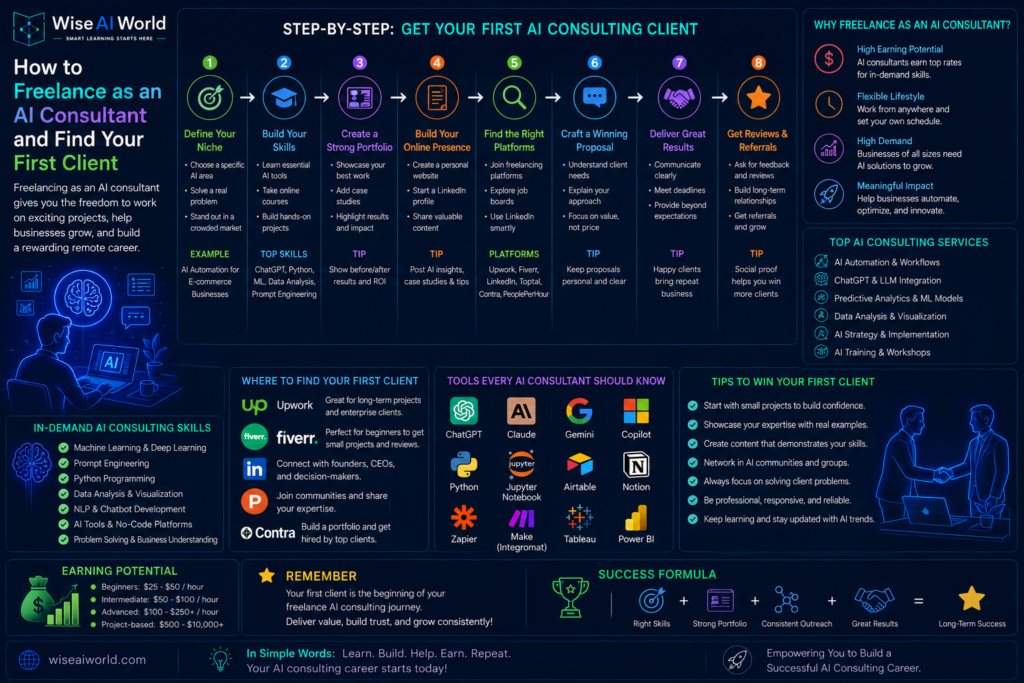
What an AI Freelance Consultant Actually Does
Before positioning yourself, it helps to understand clearly what the market is actually buying. According to Stack’s AI freelancing guide, most AI freelancers are implementation specialists rather than AI builders. You are not inventing new AI models. You are connecting existing tools to make businesses run better, which the guide describes as being an AI plumber rather than an AI architect. You are not inventing the pipes. You are connecting them to make things flow.
The most common AI consulting services in 2026 fall into three categories. Strategy consulting involves assessing a business’s current state, identifying the highest-value AI opportunities, and producing a phased implementation roadmap. According to Jobbers.io’s rate guide, this is the highest-paying category because it requires combining technical AI understanding with business acumen and change management expertise.
Implementation consulting involves actually deploying AI tools into a client’s workflows, configuring them, building the automations, training the team, and ensuring adoption. According to Lilach Bullock’s freelance market analysis, AI workflow consultants who can audit what a business is doing and build repeatable AI-assisted operations are charging between 75 and 150 US dollars per hour in the UK and 100 to 200 US dollars in the US. Some package this as a one-off AI setup sprint priced between 500 and 2,000 US dollars.
Training and education involves running workshops or ongoing coaching to help teams use AI tools effectively. According to AiToMake, an executive AI briefing takes two hours to deliver and can be priced at 2,000 to 5,000 US dollars. A full-day workshop for 20 people can command 5,000 to 10,000 US dollars. You do not need to be a technical AI expert to deliver this category of service. You need fluency with the tools and the ability to explain things clearly.
Why the Market Opportunity Is So Large Right Now
According to AiToMake, 67 percent of businesses according to Deloitte know they need AI but have zero strategy for adoption. They are confused, overwhelmed, and willing to pay for someone who can cut through the noise. This creates a structural gap in the market that independent consultants are uniquely positioned to fill.
On one side, large consulting firms like McKinsey, Deloitte, and Accenture all have AI practices but their projects start at 500,000 US dollars and take six to twelve months. For the 28 million small and medium businesses in the US alone, this is completely inaccessible. On the other side, free online content tells businesses they should use AI but cannot assess a specific company’s workflows, create customized implementation roadmaps, or provide hands-on support. Independent AI consultants fill the gap between expensive firms and generic advice, offering affordable, fast, and personalized guidance at a price point small and medium businesses can access.
According to Lilach Bullock, small and mid-size businesses are drowning in AI tools they do not know how to use. They have bought , Claude Pro, maybe a Jasper or Copy.ai subscription, and they have no idea how to build a workflow that saves them time. That problem is your entry point.
Step 1: Choose Your Niche and Service Focus
The most common mistake new AI consultants make is positioning themselves as generalists. According to Emergent’s guide to making money with AI in 2026, the gap between beginner and advanced AI income is almost entirely explained by three things: niche depth, a portfolio of results, and distribution. Consultants who have documented case studies in a specific industry and a clear focus are charging 250 to 600 US dollars per hour. Generalists without evidence of results are competing with online courses priced at 99 US dollars.
The most effective approach is to combine your existing domain expertise with AI skills. If you have a background in marketing, position yourself as an AI marketing consultant who helps businesses automate content production, improve ad performance with AI tools, and build AI-assisted customer journey workflows. If you have a background in finance or accounting, position yourself as an AI automation consultant for financial services, helping firms automate reporting, client communications, and compliance documentation. If you have a background in healthcare administration, position yourself as a healthcare AI workflow consultant.
According to Aftab’s analysis of AI income in 2026 on Medium, vertical expertise combined with AI skills commands two to three times the rates of a generalist AI consultant. The premium comes from understanding the specific problems, language, regulations, and workflows of a particular industry rather than applying generic AI knowledge.
If you do not yet have strong domain expertise in a profitable niche, the three highest-demand entry points for beginners according to multiple sources are AI workflow automation for small businesses, AI content production systems for marketing teams, and AI training and education workshops for teams at organizations that have purchased but are not using AI tools effectively.
Step 2: Build Your Skills to a Deployable Level
You do not need to build AI models to be an AI consultant. According to AiToMake, you need to understand business problems, know which AI tools solve them, and communicate your value clearly. The technical skills required depend on the services you plan to offer.
For workflow automation and implementation consulting, fluency with tools like , , , Zapier, Make, Notion AI, and relevant industry-specific tools is sufficient. According to Jobbers.io, 60 percent of AI work in 2026 involves prompting and workflow design rather than coding, making prompt engineering one of the most practically valuable skills for this tier of consulting.
For AI strategy consulting, you need the ability to assess a business’s current processes, identify high-value automation opportunities, estimate implementation costs and timelines, and produce clear written recommendations. This is more about consulting and communication skills than technical AI knowledge, which is why experienced business professionals with domain expertise often transition into this area effectively.
For AI training and education, you need to be genuinely hands-on comfortable with the tools you teach, able to design workshop curricula, and an effective communicator who can translate technical concepts into plain language for non-technical audiences.
According to Lilach Bullock, marketing managers have retrained in six weeks and started landing AI workflow consulting contracts. The barrier to entry at the implementation tier is lower than most people assume if you have existing business experience and the discipline to build genuine tool fluency. For building foundational AI knowledge, our guide on gives you a structured starting point.
Step 3: Build Your Portfolio Before You Have Paying Clients
The most common objection new consultants face is: why should I hire you if you have no clients? The answer is to build evidence of your capability before you need to rely on it in a sales conversation.
According to Lilach Bullock, you should build two or three portfolio samples even if they are self-initiated or done for free for a charity or friend. A documented case study from a volunteer engagement where you built an AI workflow for a local charity, a friend’s small business, or your own employer is worth more than a polished website with no evidence of results.
The most valuable portfolio piece follows this structure: describe the problem the business faced, explain the AI solution you designed and implemented, and quantify the result. Hours saved per week. Percentage reduction in time spent on a specific task. Number of customer inquiries handled automatically. Revenue generated from AI-assisted content. According to AiToMake, David’s case study of saving 20 percent on procurement costs was the entire basis for his first paid consulting contract. You need one specific, quantified result, not ten vague references.
Self-initiated projects also count. Build an AI-powered content workflow for your own LinkedIn presence and document the process. Set up a Zapier automation connecting ChatGPT to an email system and write up how it works and what it would save a typical business. Create a demonstration of how could transform a typical small business admin workflow and post the walkthrough publicly. These demonstrations serve as proof of capability even before you have paying clients.
Step 4: Price Your Services Correctly From the Start
Pricing is where most new AI consultants undermine themselves. According to Stack, three critical mistakes are undercharging by anchoring rates to self-doubt rather than return on investment, overpromising on scope, and chasing multiple tools rather than learning one thing deeply.
According to Jobbers.io, the recommended first project strategy for someone with no prior consulting experience is to estimate realistic hours, calculate at 50 US dollars per hour even if the market rate is higher, add a 30 to 50 percent buffer for scope uncertainty, and present it as a project price rather than an hourly breakdown. For a 20-hour project, this produces a project quote of around 1,400 US dollars. This is intentionally below market rate to win your first testimonial and portfolio piece. From projects two and three onwards, raise to the 60 to 70 US dollar per hour equivalent. From project four onwards, move to market rates of 80 to 150 US dollars per hour for implementation work.
For strategy consulting and training workshops, always frame pricing around business value rather than time. According to Stack, if you are saving a founder 10 hours per week, that is worth far more than 50 US dollars per hour. A 5,000 US dollar AI workflow setup that saves a business owner 10 hours every week is a payback period of around five weeks against a conservative 100 US dollar per hour value of their time. Framing your proposal around that return on investment rather than your hourly rate makes the conversation about value rather than cost.
Step 5: Find Your First Client Using These Five Channels
Your Existing Network First
According to Lilach Bullock, the most important first action is to tell your existing network specifically what you do. Not “I am interested in AI” but “I help small businesses set up AI workflows that save them five or more hours per week. I am taking on two new clients this month.” Specificity is critical because vague announcements generate no referrals while specific offers generate concrete conversations.
Think about every business owner, manager, or professional you know. Many of them are dealing with exactly the problem you solve: they know AI is important, they have bought some tools, and they have no idea how to make it work. A direct, specific message explaining what you do and the specific outcome you deliver gives them a reason to respond or refer you.
LinkedIn Direct Outreach
According to Idlen’s freelance AI developer guide, the most effective LinkedIn outreach message follows a specific structure: note a specific observation about the company, such as a recent product launch, funding round, or job posting, briefly introduce what you do for companies like theirs, reference a similar result you have delivered, and ask for a 15-minute call. According to Lilach Bullock, send 20 targeted, personalised outreach messages, expect a low reply rate, and keep going regardless. Volume combined with personalisation is the formula.
Freelancing Platforms for Early Social Proof
Platforms like Upwork, Contra, and Fiverr are useful for landing your first two or three clients and collecting verified reviews, which are valuable social proof for subsequent direct outreach. According to Lilach Bullock, Upwork is worth using for early social proof but the race-to-the-bottom pricing makes it hard to earn well long-term. The recommendation is to use it to land your first few clients and reviews, then move to direct outreach and higher-paying platforms like Contra or Toptal.
According to Upwork’s current AI consultant marketplace data, entry-level AI consultants handling foundational tasks command lower rates while senior experts providing strategic AI transformation guidance command substantially higher rates. Starting on Upwork with clearly scoped, deliverable-focused projects while building your portfolio gives you reviews that make later direct outreach far more credible.
Content and Thought Leadership
Publishing genuinely useful content about AI for your target audience is a slower but highly scalable client acquisition channel. LinkedIn posts demonstrating how you solved a specific AI workflow problem, short videos showing an AI automation you built, or detailed write-ups of case studies posted publicly all serve as demonstrations of expertise that attract inbound inquiries over time.
According to Emergent, the experienced consultants generating consistent inbound leads have one thing in common: they picked a niche, built a specific skill, and found a distribution channel for their work. Content is that distribution channel for many of the most successful independent AI consultants in 2026.
AI-Focused Communities
Discord and Slack communities focused on AI tools, indie hackers, and specific AI platforms are active places where potential clients and referral sources participate. Contributing genuinely useful information, answering questions, and demonstrating expertise in these communities builds reputation organically. Many independent AI consultants report landing clients from communities they participate in regularly, where their expertise is visible over time rather than pitched directly.
Step 6: Structure Your First Engagement to Generate Referrals
Your first client is the beginning of your referral network, not just a one-time transaction. According to Jobbers.io, skipping process is one of the most costly mistakes early freelancers make. Use proposals, onboarding documents, and clear timelines even for small projects. A professional process builds trust, reduces scope creep, and signals that you are an operator rather than an experimenter.
After delivering results, ask directly for a testimonial and a specific referral. A satisfied client who saved five hours per week using an AI workflow you built knows other business owners with the same problem. One warm referral from a happy client is worth more than 20 cold LinkedIn messages, and it comes with a built-in trust transfer that dramatically shortens the sales cycle.
Realistic Income Expectations
According to Emergent, beginners applying AI to freelance services can earn 500 to 2,000 US dollars per month within 90 days. Experienced freelancers with AI-augmented services earn 5,000 to 15,000 US dollars per month. According to Stack, solo AI consultant operators typically earn 8,000 to 15,000 US dollars per month once established, with specialized consultants on niche retainers earning at the higher end. According to Jobbers.io, by month 24 with focused effort and specialization, a 150 to 250 US dollar per hour positioning and consistent 8,000 to 20,000 US dollars per month income is achievable.
The honest caveat from multiple sources is consistent: the bottleneck is almost never skills. It is marketing and positioning. The consultants earning 20,000 US dollars per month are not necessarily more technically skilled than those earning 2,000 US dollars per month. They have better case studies, clearer niches, and more systematic approaches to client acquisition.
Key Takeaways
- Demand for AI and machine learning freelancers increased by 1,847 percent between 2023 and 2026 according to Upwork’s Skills Index, creating extraordinary opportunity for independent consultants.
- You do not need a computer science degree or prior consulting experience. You need to understand business problems, know which AI tools solve them, and communicate your value clearly.
- The three main AI consulting service types are strategy, implementation, and training, each with different skill requirements and pricing levels.
- Niche specialization combined with domain expertise commands two to three times the rates of generalist AI consulting.
- Your first portfolio piece should document one specific, quantified result even if it comes from a volunteer or self-initiated project.
- The five most effective client acquisition channels are your existing network, LinkedIn direct outreach, freelancing platforms for early social proof, content and thought leadership, and AI-focused communities.
- Beginners can realistically earn 500 to 2,000 US dollars per month within 90 days, with experienced specialists earning 8,000 to 20,000 US dollars per month.
Conclusion
The AI consulting market in 2026 has a structural gap that independent consultants are uniquely positioned to fill. Large firms are too expensive and slow for small and medium businesses. Free content is too generic. You can build a genuinely valuable practice by combining specific domain expertise with AI tool fluency, starting with one niche, building one documented case study, and reaching out to 20 targeted prospects with a specific offer.
The path is not complicated. It requires consistent execution rather than technical genius. To build the foundational knowledge that underpins successful AI consulting, read our guides on , , and .
Sources
- AiToMake: Complete Guide to Launching a High-Value AI Consulting Business in 2026
- Jobbers.io: Complete AI and ML Freelancer Roadmap 2026
- Jobbers.io: AI Freelancing Jobs 2026 High-Paying Opportunities and Skill Requirements
- Stack: AI Freelancing Explained Rates Projects and How to Get Clients
- Lilach Bullock: Freelance Work Opportunities Right Now What Is Paying in 2026
- Emergent: How to Make Money With AI in 2026 12 Proven Ideas
- Idlen: Freelance AI Developer Rates Tools and How to Get Started in 2026
- Medium: How to Actually Make Money With AI in 2026 Beyond the Hype

Manish Prakash Dubey is an AI educator and technology writer based in India. He founded WiseAIWorld to make artificial intelligence simple and practical for students, professionals, and beginners. His work focuses on AI basics, machine learning, deep learning, NLP, computer vision, and real-world AI tools.
