
Manual lead qualification is a primary bottleneck in modern B2B sales pipelines. When an inbound prospect submits a contact form, delay in response time reduces conversion probability. Traditional static lead scoring—assigning points based solely on company size or job title—frequently misses crucial context hidden inside open-ended submission fields.
By pairing instant API webhooks with OpenAI’s Structured Outputs and an automation orchestrator like Make.com or n8n, Revenue Operations (RevOps) teams can build real-time qualification engines. This pipeline evaluates company domain data, analyzes open-ended intent, assigns a weighted ICP (Ideal Customer Profile) fit score, and routes hot leads directly to sales representatives in under 10 seconds.
In this technical guide, we walk step-by-step through architecting an automated lead qualification, enrichment, and CRM routing pipeline from scratch.
Architectural Overview: Real-Time Lead Scoring Engine
The system relies on an event-driven architecture designed for sub-10-second processing times.
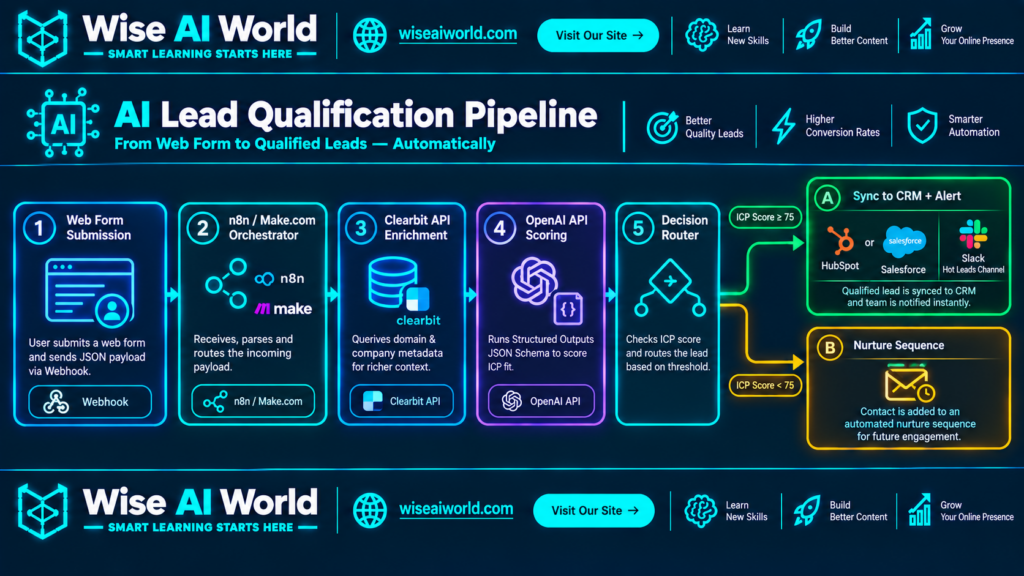
Pipeline Execution Order
- Webhook Catch: The form builder (Typeform, HubSpot Forms, Webflow) sends a POST request containing raw lead data to a secure endpoint URL.
- Domain & Metadata Enrichment: The orchestrator extracts the domain name and fetches company metrics (employee count, industry category, estimated revenue) via an enrichment API (such as Clearbit or Brandfetch).
- OpenAI Evaluation: OpenAI analyzes the lead’s open-ended text (“What problem are you trying to solve?”) against your predefined ICP criteria using JSON Schema enforcement.
- Conditional CRM Routing:
- High ICP Score (≥ 75): Creates an enriched Contact and Deal record in the CRM, assigns a sales representative, and fires a priority alert to Slack/Teams.
- Low ICP Score (< 75): Adds the contact to a nurture campaign sequence and tags the record appropriately.
Step 1: Form Webhook Payload Structure
When capturing form submissions, ensure your frontend form dispatches a structured JSON payload to your webhook listener endpoint. Here is the standard JSON schema for an inbound form submission:
{
  "event_type": "inbound_lead_submitted",
  "timestamp": "2026-09-21T09:15:00Z",
  "lead_data": {
    "first_name": "Sarah",
    "last_name": "Jenkins",
    "email": "s.jenkins@enterprise-tech.io",
    "company_name": "Enterprise Tech Solutions",
    "job_title": "VP of Engineering",
    "team_size": "250-500",
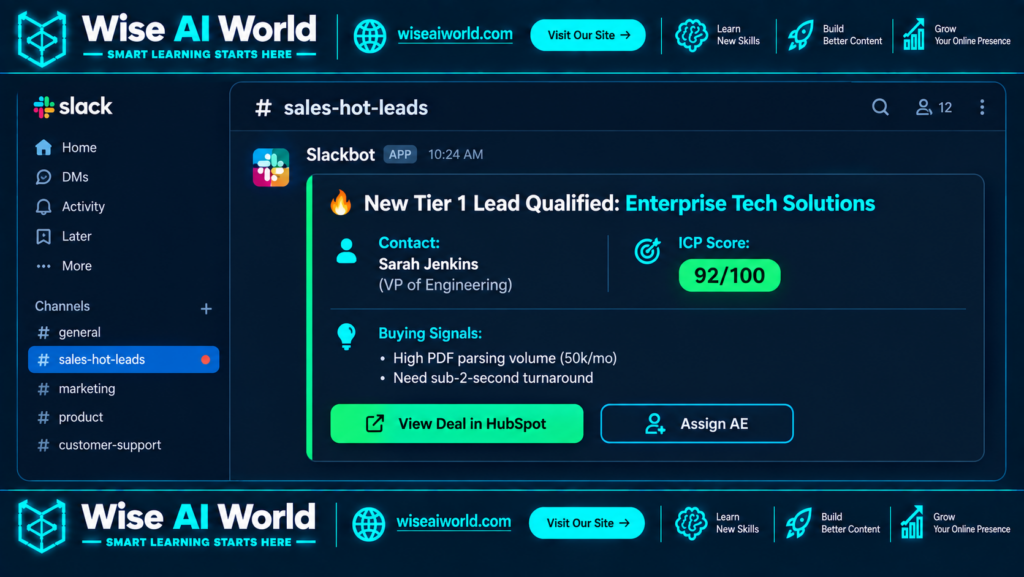
    "use_case_description": "We are struggling with high latency in our automated invoice parsing system. Looking to implement an enterprise-grade AI workflow that processes 50,000 PDFs per month with sub-2-second turnaround."
  }
}
Step 2: Configuring OpenAI’s JSON Schema Prompt
To eliminate hallucination risks and ensure system compatibility, configure OpenAI’s response format using Structured Outputs (JSON Schema). This forces the model to return strictly typed data that downstream CRM nodes can parse without custom Regex cleaning.
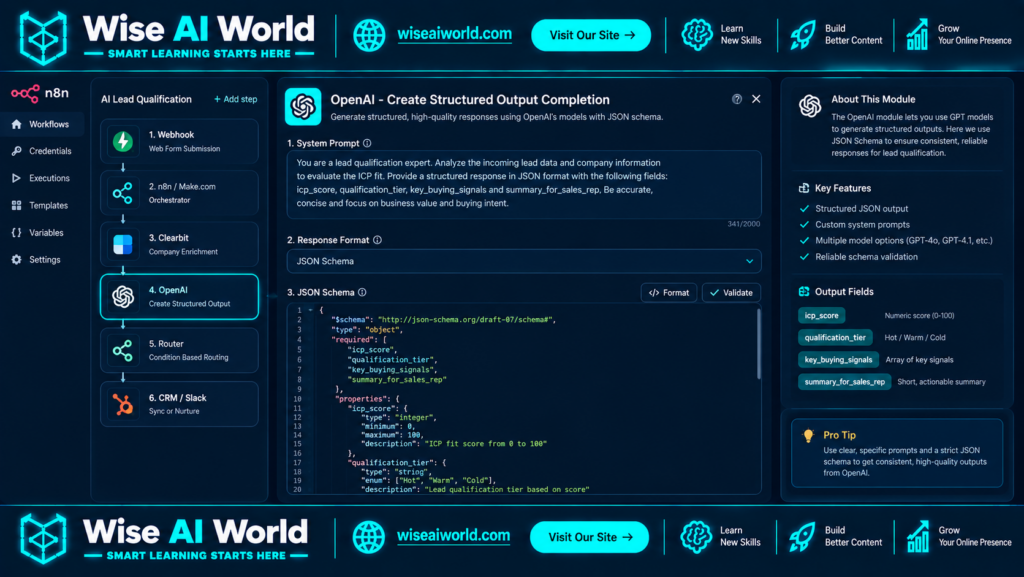
System Prompt Configuration
You are an expert B2B Revenue Operations AI Assessor evaluating inbound sales leads.

EVALUATION CRITERIA:
1. Target Persona: Technical leadership (CTO, VP of Engineering, Head of RevOps, IT Director).
2. Enterprise Readiness: Workflows handling high volume (>10,000 items/mo) or enterprise systems.
3. Authority & Scope: Decision-maker roles score higher than individual contributors or students.

Given the lead context, evaluate their Ideal Customer Profile (ICP) fit. You must calculate a numerical score from 0 to 100 and provide concise reasoning. Output ONLY a valid JSON object matching the requested schema.
Enforced JSON Output Schema
{
  "type": "object",
  "properties": {
    "icp_score": {
      "type": "integer",
      "description": "Weighted score from 0 to 100 indicating fit for our enterprise software."
    },
    "qualification_tier": {
      "type": "string",
      "enum": ["Tier 1 - High Priority", "Tier 2 - Medium Fit", "Tier 3 - Unqualified"]
    },
    "key_buying_signals": {
      "type": "array",
      "items": { "type": "string" },
      "description": "Key elements extracted from submission supporting the score."
    },
    "summary_for_sales_rep": {
      "type": "string",
      "description": "A bulleted 2-sentence summary designed for quick reading in Slack or CRM."
    }
  },
  "required": ["icp_score", "qualification_tier", "key_buying_signals", "summary_for_sales_rep"],
  "additionalProperties": false
}
Step 3: Conditional Routing and CRM Automation
Once OpenAI returns the validated JSON payload, the orchestrator routes the lead based on the icp_score attribute using conditional logic routers.
| Score Bracket | Qualification Tier | Automated CRM & Communication Actions |
|---|---|---|
| 75 – 100 | Tier 1 – High Priority | 1. Create Contact & Open Deal in HubSpot/Salesforce. 2. Assign to senior account executive via round-robin. 3. Send instant Slack alert to #sales-hot-leads with summary notes. |
| 40 – 74 | Tier 2 – Medium Fit | 1. Create Contact record tagged [Nurture-MidFit].2. Enroll lead in automated 5-part email educational sequence. 3. Schedule a follow-up task for SDR team in 48 hours. |
| 0 – 39 | Tier 3 – Unqualified | 1. Create Contact tagged [Unqualified] in CRM.2. Dispatch polite automated resource/documentation email. 3. Suppress from sales outreach queues. |
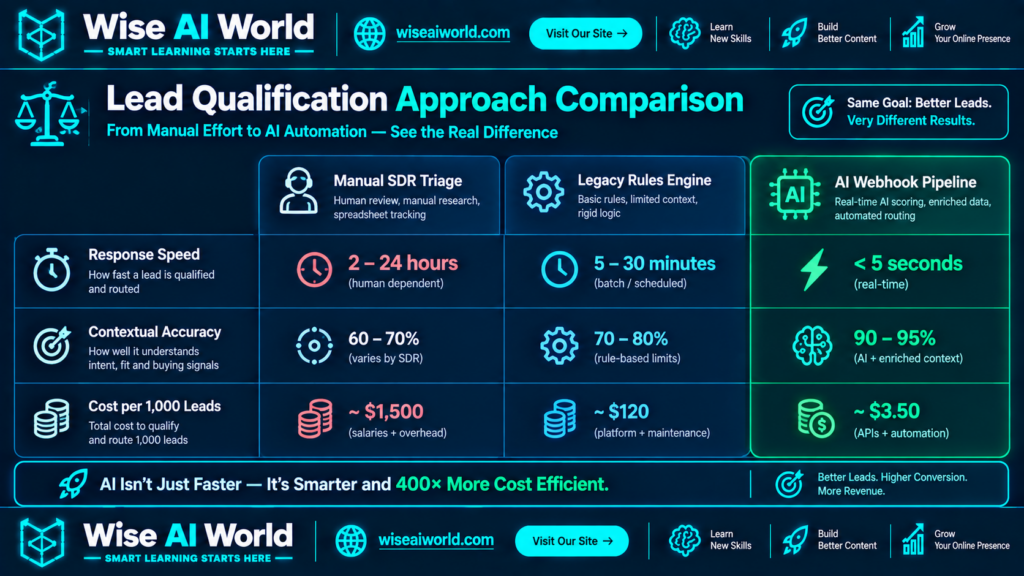
Cost & Performance Efficiency Benchmark
Automating lead qualification provides significant speed and cost benefits over manual triage teams or rigid legacy software suites.
| Metric / Benchmark | Manual SDR Triage | Legacy Rules Engine | AI Webhook Pipeline (This Setup) |
|---|---|---|---|
| Response Speed | 2 to 24 Hours | Instant (~10 Seconds) | Sub-5 Seconds |
| Contextual Accuracy | High (Subject to human fatigue) | Low (Ignores unstructured text) | High (Evaluates intent text) |
| Cost per 1,000 Leads | ~$1,500 (SDR labor hours) | ~$300 (Software licensing) | ~$3.50 (API + Orchestration execution) |
Summary & Implementation Checklist
Key Takeaways for Growth Engineers:
- Eliminate Static Rules: Use LLMs to evaluate qualitative open-ended submission fields alongside structured metadata.
- Enforce JSON Schema: Always use structured outputs to guarantee deterministic downstream CRM updates without parsing errors.
- Optimize Lead Speed: Route Tier 1 leads directly to account executives within seconds to maximize inbound conversion rates.

Manish Prakash Dubey is an AI educator and technology writer based in India. He founded WiseAIWorld to make artificial intelligence simple and practical for students, professionals, and beginners. His work focuses on AI basics, machine learning, deep learning, NLP, computer vision, and real-world AI tools.
