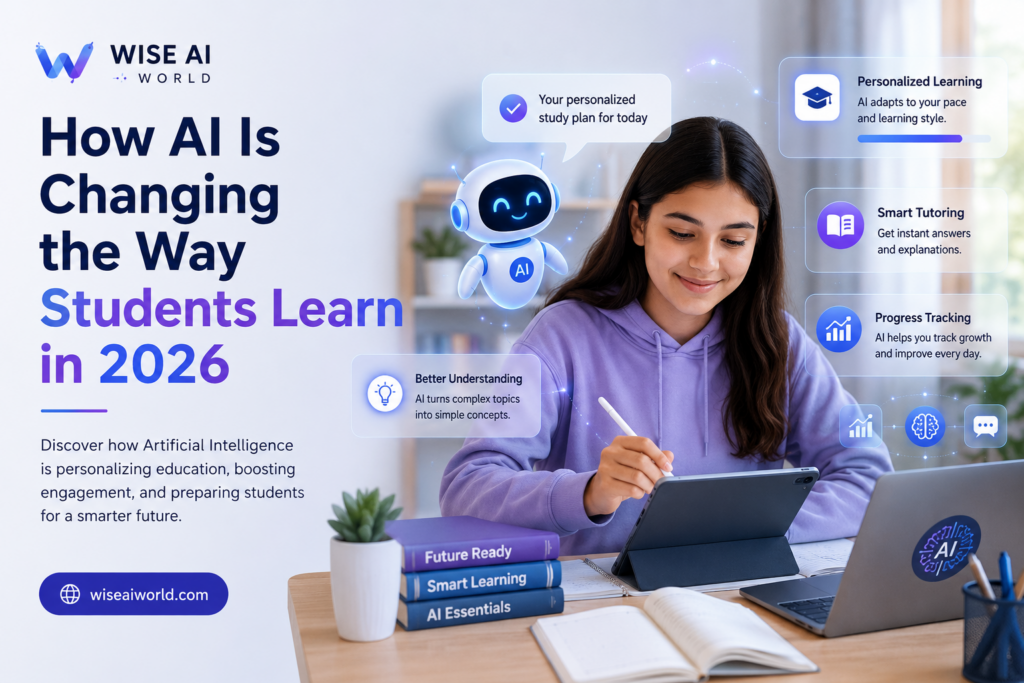
For most of the history of formal education, a fundamental tension has existed at the heart of teaching: a single teacher faces a classroom of thirty students, each learning at a different pace, with different strengths, different gaps in understanding, and different ways of engaging with material. The traditional solution has been standardization, teach everyone the same content at the same pace and hope most students keep up. Artificial intelligence is beginning to resolve this tension in ways that were simply not possible before.
According to a 2025 report by the Center for Democracy and Technology, cited by Faculty Focus, 85 percent of teachers and 86 percent of students used AI in the preceding school year. That near-universal adoption is not a reflection of a single tool or trend. It reflects the fact that AI has become embedded across multiple layers of how education is delivered, experienced, and assessed.
The Scale of AI in Education in 2026
The global AI in education market has grown from 5.18 billion US dollars in 2024 to 7.05 billion US dollars in 2025 and is projected to reach 112.3 billion US dollars by 2034, growing at 36 percent annually according to Passive Secrets’ comprehensive analysis of AI education statistics. That growth rate reflects extraordinary demand from schools, universities, corporate training programs, and self-directed learners worldwide.
Student adoption is particularly striking. According to Passive Secrets, 82 percent of college students now use AI tools in their academic work, compared with 58 percent of high school students. Meanwhile, 90 percent of educators believe generative can improve accessibility and personalized learning, and 81 percent feel optimistic about AI’s future in education. The overall picture is of a sector in rapid, largely willing transformation, accompanied by genuine and understandable concerns about integrity, equity, and the changing role of teachers.
Personalized Learning: Adapting to Every Student
The most fundamentally transformative application of AI in education is personalized learning, the ability to adapt instructional content, pacing, difficulty level, and feedback to the individual needs of each student rather than delivering a one-size-fits-all curriculum.
According to research published in Frontiers in Education, recent developments in generative AI and large language models have further revolutionized the personalized learning landscape, enabling systems to provide contextually appropriate feedback, generate customized learning materials, and engage in sophisticated natural language interactions with learners. AI systems can now adapt not just to what a student knows but to how they learn, their preferred explanation style, their engagement patterns, and their emotional state during a learning session.
According to Engageli’s guide to AI education statistics, AI optimizes learning experiences by focusing on areas where each person needs development rather than covering material they already know, making study time dramatically more efficient. A student who has already mastered a concept does not need to sit through instruction on it again, while a student who is struggling receives more examples, different explanations, and targeted practice rather than moving on before understanding is solid.
Research published in ScienceDirect’s systematic review of AI in personalized learning confirms that AI-driven personalized learning can significantly improve academic outcomes through adaptive feedback and data-driven instructional support, with evidence drawn from implementations across primary, secondary, and higher education in multiple countries.
AI Tutoring: A Patient, Always-Available Learning Partner
One of the most compelling practical applications of AI in education is AI tutoring, the use of conversational AI to provide one-on-one instructional support that adapts to the student’s questions and understanding in real time.
Research published in June 2025, cited by Engageli, found that AI tutoring outperforms in-class active learning in a randomized controlled trial, representing one of the strongest pieces of evidence yet that well-designed AI tutoring can produce learning gains that exceed those from traditional classroom instruction. The specific advantage of AI tutoring is its availability: it is accessible at any hour, never impatient, never embarrassing to ask a basic question, and capable of explaining the same concept ten different ways until one clicks for a specific student.
Tools like Khan Academy’s Khanmigo, built on
According to Novagrad’s analysis of AI personalized learning, AI-driven tutoring platforms are particularly valuable for language learning, where real-time conversational practice with immediate pronunciation and grammar feedback addresses one of the historically most difficult challenges for classroom language instruction: providing adequate speaking practice when classroom time is limited and teachers cannot give individual attention to thirty students simultaneously.
How AI Is Changing What Students Need to Learn
Beyond changing how students learn, AI is also changing what students need to learn. According to Engageli, Microsoft’s 2025 AI in Education Report found that AI fluency has become a baseline hiring requirement across industries. This means that understanding how to work effectively with AI tools, knowing when to trust AI outputs, when to question them, and how to use them productively, is now a foundational literacy for entering the workforce, alongside reading, writing, and arithmetic.
This shift has curriculum implications at every level of education. Schools are beginning to integrate AI literacy into existing subjects rather than treating it as a separate technology class. Students learning to write are taught to use AI tools ethically to improve drafts rather than generate them wholesale. Students learning research methods are taught to evaluate AI-generated information critically rather than accepting it at face value. This is consistent with the OECD’s 2026 Digital Education Outlook recommendation, cited by Engageli, of moving beyond general-purpose AI tools toward purpose-built educational AI designed to produce durable learning gains rather than simply better task outputs.
AI and Teacher Support: Reducing Workload and Expanding Capability
The impact of AI on education is not limited to students. Teachers are one of the most significant beneficiaries of AI tools when those tools are well implemented. According to Passive Secrets, 44 percent of educators who use AI say it reduces their workload and makes their job easier.
The most commonly automated tasks include generating quiz questions, grading multiple-choice and short-answer work, creating differentiated versions of the same lesson for different ability levels, producing lesson plan outlines, and generating written feedback on student work. Each of these tasks individually consumes significant teacher time. Together they can represent hours of administrative work per week that AI can handle in minutes, freeing teachers to focus on the relational, motivational, and mentorship dimensions of teaching that AI cannot replicate.
According to Novagrad, with AI taking care of repetitive tasks, content adaptation, and data analysis, teachers can focus more on mentorship. Students receive more personalized attention than ever before, and learners of all ages gain the confidence that comes from understanding material at their own pace. Ironically, AI may be making education more human rather than less, by removing the administrative burden that competes with teachers’ time for actual human connection with students.
AI in Higher Education and Corporate Training
The impact of AI in education extends beyond schools into universities and corporate training environments. In higher education, 82 percent of college students use AI tools, with the most common uses including research assistance, writing support, coding help, and study summarization.
In corporate training, according to Engageli, AI-powered learning platforms adapt training content to the existing knowledge level and role-specific needs of each employee, making onboarding and upskilling significantly more efficient than traditional one-size-fits-all training programs. The same personalization principles that improve outcomes in schools produce measurable efficiency gains in professional development contexts, where the cost of training time is directly connected to organizational productivity.
For students interested in building AI skills specifically, our guide on provides a structured path for learning these skills at any level.
The Challenges: Academic Integrity, Equity, and Teacher Preparedness
The transformative potential of AI in education comes with genuine challenges that educators, institutions, and policymakers are actively grappling with in 2026.
Academic integrity is the most pressing immediate concern. According to Passive Secrets, 72 percent of educators fear AI will increase plagiarism and cheating, and educators catching AI-related cheating rose from 53 percent to 61 percent in a single year. Only 40 percent of people believe AI is used ethically in classrooms, and student trust in ethical AI use is even lower at 29 percent. These figures reflect a genuine crisis of confidence in academic integrity that educational institutions are responding to with updated policies, AI detection tools, and assignment redesigns that emphasize process over product.
Teacher preparedness is a second significant challenge. According to Passive Secrets, 85 percent of teachers feel unprepared to manage AI in their classrooms, with 32 percent describing themselves as completely unprepared. This is not a reflection of teachers’ capabilities but of the speed at which AI has arrived in educational settings without adequate accompanying professional development.
Equity is a third concern. The benefits of AI-powered personalized learning are most accessible to students in well-resourced schools and families with reliable internet access and devices. Students in under-resourced schools and lower-income families risk being left behind as the gap between AI-enhanced and AI-limited educational experiences widens. According to research cited in ScienceDirect, data privacy and infrastructural inequality are among the primary challenges documented in AI personalized learning implementations across the US, China, and India.
These concerns are real and important. They are also addressable through thoughtful policy, investment in teacher training, and attention to equitable access. The ethical dimensions of AI in education connect to broader AI ethics questions explored in our article on .
Key Takeaways
- 85 percent of teachers and 86 percent of students used AI in the preceding school year according to the Center for Democracy and Technology 2025 report.
- The global AI in education market is growing at 36 percent annually, from 7.05 billion US dollars in 2025 to a projected 112.3 billion US dollars by 2034.
- AI personalized learning adapts content, pacing, and feedback to individual students, with research from Frontiers in Education confirming it significantly improves academic outcomes.
- A 2025 randomized controlled trial found AI tutoring outperforms in-class active learning, representing strong evidence for AI’s instructional effectiveness when well designed.
- 44 percent of educators say AI reduces their workload, allowing more focus on mentorship and human connection with students.
- 72 percent of educators fear AI will increase plagiarism, and teacher preparedness remains a significant challenge with 85 percent feeling unprepared to manage AI in their classrooms.
Conclusion
AI is not replacing teachers or making education impersonal. At its best, it is doing the opposite: taking on the administrative and repetitive dimensions of teaching so that human educators can focus on what only they can provide, mentorship, motivation, encouragement, and the relationship between teacher and student that research consistently identifies as one of the most important factors in educational outcomes.
For students, AI offers something that has never before been widely accessible: a patient, always-available learning partner that adapts to your pace, your gaps, and your way of thinking. The challenge for 2026 and beyond is ensuring that this opportunity is available equitably, used with integrity, and supported by teachers who feel confident and prepared rather than overwhelmed and displaced.
To explore how AI is transforming other major sectors alongside education, read our articles on , , and .
Sources
- Passive Secrets: 75 Plus AI in Education Statistics 2026 New Trends and Impact
- Faculty Focus: Designing the 2026 Classroom Emerging Learning Trends in an AI Powered Education System
- Engageli: 25 AI in Education Statistics to Guide Your Learning Strategy in 2026
- Frontiers in Education: AI in Education Systematic Review of Personalized Learning Trends 2026
- ScienceDirect: AI in Personalized Learning Global Systematic Review 2025
- Novagrad: AI Personalised Learning 2025 to 2026 Education Revolution

Manish Prakash Dubey is an AI educator and technology writer based in India. He founded WiseAIWorld to make artificial intelligence simple and practical for students, professionals, and beginners. His work focuses on AI basics, machine learning, deep learning, NLP, computer vision, and real-world AI tools.
