
The AI job market in 2026 is one of the most competitive and high-paying in all of technology, but it rewards a specific kind of preparation. According to Tredence’s 2026 interview guide, most candidates fail AI interviews not because they lack knowledge but because they prepare for the wrong exam. They memorize definitions and skip deployment context. They answer what a model does without explaining what it costs in production or why it sometimes fails. Interviewers at serious AI companies are not looking for people who can recite textbook definitions. They are looking for people who understand the underlying reasoning deeply enough to apply it to messy, real-world problems.
This guide covers the most common AI interview questions across three categories: conceptual and foundational questions, technical and algorithmic questions, and behavioural and situational questions. For each question, you will find not just an answer but an explanation of what interviewers are actually looking for and how to frame your response to demonstrate genuine understanding.
If you are still building your foundational knowledge before interview preparation, start with our guide on and our article on .
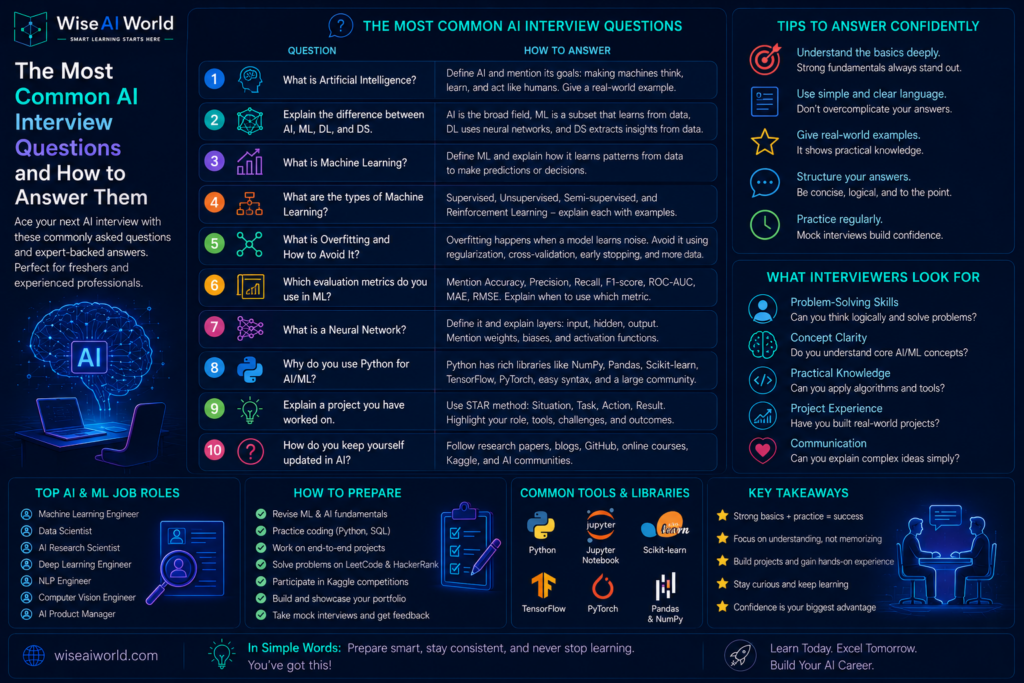
What to Expect in an AI Interview in 2026
According to Tredence, Gartner research identifies AI and machine learning engineers as the most in-demand role for 2026, and by 2027, 75 percent of hiring processes are projected to incorporate AI proficiency testing. IBM has publicly stated it is tripling US entry-level hiring to address a future leadership vacuum, and is specifically moving away from rote coding tests toward evaluating candidates’ ability to oversee and refine machine-generated work.
A typical AI interview in 2026 involves three to four rounds. An initial screen tests conceptual understanding through verbal or written questions. A technical round tests coding ability, algorithmic knowledge, or system design depending on the role. A case study or take-home assignment evaluates practical application on a real problem. A final round with senior staff or leadership tests communication, judgment, and cultural fit.
The questions below are drawn from real reported interviews at companies including Google, Meta, Amazon, Microsoft, and leading AI startups, compiled from sources including Exponent, The Ultimate Resources, and Simplilearn.
Section 1: Conceptual and Foundational Questions
Question 1: What Is the Difference Between AI, Machine Learning, and Deep Learning?
This is almost always the first question in any AI interview, and it is asked not because the answer is obscure but because how you answer it reveals your conceptual clarity. A weak answer recites three separate definitions. A strong answer explains the nested relationship.
Strong answer: Artificial intelligence is the broad goal of building systems that perform tasks requiring human intelligence. Machine learning is one approach to achieving that goal, where systems learn patterns from data rather than following manually written rules. Deep learning is a specialized subset of machine learning that uses multi-layered neural networks and excels at complex unstructured data like images, audio, and natural language. The relationship is nested: deep learning sits inside machine learning, which sits inside AI. Every deep learning system is a machine learning system. Every machine learning system is an AI system. But not every AI system uses machine learning, and not every machine learning system uses deep learning.
Read our full guide on if you want to deepen your understanding of this answer.
Question 2: What Is the Bias-Variance Tradeoff?
According to Vinsys and Simplilearn, this is one of the most consistently asked conceptual questions in machine learning interviews at every level.
Strong answer: Bias is error that comes from an overly simplistic model that misses real patterns in the data. A high-bias model underfits, performing poorly on both training and test data. Variance is error that comes from a model that is too sensitive to the specific training data it saw, capturing noise and irrelevant details rather than genuine patterns. A high-variance model overfits, performing well on training data but poorly on new data. The tradeoff is that as you increase model complexity to reduce bias, you typically increase variance, and vice versa. The goal in machine learning is finding the model complexity that minimizes total error, which means getting both bias and variance low enough for the specific task and dataset.
To demonstrate depth, add: In practice, the tools for managing this tradeoff include regularization to reduce variance, cross-validation to detect it, and early stopping in neural networks. Read more in our article on .
Question 3: What Is the Difference Between Supervised, Unsupervised, and Reinforcement Learning?
Strong answer: Supervised learning trains on labeled data where both inputs and correct outputs are provided. The model learns to map inputs to outputs, making it useful for classification tasks like spam detection and regression tasks like price prediction. Unsupervised learning works with unlabeled data, where the system identifies hidden patterns or groupings without guidance. Clustering algorithms like K-Means are common examples, used in customer segmentation and anomaly detection. Reinforcement learning trains through interaction with an environment, receiving rewards for good actions and penalties for bad ones, and learning over time to maximize cumulative reward. It powers game-playing AI systems like AlphaGo and is used in robotics and autonomous vehicle development.
What interviewers are listening for: an ability to not just define these but to connect them to real applications, which demonstrates practical understanding rather than textbook knowledge.
Question 4: What Is Overfitting and How Do You Prevent It?
Strong answer: Overfitting occurs when a model learns the training data too well, including noise and random fluctuations, rather than the underlying patterns. The result is a model that performs excellently on training data but poorly on new data it has never seen. Prevention techniques include getting more training data, using a simpler model if the current one is more complex than the problem requires, applying regularization such as L1 or L2 to penalize model complexity, using dropout in neural networks, applying early stopping to halt training when validation performance plateaus, using cross-validation to monitor generalization during training, and applying data augmentation to increase effective dataset size.
Question 5: What Is a Large Language Model and How Does It Work?
This question has moved from advanced to standard in AI interviews since 2023. According to Simplilearn, LLMs and NLP are the hottest ML topics in 2026.
Strong answer: A large language model is a type of deep learning model trained on enormous amounts of text data using a Transformer architecture. The Transformer uses self-attention mechanisms to weigh the relevance of every word in a sequence to every other word, allowing it to capture context across long passages rather than processing text sequentially. During training, the model learns statistical patterns between words, phrases, and concepts. At inference time, it generates text by predicting the most statistically appropriate next token given everything that came before it. Examples include GPT-4, Claude, and Gemini. LLMs can perform a wide range of language tasks without task-specific training through a technique called prompting, which directs the model’s generation with instructions in natural language.
Read our guide on for a deeper understanding of the underlying process.
Section 2: Technical and Algorithmic Questions
Question 6: What Is Gradient Descent and How Does It Work?
According to Exponent, gradient descent was the top reported ML interview question at OpenAI.
Strong answer: Gradient descent is the optimization algorithm used to train most machine learning models. The goal of training is to minimize a loss function, which measures how wrong the model’s predictions are. Gradient descent does this by calculating the gradient, which is the direction of steepest increase in the loss function, and then moving the model parameters in the opposite direction, downhill toward a minimum. The size of each step is controlled by the learning rate. If the learning rate is too large, the algorithm overshoots the minimum. If it is too small, convergence is very slow. Stochastic gradient descent updates parameters after each individual training example. Mini-batch gradient descent, the most common variant in practice, updates parameters after each small batch of examples, balancing computational efficiency with stability.
Question 7: What Is Retrieval-Augmented Generation and Why Does It Matter?
RAG has become a standard interview topic for AI engineering roles in 2026. According to The Ultimate Resources, this is one of the most practical AI skills tested in 2026 interviews.
Strong answer: Retrieval-Augmented Generation is a technique that enhances the accuracy and reliability of generative AI models by combining them with a retrieval system that fetches relevant information from an external knowledge base at inference time. The typical pipeline works as follows: the user submits a query, the query is converted into a vector embedding, a semantic search retrieves the most relevant document chunks from a vector database, those chunks are injected into the prompt as context, and the language model generates a grounded response using that context. RAG solves three key LLM limitations: hallucination, because responses are grounded in retrieved facts rather than generated from training patterns alone; stale knowledge, because the retrieval database can be updated without retraining the model; and lack of domain-specific knowledge, because proprietary or specialized documents can be indexed and retrieved without exposing them in model training.
Question 8: How Would You Handle Missing Data in a Machine Learning Dataset?
Strong answer: Handling missing data appropriately depends on the amount and pattern of missingness. The main approaches are removal, where rows or columns with missing values are dropped when the proportion is small and the missingness appears random; imputation with simple statistics, where missing values are replaced with the mean, median, or mode of the column; and advanced imputation, where missing values are predicted using algorithms like K-Nearest Neighbors or regression models based on the values of other features. In some cases, creating an additional binary feature indicating whether a value was missing can itself be informative for the model. The choice depends on how much data is missing, whether the missingness is random or systematic, and how important the affected features are to the prediction task.
Question 9: What Is the Difference Between Precision and Recall and When Does Each Matter?
Strong answer: Precision measures what proportion of the positive predictions the model made were actually correct. Recall measures what proportion of all actual positives the model successfully identified. There is typically a tradeoff between them: increasing the threshold for classifying something as positive increases precision but reduces recall, and vice versa. Which metric to optimize depends entirely on the consequences of each type of error. In a cancer screening tool, recall is more important because missing a true positive, a patient who has cancer, is far more costly than a false positive that leads to additional testing. In a spam filter, precision may matter more because repeatedly marking legitimate email as spam is more damaging to user trust than occasionally letting a spam message through.
Question 10: What Is Transfer Learning and Why Is It Useful?
Strong answer: Transfer learning involves taking a model that has already been trained on a large dataset for one task and adapting it for a different but related task, using the knowledge the model has already acquired. Rather than training a model from scratch, which requires enormous amounts of data and computing resources, transfer learning allows you to start with a pre-trained model and fine-tune it on a smaller task-specific dataset. This is why most practical deep learning applications today do not train models from scratch. A computer vision model might start with a model pre-trained on ImageNet. A language application might start with a pre-trained large language model like GPT or BERT and fine-tune it on domain-specific text. Transfer learning makes high-quality AI accessible for tasks and organizations that could not otherwise afford the data and compute required to train from scratch.
Section 3: Modern AI Topics Increasingly Tested in 2026
Question 11: What Is Prompt Engineering and What Are the Key Techniques?
According to The Ultimate Resources, prompt engineering is described as one of the most practical AI skills in 2026 and is now tested in interviews for roles ranging from AI engineering to product management.
Strong answer: Prompt engineering is the discipline of designing and optimizing inputs to large language models to achieve desired outputs reliably and efficiently. Key techniques include zero-shot prompting, where the model performs a task with no examples provided; few-shot prompting, where two to five examples are included in the prompt to guide output format and quality; chain-of-thought prompting, where the model is instructed to reason step by step before answering, which significantly improves performance on complex reasoning tasks; role prompting, where the model is assigned a specific persona or expertise level; and negative prompting, where the model is told explicitly what to avoid. The quality of a prompt significantly determines the quality of output, and prompt engineering bridges the gap between what a model can theoretically do and what it actually produces for a specific use case.
Question 12: What Is an AI Agent and How Does It Differ From a Chatbot?
Strong answer: A chatbot is a conversational system that responds to individual user inputs, typically following predefined flows or generating responses from a language model based on each turn of conversation. An AI agent is a more autonomous system that can plan, reason, use tools, and take sequences of actions to accomplish multi-step goals without requiring human guidance at each step. An agent can search the web, write and execute code, read files, send emails, and chain these actions together in pursuit of a broader objective. The key distinction is autonomy over time: a chatbot responds to what you say next, while an agent pursues a goal across many steps, making its own decisions about what actions to take. AI agents have become one of the fastest-growing application areas in 2026 and are increasingly tested in AI engineering interviews.
Section 4: Behavioural and Situational Questions
Question 13: Tell Me About an AI Project You Built
This is consistently one of the most important questions in any AI interview, and the most common source of failure among otherwise technically capable candidates. Interviewers are not primarily evaluating the impressiveness of the project. They are evaluating whether you can think and communicate like someone who builds AI systems professionally.
Strong structure for your answer: Start with the business or personal problem you were solving and why it mattered. Explain the data you used, where it came from, and any significant challenges with it. Describe the modelling approach you chose and, critically, why you chose it over alternatives. Discuss how you evaluated the model and what the results were, being honest about limitations. Explain what you would do differently if you were doing it again. Avoid jargon without explanation, do not skip over the data work which is often where the real learning happened, and be ready for follow-up questions on any technical decision you mention.
Question 14: How Do You Stay Current With AI Developments?
Strong answer: Give specific, genuine examples rather than generic statements. Name specific sources you follow: ArXiv for research papers, specific newsletters, particular researchers on LinkedIn or Twitter, relevant conferences like NeurIPS, ICML, and ICLR. Mention a specific recent development that interested you and what you found significant about it. If you have implemented anything you read about, mention that, since reading plus doing is far more credible than reading alone.
Question 15: How Would You Explain a Complex AI Concept to a Non-Technical Stakeholder?
This question is asked because the ability to communicate technical concepts clearly is one of the most valuable and least common skills in AI roles. According to Jobaaj Learnings, one of the most common interview mistakes is failing to explain reasoning clearly and rushing through answers.
Strong approach: Pick a genuinely complex concept such as a neural network, overfitting, or a recommendation algorithm. Explain it using an analogy that connects to the stakeholder’s existing experience. Then explain the business implication. For example, to explain overfitting to a business stakeholder: “Imagine training a new sales representative by having them memorize the exact scripts from our ten best sales calls last year. In those specific situations they would perform perfectly. But when they encounter a slightly different customer situation, they would be lost because they memorized examples rather than understanding the underlying principles of good selling. That is what overfitting means for an AI model.”
Salary Benchmarks Worth Knowing
According to Tredence’s March 2026 Glassdoor data, AI and ML roles command some of the highest compensation in technology. Entry-level machine learning engineer roles start between 100,000 and 150,000 US dollars annually in the US market. Mid-level roles sit between 150,000 and 220,000 US dollars. Senior roles and specialist positions command 220,000 US dollars and above in total compensation at major technology companies. BCG research cited by Simplilearn indicates that AI-mature firms are seeing five times revenue increases and three times cost reductions compared to laggards, explaining why demand for AI talent commands this premium.
Common Interview Mistakes to Avoid
According to Jobaaj Learnings, the most common AI interview mistakes are not explaining your thought process, rushing through answers, and failing to articulate complex concepts clearly. Interviewers care as much about how you think as what you know. Talking through your reasoning, acknowledging uncertainty honestly, and asking clarifying questions when a problem is ambiguous are all positive signals, not weaknesses.
Memorizing definitions without understanding the reasoning behind them is the technical version of the same mistake. If you cannot explain why gradient descent uses the gradient rather than just what gradient descent is, or why you would choose precision over recall in a specific scenario rather than just defining both terms, you will fail technical questions even if your definitions are word-perfect.
Key Takeaways
- AI and machine learning engineers are the most in-demand tech role for 2026 according to Gartner, with 75 percent of hiring processes projected to incorporate AI proficiency testing by 2027.
- The most consistently asked foundational questions cover the AI versus ML versus deep learning distinction, bias-variance tradeoff, overfitting, and the three types of machine learning.
- Modern AI interviews increasingly test knowledge of large language models, RAG, prompt engineering, and AI agents alongside traditional machine learning fundamentals.
- Interviewers evaluate how you think and communicate as much as what you know. Explaining your reasoning, not just your conclusions, is one of the most important skills to demonstrate.
- The ability to explain complex AI concepts to non-technical stakeholders is one of the most consistently valued skills across all AI roles.
- Entry-level AI engineering roles start at 100,000 to 150,000 US dollars in the US market, with mid-level roles reaching 220,000 US dollars and above.
Conclusion
Preparing for AI interviews in 2026 means building genuine understanding of foundational concepts, staying current with modern developments including large language models, RAG, and AI agents, and practising the communication skills needed to explain technical ideas clearly to both technical and non-technical audiences. The candidates who succeed are not necessarily those who have studied the most topics but those who understand their chosen topics deeply enough to reason through unfamiliar variations and explain their thinking under pressure.
Use the questions and answers in this guide as a starting point, then deepen your understanding of each topic through the related guides linked throughout. For a broader career strategy including portfolio building, certifications, and timelines, read our full guide on .
Sources
- Tredence: Top 20 AI and Machine Learning Interview Questions 2026
- The Ultimate Resources: Top 25 AI and Machine Learning Interview Questions 2026
- Exponent: Top ML Interview Questions 2026 Guide
- Simplilearn: 60 Plus Machine Learning Interview Questions and Answers
- Jobaaj Learnings: Top AI Interview Questions and Answers in 2026
- Vinsys: Top 30 AI Interview Questions and Answers 2026

Manish Prakash Dubey is an AI educator and technology writer based in India. He founded WiseAIWorld to make artificial intelligence simple and practical for students, professionals, and beginners. His work focuses on AI basics, machine learning, deep learning, NLP, computer vision, and real-world AI tools.
