
When most people think of Machine Learning (ML), they visualize futuristic robotics, high-performance GPU clusters, or self-driving autonomous vehicles. In reality, machine learning is not locked inside research laboratories. It is silently running in the background of almost every mobile application installed on your smartphone right now.
Every time you unlock your phone with a glance, check your email, stream a personalized music playlist, or follow real-time traffic navigation, sophisticated statistical algorithms process millions of data points to optimize your digital experience.
In this detailed deep dive, we will peel back the technical curtain to examine how machine learning powers the everyday apps you already rely on—and how these invisible algorithms shape modern digital interactions.
1. The Invisible Engine: How ML Transforms Static Software
Traditional software engineering relies on deterministic code: developers write explicit “if-then” rules to handle predefined scenarios. If an unexpected condition occurs, traditional code fails.
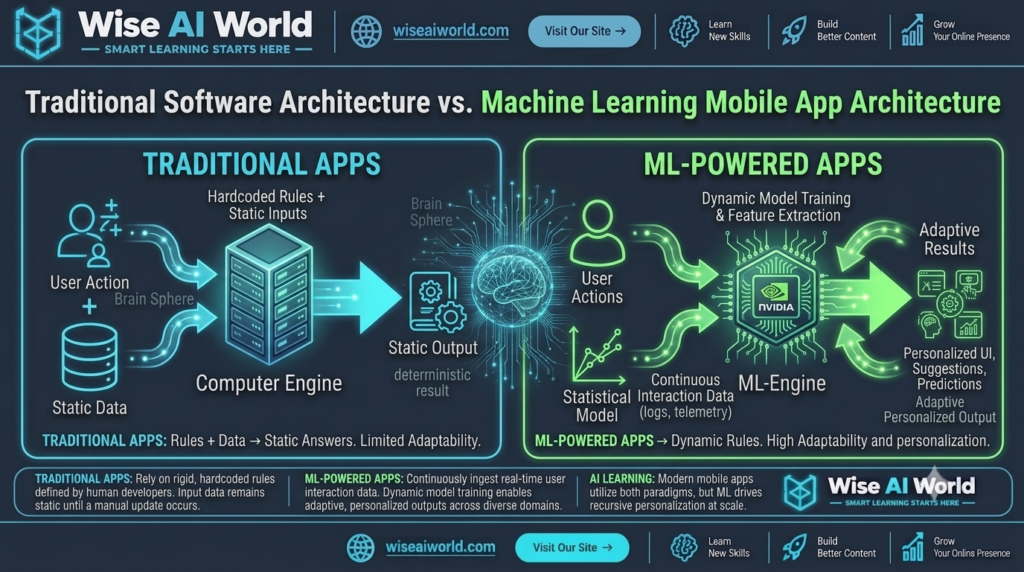
Machine learning replaces rigid rule sets with statistical pattern recognition. Instead of following fixed instructions, ML-powered apps analyze continuous user telemetry—clicks, pause duration, location coordinates, typing speeds, and interaction timing—to adapt their user interface and functionality dynamically in real time.
2. Comprehensive Matrix: Everyday Apps and Their ML Engines
The matrix below highlights the specific machine learning algorithms and technical paradigms operating behind five popular consumer platforms.
| Application | Core Feature | Underlying ML Technique | Primary Data Inputs |
|---|---|---|---|
| Google Maps | Predictive Traffic & ETA Routing | Graph Neural Networks (GNNs) & Time-Series Regression | Real-time GPS telemetry, historical speed patterns, road conditions. |
| Spotify | Discover Weekly & Recommendation Engine | Collaborative Filtering & Convolutional Audio CNNs | User listening history, song skip rates, raw audio spectrogram analysis. |
| Gmail | Spam Protection & Smart Reply | Transformer-based Natural Language Processing (NLP) | Header metadata, semantic text structure, user flag actions. |
| Netflix | Personalized Artwork & Content Ranking | Contextual Multi-Armed Bandits & Deep Learning | Viewing history, thumbnail click-through rates, time of day, device type. |
| Mobile Banking Apps | Real-Time Fraud Prevention | Isolation Forests & Anomaly Detection Algorithms | Transaction amounts, geolocation coordinates, merchant categories, behavioral patterns. |
3. Deep Dive: ML Implementation in 5 Everyday Applications
1. Navigation Apps: Google Maps and Traffic Prediction
Google Maps does not simply calculate distances based on road length. It combines real-time GPS signals from millions of active smartphones with historical speed data to predict traffic congestion before it happens.
By leveraging Graph Neural Networks (GNNs), Google Maps models road networks as interconnected nodes and edges. The system evaluates current vehicle velocities, localized construction reports, time-of-day variables, and historical traffic bottlenecks to forecast travel times accurately and recalculate optimal alternative routes dynamically.
2. Audio Streaming: How Spotify’s Recommendation Engine Works
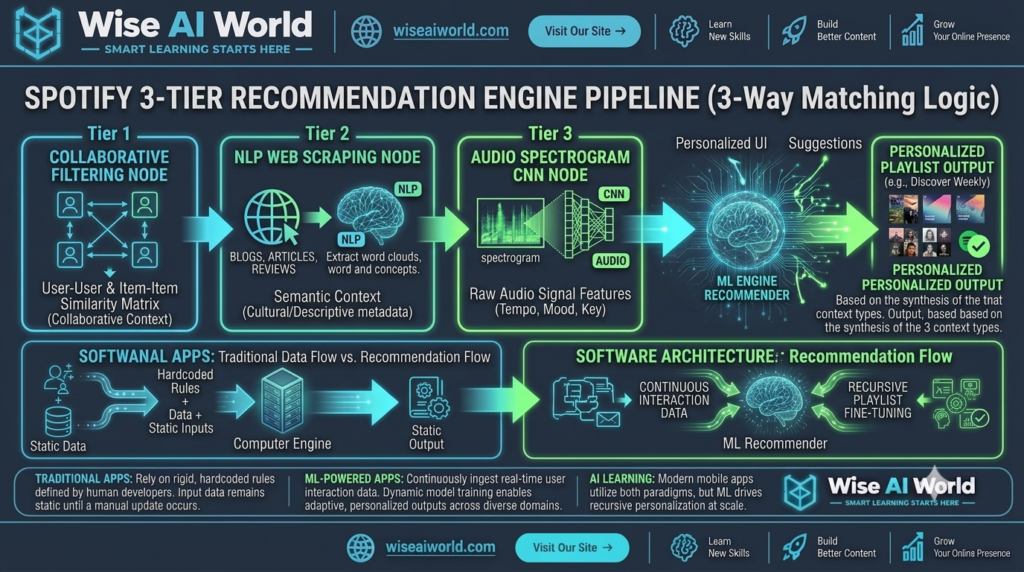
Spotify’s flagship discovery feature, Discover Weekly, uses three distinct machine learning layers working in tandem:
- Collaborative Filtering: Compares your listening habits against millions of other users. If User A and User B share 90% of their saved tracks, the algorithm recommends the remaining 10% to each other.
- Natural Language Processing (NLP): Continuously scrapes music blogs, news articles, and social media reviews to track terms used to describe specific tracks and artists.
- Audio Feature Extraction (CNNs): Analyzes raw acoustic wave files—examining key signatures, tempo, time signatures, and harmonic cadence—to identify musical similarity even for brand-new artists with zero playback history.
3. Email Security: Gmail’s NLP Spam and Phishing Protection
Modern email filters do not simply check messages against static lists of blocked senders. Gmail’s machine learning framework processes billions of incoming messages daily using advanced classification models.
The system analyzes sender IP reputation, header structure, link validity, and the semantic intent of the text body. If a message mimics phishing patterns (such as urgent requests for credentials or suspicious link redirects), the classifier flags the email as spam instantly—achieving over 99.9% protection accuracy.
4. Video Streaming: Netflix’s Personalized UI and Thumbnail Optimization
Two users opening Netflix on the same device will often see completely different artwork for the exact same movie. Netflix uses Contextual Multi-Armed Bandit algorithms to personalize thumbnail graphics dynamically.
If a user frequently watches romantic comedies, the algorithm displays a movie poster featuring the lead romantic actors. If another user prefers action blockbusters, the platform displays an explosion or intense chase scene from the same film to maximize click-through probability.
5. Financial Security: Real-Time Banking Anomaly Detection
When you swipe your credit card or send a mobile payment, automated machine learning models evaluate the transaction in under 100 milliseconds. Anomaly detection models compare the transaction against your baseline behavior—evaluating device IDs, geographic location, merchant category, and spending velocity.
If an account based in Chicago suddenly attempts an unusual high-value transaction in another country without traveling, the local ML engine automatically blocks the transaction and sends a push confirmation alert to your phone.
4. Everyday Smartphone Hardware Integrations
Machine learning in mobile apps is no longer restricted to cloud data centers. Modern smartphones include dedicated hardware called **Neural Processing Units (NPUs)** or **Tensor Cores** that perform ML inference directly on device.
- Biometric Facial Recognition: Smartphone facial unlock systems convert infrared depth maps of your face into numerical embeddings, verifying your identity locally without sending biometric data to external servers.
- Predictive Mobile Keyboards: Keyboard apps (like Gboard or SwiftKey) use local language models to learn your typing habits, vocabulary, and common phrases to offer instant auto-suggestions.
- Camera Image Signal Processing (Computational Photography): When you capture a photo in low light, local convolutional neural networks process multiple raw exposures simultaneously—reducing noise, sharpening edges, and adjusting white balance before saving the image file.
5. Summary: The Future of Everyday Machine Learning
Machine learning has quietly integrated into the core architecture of modern mobile applications. As on-device processing power increases and local models grow more efficient, consumer software will continue shifting toward proactive, contextual, and hyper-personalized experiences.
| App Domain | Primary ML Benefit | Next-Gen Evolution |
|---|---|---|
| Navigation & Mobility | Real-time route optimization | Predictive multimodal trip planning and micro-mobility integration. |
| Media & Streaming | Personalized discovery and content ranking | Generative real-time UI layouts and context-aware dynamic audio processing. |
| Communication & Productivity | Automated filtering and smart text generation | Autonomous task execution agents operating via voice and text commands. |

Manish Prakash Dubey is an AI educator and technology writer based in India. He founded WiseAIWorld to make artificial intelligence simple and practical for students, professionals, and beginners. His work focuses on AI basics, machine learning, deep learning, NLP, computer vision, and real-world AI tools.
