
Artificial Intelligence is frequently discussed as a single monolithic technology. However, the systems powering customer support chatbots today are fundamentally different from the theoretical systems that researchers refer to as “human-level intelligence.”
To accurately categorize the capabilities, evolutionary trajectory, and technical limitations of machine intelligence, computer scientists classify Artificial Intelligence into three distinct developmental stages: Artificial Narrow Intelligence (ANI), Artificial General Intelligence (AGI), and Artificial Superintelligence (ASI).
In this comprehensive guide, we will break down the structural differences, underlying architectures, real-world examples, and ethical implications of these three stages of AI evolution.
1. The Evolutionary Spectrum of Artificial Intelligence
Understanding the types of AI requires viewing them along an evolutionary spectrum measured by cognitive capability, adaptability, and contextual understanding.
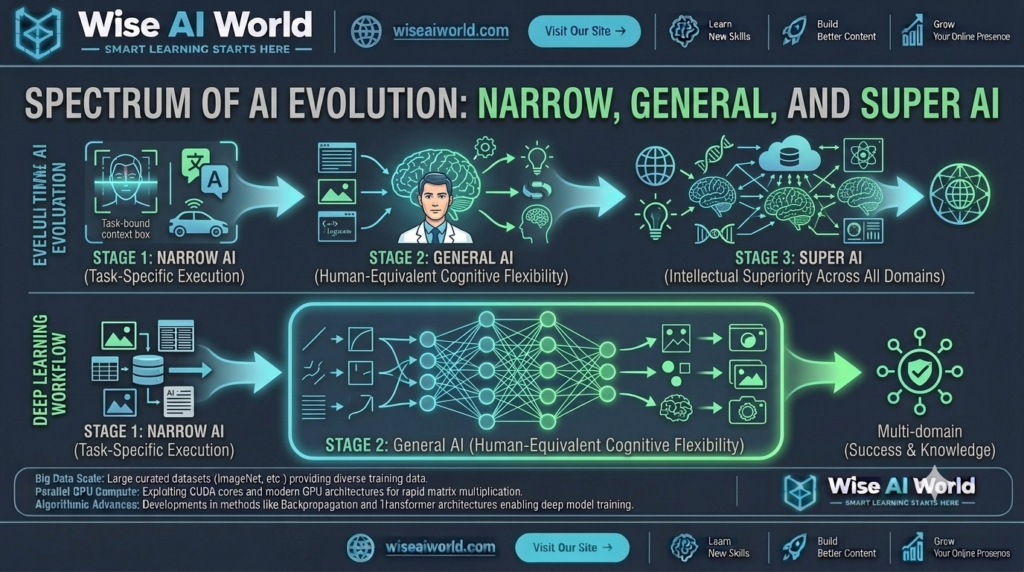
The 3 Core Developmental Stages
- Artificial Narrow Intelligence (ANI) / Weak AI: Systems designed and trained to perform a single specific task or a narrow set of related tasks. ANI operates under strict domain constraints and cannot transfer its learned capabilities to unprogrammed domains.
- Artificial General Intelligence (AGI) / Strong AI: Theoretical machines capable of understanding, learning, and applying intellectual capabilities across diverse domains at a level equivalent to a human being. AGI possesses cross-domain reasoning, transfer learning, and autonomous adaptability.
- Artificial Superintelligence (ASI): Theoretical AI that surpasses human intelligence across every field—including scientific creativity, emotional intelligence, strategic reasoning, and social skills.
2. Comprehensive Comparison: ANI vs. AGI vs. ASI
The matrix below compares the structural, operational, and practical differences across all three stages of artificial intelligence.
| Dimension | Narrow AI (ANI) | General AI (AGI) | Super AI (ASI) |
|---|---|---|---|
| Current Status | Fully Deployed & Operational | Theoretical / Active Research | Speculative / Theoretical Concept |
| Scope of Work | Task-Specific (Single Domain) | Multi-Domain & Adaptable | Universal (Outperforms Humans in All Domains) |
| Cognitive Flexibility | None. Fails outside its training context. | High. Possesses zero-shot transfer learning. | Infinite. Capable of recursive self-improvement. |
| Real-World Examples | AlphaGo, Llama 3, Siri, Autonomous Driving ML | None (Hypothetical) | None (Hypothetical) |
| Underlying Architecture | Deep Neural Networks, Transformers, CNNs | Hybrid Cognitive Architectures, Neuromorphic Hardware | Recursive Self-Improving Neural Systems / Quantum AI |
3. Deep Dive into the 3 Stages of AI
1. Artificial Narrow Intelligence (ANI): The World Today
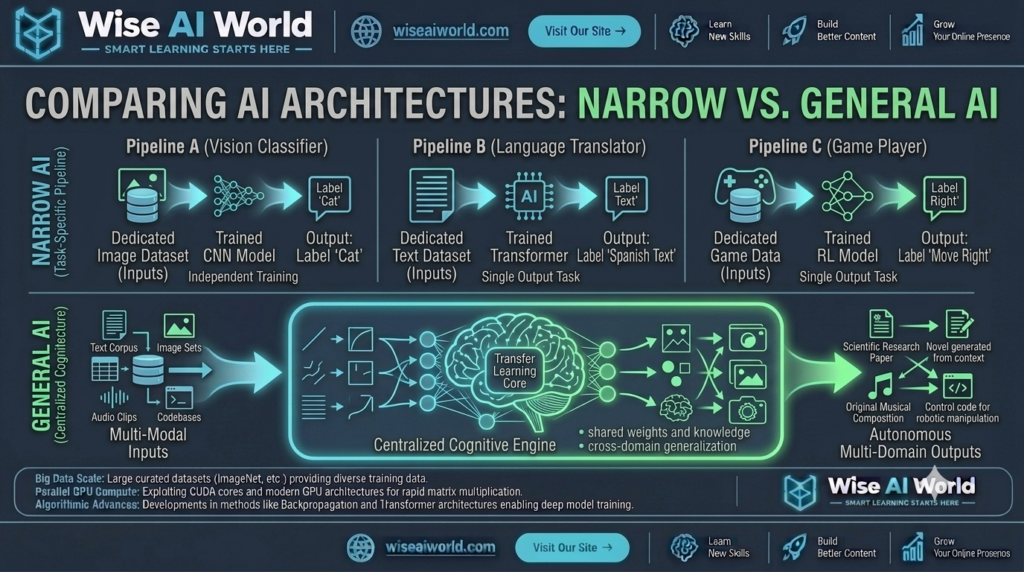
Every commercial AI application in existence today falls strictly into the category of Artificial Narrow Intelligence. Narrow AI systems are optimized to execute a specialized function with incredible precision—often exceeding human capabilities within that constrained boundary—but they lack consciousness or generalized awareness.
For example, a state-of-the-art chess engine like Stockfish can easily defeat human grandmasters. However, that same chess engine cannot analyze a financial balance sheet, summarize a news article, or distinguish a cat from a dog without being completely re-architected and trained on entirely different datasets.
Even modern Large Language Models (LLMs) like GPT-4o or Llama 3—despite their vast knowledge bases and fluent conversational ability—remain sophisticated forms of Narrow AI. They rely on high-dimensional statistical pattern matching (predicting the next token) rather than genuine understanding or autonomous reasoning.
2. Artificial General Intelligence (AGI): The Next Frontier
Artificial General Intelligence represents a theoretical paradigm shift where a machine possesses the ability to perform any intellectual task that a human being can do. Key attributes required for an engine to achieve AGI status include:
- Transfer Learning: The ability to apply skills learned in one domain (e.g., playing piano) to a completely unrelated domain (e.g., solving software architecture problems).
- Abstract Reasoning: Understanding underlying conceptual frameworks rather than memorizing statistical patterns in training data.
- Common Sense & Contextual Awareness: Intuiting unstated physical, social, and cultural rules without explicit prompt guidance.
- Autonomous Goal Formation: Setting sub-goals to solve complex, open-ended problems without continuous human oversight.
3. Artificial Superintelligence (ASI): The Theoretical Horizon
Super AI refers to a hypothetical future point where artificial intelligence surpasses the combined cognitive output of all human minds across every discipline. Popularized by AI theorists like Nick Bostrom, ASI is closely associated with the concept of the Technological Singularity.
The defining characteristic of ASI is recursive self-improvement: a superintelligent system could design its own hardware upgrades and rewrite its own software architecture at lightspeed, leading to an exponential explosion in intelligence that outpaces human comprehension.
4. Secondary Classification: Functional AI Types
In addition to the developmental stages (ANI, AGI, ASI), computer scientists also categorize AI systems based on their functional capabilities as proposed by researcher Arend Hintze:
- Reactive Machines: The most basic form of AI. They do not possess memory and cannot use past experiences to inform current decisions (e.g., IBM’s Deep Blue).
- Limited Memory AI: Systems that store historical data for a short duration to make informed decisions. Modern autonomous vehicles use limited memory AI to monitor speed, lane position, and surrounding traffic over time.
- Theory of Mind AI: A theoretical class of AI that understands human emotions, beliefs, and thought processes, allowing machines to interact socially as psychological equals.
- Self-Aware AI: The ultimate theoretical stage where a machine gains self-awareness, consciousness, and an understanding of its own existence independent of human operators.
5. Strategic Summary & What It Means for Enterprise Strategy
Understanding where AI capabilities currently stand prevents business leaders and engineers from misallocating capital or falling for speculative hype cycles.
| Stage | Engineering Horizon | Enterprise Action Plan |
|---|---|---|
| Narrow AI (ANI) | Active Today | Deploy immediately for workflow automation, customer service, document parsing, and predictive modeling. |
| General AI (AGI) | Estimated 5 to 20+ Years | Monitor academic research, invest in flexible API infrastructure, and establish AI ethics frameworks. |
| Super AI (ASI) | Theoretical Future | Participate in AI alignment frameworks, governance policies, and safety protocols. |
Disclosure: WiseAIWorld independently evaluates AI frameworks, machine learning models, and automated software platforms. Some links on this page contain affiliate tracking codes. If you register through these links, we may earn a small commission at no extra cost to you.

Manish Prakash Dubey is an AI educator and technology writer based in India. He founded WiseAIWorld to make artificial intelligence simple and practical for students, professionals, and beginners. His work focuses on AI basics, machine learning, deep learning, NLP, computer vision, and real-world AI tools.
