
Imagine applying for a loan and being rejected by an algorithm that no one at the bank can fully explain. Imagine a hiring system that quietly filters out qualified candidates because of patterns in historical data that reflect decades of past discrimination. Imagine a video of a public figure saying something they never said, indistinguishable from reality to most viewers. These are not hypothetical scenarios from a distant future. They are real situations that have already happened, and they sit at the heart of why AI ethics matters to every single person, not just researchers and policymakers.
This article explains what AI ethics is, why it has become one of the most important topics in technology, and what it means for you whether you are a casual user of AI tools, a business owner, or simply someone living in a world increasingly shaped by automated decisions.
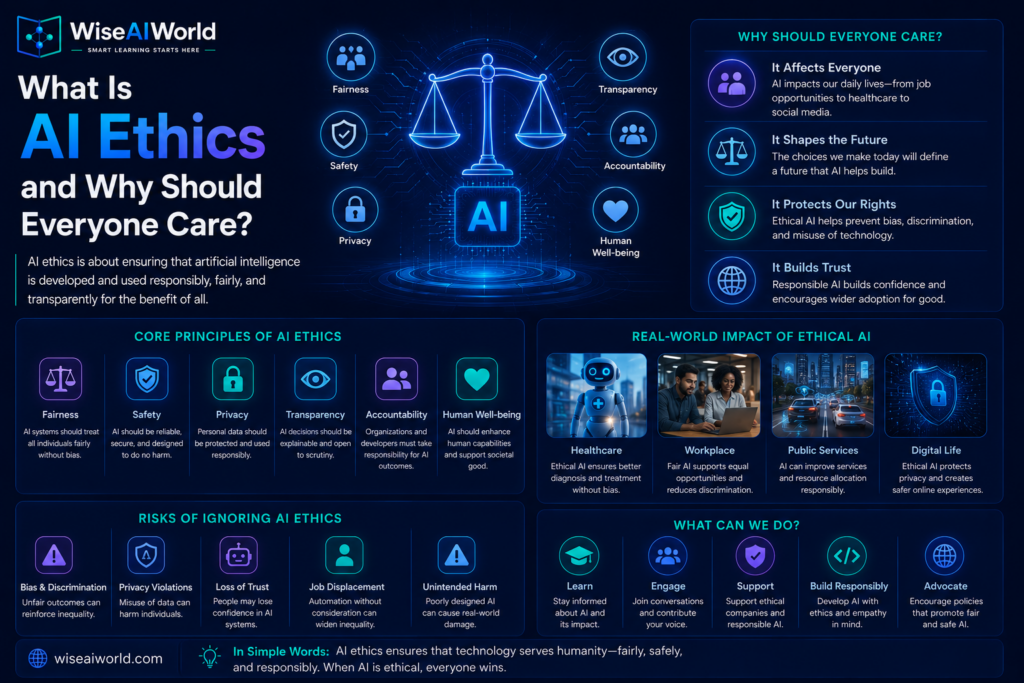
What Is AI Ethics?
AI ethics is the field concerned with the moral principles and values that should guide the development, deployment, and use of systems. It addresses questions about fairness, accountability, transparency, privacy, and the broader social impact of AI technology.
According to research published on arXiv, contemporary thinkers have identified three major areas of ethical concern regarding AI: privacy and surveillance, bias and discrimination, and the downgrading of human judgment in crucial decisions. Philosopher Michael Sandel has framed this last concern as a question about whether algorithms can replace elements of human deliberation such as doubt, empathy, and practical wisdom in decisions that affect people’s lives.
AI ethics is not an abstract academic exercise. It directly shapes how AI systems are designed, what data they are trained on, what safeguards are put in place, and ultimately who benefits and who is harmed by AI deployment.
Why AI Ethics Matters More Than Ever in 2026
The urgency around AI ethics has grown directly alongside AI adoption. As AI systems move from experimental tools into systems that make or influence real decisions about hiring, lending, healthcare, policing, and content moderation, the consequences of getting these systems wrong become far more serious.
Trust has also become a measurable business factor. According to Edelman’s 2025 Trust Barometer, cited by EIF, 72 percent of consumers say they are more likely to use AI products from companies that are transparent about how their AI works. This means ethical AI practices are not just a moral consideration but increasingly a competitive and commercial one.
Algorithmic Bias and Discrimination
One of the most documented AI ethics issues is algorithmic bias, where AI systems produce systematically unfair outcomes for certain groups of people. According to EIF, real-world examples ranging from biased hiring algorithms to opaque credit scoring systems have made the consequences of unregulated AI impossible to ignore.
Bias in AI systems typically originates from training data. If historical hiring data reflects decades of bias against certain groups, a model trained on that data will learn and potentially amplify those same patterns, even without anyone explicitly programming discrimination into the system. The model is simply learning from the data it was given, and if that data reflects biased human decisions, the model reproduces that bias at scale.
This is particularly concerning in high-stakes areas. In healthcare, research published in 2026 examining the EU AI Act, available via the National Library of Medicine, highlights that medical AI systems need their performance examined across different subgroups, such as by sex and ethnicity, to reveal potential biases that could otherwise go undetected and result in worse healthcare outcomes for underrepresented groups.
Privacy and Surveillance
AI systems, particularly those involving and facial recognition, raise significant privacy concerns. The ability to identify individuals from images and video at scale creates possibilities for surveillance that did not previously exist, and these capabilities have outpaced the legal and ethical frameworks designed to govern them.
According to the Decode the Future analysis of the EU AI Act, certain particularly invasive uses of AI have already been banned in the European Union since February 2025. These prohibited practices include government social scoring systems that evaluate citizens based on behavior, real-time remote biometric identification in public spaces by law enforcement except in narrow circumstances like terrorism or missing persons cases, emotion recognition systems in workplaces and schools, and the untargeted scraping of facial images from the internet or security cameras to build facial recognition databases.
These prohibitions represent some of the first concrete legal lines drawn around what societies consider acceptable uses of AI, and they reflect genuine concerns about how easily AI capabilities can be turned toward mass surveillance.
Accountability: Who Is Responsible When AI Makes a Mistake?
One of the thorniest questions in AI ethics is accountability. When a self-driving car is involved in an accident, when a medical AI tool contributes to a misdiagnosis, or when an automated content moderation system wrongly removes someone’s content, who bears responsibility?
This question is genuinely difficult because AI systems involve multiple parties: the developers who built the underlying model, the company that deployed it for a specific purpose, the people who selected and prepared the training data, and the end users who operate the system. Unlike traditional software, where a bug can often be traced to a specific line of code, AI systems based on produce outputs through processes that are often described as black boxes, even by the people who built them, making it genuinely difficult to explain why a specific decision was made.
This is why explainable AI, the effort to make AI decision-making processes more transparent and interpretable, has become an important area of both technical research and regulatory focus. Without some degree of explainability, meaningful accountability becomes very difficult to establish.
Deepfakes and Misinformation
Generative AI has made it possible to create remarkably convincing fake images, audio, and video, commonly known as deepfakes. While this technology has legitimate creative and educational applications, it has also been used to create non-consensual intimate imagery, impersonate public figures, and spread misinformation.
According to Decode the Future, regulatory responses are actively evolving in response to specific incidents. As of early 2026, European lawmakers were negotiating amendments to add AI-generated non-consensual intimate imagery, sometimes referred to as nudification tools, to the list of prohibited AI practices, a direct response to real incidents involving deepfake imagery on major platforms.
The speed at which this technology has advanced has consistently outpaced both public awareness of how to spot fake content and the legal frameworks needed to address misuse, making media literacy and critical evaluation of online content more important than ever.
How Governments Are Responding: The Global Regulatory Landscape
Governments around the world are responding to these ethical concerns with new regulatory frameworks, though the approach varies significantly by region.
The European Union has taken the most comprehensive approach with the EU AI Act, described by the Council of the European Union as the world’s first law specifically regulating artificial intelligence. The Act categorizes AI systems into different risk levels and imposes obligations accordingly. According to IBM, rules for general-purpose AI models took effect from August 2025, with rules for high-risk AI systems, covering areas like hiring, credit scoring, and biometric identification, set to apply from August 2026.
According to EIF, the United States has taken a more sector-specific approach, with agencies like the Federal Trade Commission, Food and Drug Administration, and Securities and Exchange Commission issuing domain-specific AI rules rather than a single comprehensive law. This reflects a broader global pattern where the regulatory approach to AI ethics remains fragmented but is accelerating across virtually every major economy.
The European Commission has also encouraged voluntary commitments ahead of full regulatory enforcement. According to Baker McKenzie, over 100 companies had joined the voluntary AI Pact by September 2024, agreeing to work toward future compliance by identifying high-risk systems and promoting AI literacy among their staff ahead of mandatory requirements.
What AI Ethics Means for Everyday Users
You do not need to be a policymaker or AI developer for these issues to matter to you. AI ethics affects everyday users in several concrete ways.
When AI systems make decisions that affect you, such as a loan application, a job application screened by automated systems, or insurance pricing, understanding that these systems can carry biases inherited from historical data gives you grounds to ask questions and, where possible, seek human review of automated decisions.
When evaluating content you encounter online, particularly images, audio, or video involving public figures or sensational claims, awareness that AI-generated and manipulated content is increasingly sophisticated and widespread should inform how readily you accept and share such content.
What Responsible AI Development Looks Like
Across the research and regulatory landscape, several principles consistently emerge as core to responsible AI development.
Diverse and representative training data helps reduce the risk that AI systems will perform poorly or unfairly for underrepresented groups. This requires deliberate effort, since data collected from the real world often reflects existing societal inequalities.
Transparency about how AI systems work, what data they were trained on, and what their limitations are, helps users and regulators understand and evaluate AI systems appropriately. According to IBM, rigorous data governance, including documentation of data collection processes and origins, is a core requirement under emerging AI regulation.
Human oversight, particularly for high-stakes decisions, ensures that AI systems augment rather than fully replace human judgment in situations where the consequences of errors are severe. This connects directly to the broader question of , since even well-built models make mistakes, and human review provides a critical safety net.
Ongoing monitoring after deployment matters because AI systems can behave differently in the real world than they did during testing, and because the data and contexts these systems operate in continue to change over time.
Key Takeaways
- AI ethics addresses fairness, accountability, transparency, privacy, and the broader social impact of AI systems.
- Algorithmic bias arises when AI systems learn and amplify patterns of discrimination present in their training data, with documented real-world consequences in hiring, lending, and healthcare.
- Privacy and surveillance concerns have led the EU to ban certain AI practices outright, including mass facial recognition database building and emotion recognition in workplaces and schools.
- Accountability for AI mistakes remains genuinely difficult because of the black-box nature of deep learning systems, driving research into explainable AI.
- Deepfakes and AI-generated misinformation have outpaced both public awareness and legal frameworks, making media literacy increasingly important.
- Regulation is accelerating globally, with the EU AI Act leading as the world’s first comprehensive AI law, and 72 percent of consumers saying transparency affects which AI products they choose to use.
Conclusion
AI ethics is not a niche concern for academics and regulators. It shapes whether the AI systems increasingly woven into hiring, healthcare, finance, and daily digital life treat people fairly, respect their privacy, and remain accountable when things go wrong. As AI becomes more capable and more widely deployed, the gap between what AI can do and what it should do becomes one of the defining questions of our time.
Understanding these issues equips you to use AI tools more thoughtfully, ask better questions when AI systems affect your life, and engage more meaningfully with the policy debates shaping how this technology develops. To continue exploring the technical foundations behind these systems, read our guide on , or explore to understand where current capabilities sit relative to the more advanced systems that future ethical debates will need to address.
Sources
- EIF: AI Ethics and Regulation in 2026
- Council of the European Union: The AI Act
- IBM: What Is the EU AI Act
- Decode the Future: EU AI Act Explained
- Baker McKenzie: EU Regulation on AI
- arXiv: The Impact of Artificial Intelligence on Human Thought

Manish Prakash Dubey is an AI educator and technology writer based in India. He founded WiseAIWorld to make artificial intelligence simple and practical for students, professionals, and beginners. His work focuses on AI basics, machine learning, deep learning, NLP, computer vision, and real-world AI tools.
